
If you want to improve speed, the fastest path is to train the exact movement you want to get faster at, build strength and power for that movement, and recover well enough to adapt. For most people in the United States, that means combining sprint or movement-specific drills, lower-body strength work, short high-quality intervals, and enough sleep, food, and recovery to support progress.
Speed is not one ability. It is usually a mix of reaction time, acceleration, maximum velocity, movement efficiency, and power output. The best method depends on whether you want to run faster, cycle faster, move faster in a sport, or make a machine, website, or device perform faster. This guide focuses on human physical speed, which is the most common meaning of the search.

Today's Exclusive Deals
Limited-time Exclusive Deals. Check current discount on Amazon.
Check Price on Amazon As an Amazon Associate I earn from qualifying purchases.
What Speed Means and Why It Changes
Speed improves when your body can produce force quickly and coordinate that force efficiently. In practice, that means you can apply more power in less time with less wasted movement.
For running and field sports, the biggest drivers are usually:
- Acceleration: how quickly you reach top speed from a stop or near-stop
- Top speed: the highest velocity you can briefly sustain
- Movement economy: how little energy you waste with each step
- Elastic return: how well tendons and muscles recycle force
- Coordination and timing: how cleanly your nervous system fires the right muscles at the right moment
The practical takeaway is simple: if you only “work hard,” you may improve conditioning, but not necessarily speed. Speed training is different from general fitness training because it demands short efforts, full intent, and enough rest to keep each rep fast.
The Most Effective Ways to Improve Speed
The best way to improve speed is to train speed directly and support it with strength, power, and recovery.
A strong speed plan usually includes four parts:
- Sprint or movement-specific work
- Strength training
- Power and plyometric training
- Recovery and nutrition
1) Train the movement you want to improve
If you want to run faster, you need to practice running fast. If you want to cycle faster, you need intervals on the bike. Specificity matters because speed is highly skill-based.
Good speed sessions are usually:
- Short
- High quality
- Separated by enough rest to preserve form
- Repeated with consistent mechanics
Examples for runners:
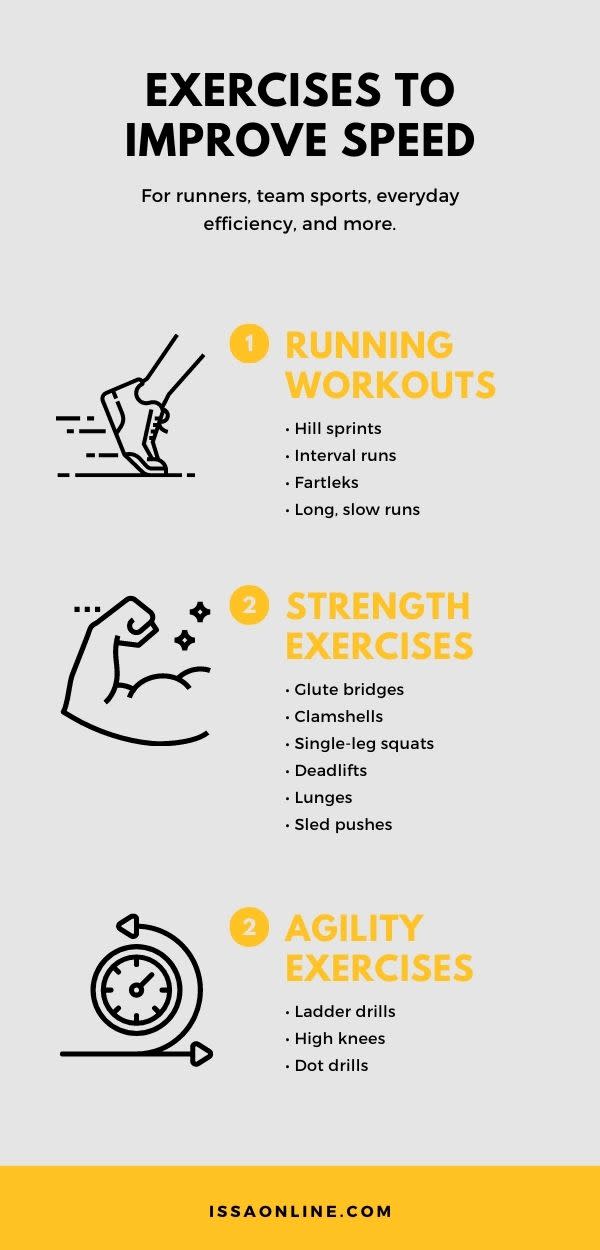
- 6 to 10 x 20-meter accelerations
- 4 to 8 x flying 20s or flying 30s
- Hill sprints with full recovery
- Short resisted sprints, used sparingly
For team sports, speed work can also include:
- First-step reactions
- Change-of-direction drills
- Deceleration practice
- Game-like sprint patterns
The goal is not to make every session exhausting. The goal is to make every rep fast and technically clean.
2) Build strength to support faster force production
Strength helps speed because faster movement depends on how much force you can apply against the ground or pedals in a very short time.
Useful exercises include:
- Squats
- Trap-bar deadlifts
- Split squats
- Step-ups
- Romanian deadlifts
- Hip thrusts
- Calf raises
- Hamstring-focused work
For most people, the most productive approach is to train lower-body strength 2 to 3 times per week with progressive overload. The exact load depends on training age, injury history, and sport demands.
A simple rule:
- If you are a beginner, build general strength first.
- If you already lift, keep strength work in the program while adding more speed-specific sessions.
- If speed drops because lifting is too fatiguing, reduce volume before reducing intensity.
3) Use plyometrics and power work carefully
Plyometrics improve the ability to produce force quickly and use the stretch-shortening cycle. That can help speed, especially when paired with sprinting and strength training.
Useful examples:
- Jump rope
- Pogo hops
- Box jumps
- Bounds
- Hurdle hops
- Skips and stiffness drills
Start with low to moderate volume. Quality matters more than soreness. If landings become noisy, mechanics break down, or contact times slow, the session is probably too long.
4) Recover enough to adapt
Speed gains require recovery. Without it, the nervous system never gets the chance to absorb the training stimulus.
Prioritize:
- Sleep: most adults need about 7 to 9 hours nightly
- Protein intake: enough to support muscle repair and adaptation
- Carbohydrates: to refill glycogen for repeated sprint work
- Hydration: especially in warm U.S. climates or outdoor training
- Rest days or low-intensity days: to prevent fatigue from flattening sprint quality
If you feel slow every session, you may be under-recovered rather than undertrained.
How to Improve Speed Step by Step
The safest and most reliable method is to progress from technique to intensity, then volume.
Step 1: Define the kind of speed you need
Different goals require different training.
| Goal | Best training focus | Example session |
|---|---|---|
| 40-yard dash | Acceleration | Short sprints from a start |
| Soccer or basketball quickness | Acceleration + deceleration | Sprint-stop-repeat drills |
| Track sprinting | Acceleration + max velocity | Blocks, flying sprints, technical work |
| Cycling speed | Power + intervals | Hard efforts with recovery |
| General athletic speed | Strength + sprint mechanics | Mixed speed and power plan |
If you do not match the training to the task, progress is slower.
Step 2: Warm up properly
A good warm-up improves movement quality and lowers the chance of strains.
Include:
- 5 to 10 minutes of light movement
- Dynamic mobility
- Sprint mechanics drills
- Gradual build-ups
- A few submaximal accelerations
A warm-up should make you feel more prepared, not tired.
Step 3: Train speed before fatigue
Do speed work early in the session, not after hard conditioning. Fatigue changes mechanics and reduces output.
Best order for a speed session:
- Warm-up
- Drills
- Accelerations or top-speed work
- Strength or power work, if included
- Conditioning only if the session calls for it
If you do long conditioning first, your sprint quality drops.
Step 4: Use full recovery between fast efforts
Speed training works best when every rep is fast enough to matter.
Practical rest guidelines:
- Short accelerations: 1 to 3 minutes between reps
- Faster or longer sprints: 3 to 5 minutes or more
- Flying sprints or high-quality max-speed work: enough rest to repeat near-top output
If your times or mechanics fall off clearly, rest longer or end the session.
Step 5: Track a simple performance marker
You improve faster when you measure something.
Track one or two of these:
- 10-yard split
- 20-meter sprint time
- Flying 10 or flying 20 time
- Vertical jump
- Repeated sprint output
- Perceived speed quality
You do not need expensive tools to notice progress. A reliable timer, consistent setup, and repeated conditions are enough to show useful trends.
A Sample Weekly Plan to Improve Speed
A simple weekly structure for many healthy adults looks like this:
Option A: Runner or general athlete
Monday
- Acceleration sprints
- Lower-body strength
Tuesday
- Light recovery or mobility
Wednesday
- Top-speed drills
- Plyometrics
Thursday
- Strength training
- Short accessory work
Friday
- Change-of-direction or sport-specific speed
Saturday
- Easy conditioning or sport practice
Sunday
- Rest
Option B: Beginner
2 days per week
- Short sprint or movement drills
- 1 to 2 strength exercises for the lower body
- 1 short plyometric block
- Mobility and recovery work
Beginners usually improve fastest when sessions stay simple and recoverable.
Common Mistakes That Slow Progress
Many people train hard but not in a way that actually improves speed.
Mistake 1: Doing too much fatigue-based conditioning
Long, exhausting workouts can improve general fitness, but they often reduce the quality of speed work. If the goal is speed, too much fatigue can work against you.
Mistake 2: Ignoring strength
Speed is not only a cardiovascular problem. If the body cannot apply force quickly, sprint mechanics and power output suffer.
Mistake 3: Training speed while already tired
Fast work done in a fatigued state is usually slower work. That may help conditioning, but it is not the best way to train top-end speed.
Mistake 4: Poor mechanics
Common technical issues include:
- Overstriding
- Excessive trunk lean
- Low hip position
- Weak arm drive
- Poor ankle stiffness
- Breaking form when the rep gets hard
Technical problems often show up as slow progress even when effort is high.
Mistake 5: Not recovering
Lack of sleep, low food intake, and too much total training can stall speed gains quickly.
What If Your Speed Is Not Improving?
If speed is stalled, check the most useful causes first.
1) Are you actually training speed?
If you only do endurance work or lifting without sprint practice, speed may not change much.
2) Are your reps high quality?
If the last half of each session is slow, you may be training fatigue more than speed.
3) Are you recovering enough?
Poor sleep, low calories, or too much weekly load can suppress adaptation.
4) Is strength lagging?
Weak force production can limit sprint progress, especially in beginners.
5) Are mechanics limiting you?
If one side is weaker, contact times are uneven, or your posture collapses under speed, technique work may be needed.
If you have repeated pain, especially in the hamstrings, Achilles tendon, knees, or hips, stop the session and consider evaluation by a qualified clinician or sports medicine professional.
How to Improve Speed Safely
Speed work is high-intensity work. That means injury risk rises when you increase volume too quickly or sprint on inadequate surfaces.
Safer practices include:
- Progressing volume gradually
- Sprinting on suitable surfaces with good traction
- Warming up fully
- Stopping when mechanics fall apart
- Avoiding all-out speed work if you are injured or very deconditioned
- Matching plyometric volume to your current capacity
If you are returning after injury, especially a hamstring, calf, ankle, or Achilles issue, get individualized clearance before returning to maximal sprinting.
Signs That Your Speed Training Is Working
You are likely moving in the right direction when:
- Your first steps feel more powerful
- Your sprint form stays cleaner under effort
- Short timed reps trend faster over several weeks
- You need less effort to hit the same pace
- Jumps, starts, and quick changes of direction feel sharper
- You recover between reps more predictably
Progress is often gradual. Small improvements in acceleration, technique, and force application add up.
FAQs
How long does it take to improve speed?
Many people notice small improvements in 4 to 8 weeks if training is specific and recovery is adequate. Larger changes often take longer, especially for trained athletes.
Is sprinting the best way to get faster?
For running speed, yes, sprinting is essential. Strength, plyometrics, and recovery support it, but sprint practice is the core stimulus.
Can lifting weights make you faster?
Yes, if the lifting program supports speed and does not create too much fatigue. Lower-body strength work often helps acceleration and power.
Does losing weight improve speed?
Sometimes. Reducing excess body mass can help if it does not reduce muscle, power, or recovery. Extreme dieting can make performance worse.
Should I train speed every day?
Usually no. Speed work is demanding, and most people improve better with 2 to 4 focused sessions per week, depending on training level and sport demands.
Final Takeaway
To improve speed, train the exact movement you want to be faster at, support it with lower-body strength and power work, and recover enough to keep each rep high quality. If your program is specific, progressive, and well-rested, speed usually improves more reliably than if you simply train harder.
For most readers in the United States, the best next step is to choose one speed goal, test a baseline, and build a weekly plan around short, high-quality efforts plus strength and recovery.

