Thinking about getting into scuba diving, or just curious about the gear investment? Understanding how much scuba diving equipment costs is key to budgeting for this incredible adventure. While renting gear is an option for occasional dives, owning your equipment offers a more personalized and often cost-effective solution long-term.
Prices can range significantly depending on brands, features, and whether you buy new or used.

Today's Exclusive Deals
Limited-time Exclusive Deals. Check current discount on Amazon.
Check Price on Amazon As an Amazon Associate I earn from qualifying purchases.Our research indicates that a complete set of new, entry-level scuba gear can range from approximately $1,200 to $2,500. High-end professional equipment can easily push past $3,000 or $4,000. This investment covers essential items like a Buoyancy Control Device (BCD), regulator set, mask, fins, exposure suit, and dive computer.
Understanding the purpose and typical cost of each component helps you make informed decisions.
Quick Answer
Scuba diving gear costs between $1,200 and $2,500 for new, entry-level sets. High-end professional equipment can exceed $4,000. Key items include a BCD, regulator, mask, fins, exposure suit, and dive computer.
Owning gear is often more economical than renting for frequent divers. The specific price depends on brand and features.
Scuba Gear Costs: Why Owning vs. Renting Adds Up
When you're first exploring scuba diving, renting gear for a course or a few dives seems like the easiest route. Rental shops typically charge around $50 to $100 per day for a full kit. Do this a few times a year, and the costs quickly accumulate.
For instance, if you dive just four times a year and rent gear each time, you could spend $200 to $400 annually.
Over a few years, this rental spend can easily surpass the cost of buying your own basic set of gear. Manufacturer specifications for regulators show they are designed for many years of use with proper maintenance. Investing in your own equipment means it fits you perfectly, you know its history, and you can maintain it to your standards.
This long-term perspective is where owning your gear shines financially.
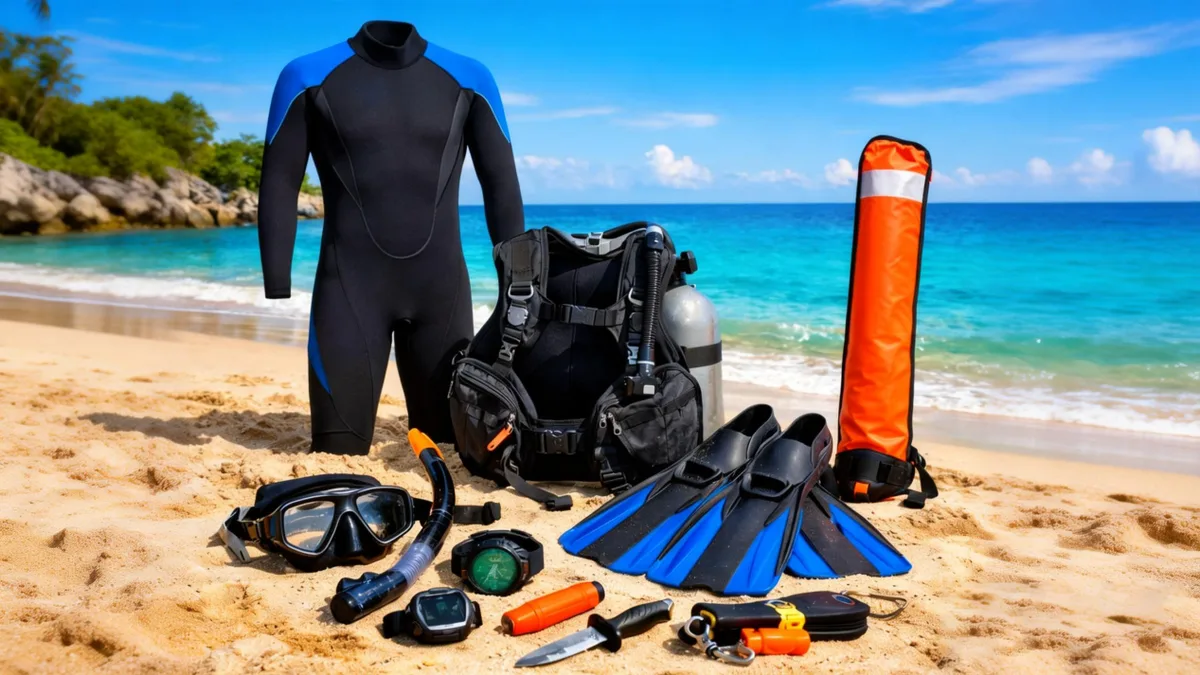
Breaking Down the Price of Key Scuba Diving Equipment
Purchasing scuba gear is like building a toolkit; each piece serves a vital function and carries its own price tag. You're not just buying individual items; you're assembling a life-support system for exploring the underwater world. Understanding the typical price range for each major component will help you budget effectively and prioritize where you might want to spend a little more for comfort or performance.
Let's break down the cost for the essential pieces of personal scuba gear. As of 2026, prices can fluctuate due to model updates and sales, but these ranges give you a solid idea. We'll cover everything from the gear you wear to the equipment that keeps you breathing safely.
Buoyancy Control Devices (BCDs): What You'll Pay
The Buoyancy Control Device, or BCD, is essentially your dive vest. It allows you to control your buoyancy by inflating or deflating it, helping you float at the surface and hover neutrally underwater. They come in various styles, like jacket-style (the most common) and back-inflate models, each with slightly different features and price points.
Integrated weight systems, where pockets for lead weights attach directly to the BCD, are common and convenient, though they can sometimes add to the cost.
New BCDs typically range from $300 for basic, no-frills models to $800 or more for advanced versions with features like integrated weight systems, multiple D-rings for attaching gear, and premium materials. For new divers, a reliable jacket-style BCD from a reputable brand like Aqua Lung or Cressi is a solid choice that balances cost and performance. If you have wider shoulders or a specific build, trying on different models is crucial for comfort and fit, which is why looking at reviews for best scuba diving BCDs can be helpful.

Regulators: The Essential Breath-Taking Investment
Your regulator set is arguably the most critical piece of scuba gear. It reduces the high-pressure air from your tank to ambient pressure so you can breathe it comfortably underwater. A standard set includes a first stage (attaches to the tank valve), a primary second stage (the part you breathe from), an alternate air source (octopus), and a submersible pressure gauge (SPG) or an integrated dive computer console.
This system ensures you have air to breathe throughout your dive.
Regulator sets can be a significant investment, often ranging from $400 for entry-level models to over $1,000 for high-performance, environmentally sealed units. Top brands like Scubapro and Mares are known for their durability and reliability. For beginners, a good quality, non-environmental first stage and a comfortable second stage are sufficient.
Remember, regulators require annual servicing by a certified technician, typically costing $100-$200, which is an ongoing cost of ownership. You can explore options for best scuba diving regulator selections to find models suitable for different budgets.
Masks & Snorkels: Finding Your Fit Without Breaking the Bank
A good dive mask is crucial for clear vision underwater. It creates a watertight seal around your eyes and nose, allowing you to equalize pressure and see your surroundings. Key features include the skirt material (silicone is standard for comfort and durability) and the lens type (tempered glass is a safety requirement for diving).
While snorkels are simpler, a comfortable mouthpiece and a purge valve can make a difference.
Masks and snorkels are among the more affordable pieces of gear. You can find a decent quality mask for $50 to $150. Higher-priced masks might offer wider fields of vision, low-volume designs for easier clearing, or specialized silicone skirts for a better fit on certain face shapes, like those for best scuba diving masks for wide face types.
Snorkels are generally less expensive, ranging from $15 to $50. Investing a bit more in a comfortable, well-fitting mask can significantly improve your diving experience.
Fins: Propulsion Power and Price Tags
Scuba fins provide the propulsion you need to move efficiently through the water. They come in two main types: full-foot fins, which you wear like slippers, and open-heel fins, which require neoprene dive boots and adjustable straps. Open-heel fins are more versatile, especially if you plan to dive in varying water temperatures that require boots.
The fin's design, material stiffness, and length all impact performance and price.
Fin prices typically fall between $70 and $300. Entry-level full-foot fins might be on the lower end, while advanced open-heel fins with features like split blades for reduced effort or advanced composite materials for better power transfer can reach the higher end. When considering best scuba diving fins for strong currents, you'll find they often come with a higher price tag due to enhanced performance characteristics.
Fit is paramount here; uncomfortable fins can lead to leg fatigue and blisters.
Exposure Protection: Wetsuits, Drysuits, and Thermals
Your exposure suit protects you from the cold and the elements. For warmer waters, a wetsuit made of neoprene is standard. These come in various thicknesses (e.g., 3mm, 5mm, 7mm) depending on the water temperature.
For colder conditions, a drysuit is necessary, which keeps you completely dry by using seals at the neck and wrists and is worn with thermal undergarments.
Wetsuits can range from $100 for a thin, basic model to $500 or more for a thick, high-performance suit with advanced features for warmth and flexibility, like those for best scuba diving wetsuit for warm water or best scuba diving wetsuit for cold water. Drysuits are a much larger investment, starting at around $800 and often going up to $2,000 or more, plus the cost of undergarments. Proper thermal protection is vital for comfort and safety, preventing hypothermia on longer dives.
Package Deals vs. Buying Piece by Piece: Smart Shopping Strategies
When you start looking at scuba gear, you'll see two main ways to buy: as individual components or as pre-assembled packages. Buying individual pieces allows you to hand-pick exactly what you want, choosing specific brands and features for each item. This is ideal if you have very particular preferences or if you find a great deal on one item that makes it worth buying separately.
For instance, you might find the perfect mask that fits your face like a dream, even if it’s not part of a package.
However, buying gear in a package deal can often save you money. Dive shops and manufacturers frequently bundle core items like a BCD, regulator, mask, and fins together at a discounted price compared to purchasing each piece separately. These beginner packages are designed to give you a functional, reliable setup for starting out.
As of 2026, you can often find these starter packages ranging from $1,200 to $2,000. It’s crucial to check what’s included, as some packages might skimp on quality for the sake of price, so looking at options for best scuba diving gear set can give you a good benchmark. Carefully compare the total cost of individual items versus the package price before making your decision.

Scuba Gear Costs: Entry-Level vs. Mid-Range vs. High-End
The cost of scuba diving equipment breaks down into distinct tiers, each offering different levels of performance, durability, and features. Entry-level gear is designed for new divers or those who dive infrequently. It's functional, safe, and typically comes from reputable brands focusing on essential reliability rather than advanced performance.
These sets aim to get you into the water without an overwhelming initial investment.
Mid-range gear is where many recreational divers settle. It offers a step up in materials, ergonomics, and often includes features like integrated weight systems or more comfortable BCD designs. This tier represents a good balance for divers who are active but don't need specialized equipment.
High-end or professional gear is built for demanding conditions, frequent diving, and advanced users. It uses premium materials, advanced engineering for optimal performance, and often comes with longer warranties. For example, regulators in this category might feature advanced diaphragms and balanced pistons for effortless breathing at any depth.
When considering your options, think about how often you’ll dive and what kind of diving you plan to do. For exploring options, reviews of best scuba diving gear for beginners can point you toward solid entry-level choices.
Who Needs What? Matching Gear Cost to Your Diving Habits
Deciding how much to spend on scuba gear really hinges on your personal diving plans and frequency. If you’re completing your certification and plan to dive only once or twice a year on vacation, renting gear or opting for a very basic, affordable package might be the most sensible financial choice. In this scenario, the total annual cost of rentals will likely stay well below the depreciation and maintenance costs of owning gear you rarely use.
However, if you’re diving more regularly, say, a few times a month or taking multiple dive trips a year, owning your equipment becomes significantly more economical and practical. For instance, a diver who completes 20 dives annually could easily spend $1,000 or more on rentals, making an initial investment of $1,500 to $2,500 for a quality entry-level set a smart long-term move. Divers who plan on technical diving, underwater photography with expensive camera setups, or frequent cold-water dives will naturally need to budget more for specialized, high-performance gear like drysuits and advanced dive computers.
It's also worth considering that specialized equipment, such as robust best scuba diving underwater lights or a reliable best scuba diving camera, can add considerable cost on top of the core life-support gear.
Common Scuba Gear Cost Pitfalls to Avoid
One of the biggest mistakes people make when buying scuba gear is being swayed by the lowest price tag without considering quality. While a bargain seems appealing, gear that's too cheap often uses lower-grade materials, leading to premature wear, poor performance, or even safety issues. For example, a regulator that feels restrictive to breathe from or a BCD that loses buoyancy quickly can ruin a dive and is a false economy if it needs replacing sooner.
Manufacturer specifications on materials and testing are important indicators here.
Another common pitfall is over-buying or buying gear that's far beyond your current needs. Purchasing a high-end, specialized drysuit when you only plan to dive in tropical waters, for instance, is an unnecessary expense. It's usually wiser to start with reliable, comfortable entry-level or mid-range gear and upgrade as your diving experience and interests evolve.
Similarly, avoid purchasing used gear without a thorough inspection by a qualified technician, especially for regulators, as hidden damage can be costly to repair. It’s always worth checking reviews for best scuba diving regulator for beginners and best scuba diving mask for beginners to avoid these traps.
Essential Accessories: What Else Costs Money?
Beyond the major life-support gear, several accessories are essential for a complete and safe dive kit. These items might not be as expensive as a regulator or BCD, but their cumulative cost adds up. A reliable best scuba diving weight belt is crucial for proper buoyancy control and safety, often costing between $30 and $80.
You'll also need a way to carry all your gear; a durable best scuba diving gear bag can range from $70 to $300 depending on size and features.
Other important accessories include a dive computer, which is vital for tracking dive time, depth, and no-decompression limits, with prices starting around $200 and going up to $1,000+ for advanced air-integrated models. A dive knife or cutting tool is a critical safety item, typically costing $30 to $100. For visibility and signaling, a surface marker buoy (SMB) is a must-have, usually between $20 and $50, and some divers opt for a best scuba diving flashlight or underwater light for deeper or darker dives, which can add another $50 to $300+.
Maintenance, Servicing, and Ongoing Costs
Owning scuba gear involves more than just the initial purchase price. Regular maintenance and professional servicing are critical for ensuring your equipment functions correctly and safely. Regulators, being complex life-support systems, require annual servicing by a certified technician.
This typically costs between $100 and $200 per service, depending on your location and the technician's rates. Neglecting this can lead to costly repairs or, worse, safety issues underwater.
Other gear also needs care. Wetsuits and drysuits should be rinsed after each use and stored properly to prevent degradation. BCDs should be flushed with fresh water, and their mechanisms checked.
Dive computers need battery replacements, which can sometimes be done by the user but may require professional service for water-resistant models. Aggregate reviews show that budgeting around 10-15% of the initial gear cost annually for maintenance and servicing is a reasonable expectation for active divers. This ongoing investment is key to the longevity of your equipment and your safety.
How to Budget for Your First Scuba Setup
Creating a budget for your first complete set of scuba gear involves understanding the price ranges for each component and then deciding where to allocate your funds. For a new diver aiming for reliable, entry-level gear, a realistic budget might look something like this: BCD ($300-$500), Regulator Set ($400-$600), Mask & Snorkel ($75-$150), Fins ($100-$200), Wetsuit (3mm, $150-$300), Dive Computer ($200-$400). This puts your total estimated new gear cost in the range of $1,225 to $2,150.
If you opt for a package deal, you can often get these core items bundled for $1,200 to $2,500, which can be a good starting point. Don't forget to factor in essential accessories like a weight system ($50-$100), a gear bag ($70-$150), and potentially a dive knife ($30-$70). Over time, you’ll also need to account for annual servicing costs for regulators.
By breaking it down item by item, you can prioritize where you want to invest more for comfort or performance, perhaps in a mask with a great fit or a regulator known for easy breathing.
Frequently Asked Questions
How much does a full set of scuba gear cost for a beginner?
A full set of new, entry-level scuba gear typically costs between $1,200 and $2,500. This includes a BCD, regulator, mask, fins, wetsuit, and dive computer.
Is it cheaper to rent or buy scuba gear?
For occasional divers (1-3 dives per year), renting is cheaper. For regular divers (10+ dives per year), owning gear usually becomes more economical over time.
What is the most expensive piece of scuba gear?
The regulator set is often the most expensive single component, with prices ranging from $400 to over $1,000 for high-performance models. Drysuits, if needed, can also represent a significant upfront cost.
Can I buy used scuba gear to save money?
Yes, buying used gear can save money, especially for items like fins or masks. However, critical life-support gear like regulators should be purchased cautiously and always inspected and serviced by a professional before use.
How much should I budget for regulator servicing?
Regulator servicing is a recurring cost, typically ranging from $100 to $200 annually, depending on your location and the service center. This is essential for safety and equipment longevity.