
Soccer vs. Futsal: What's the Real Difference?
Ever found yourself watching a game and wondering if you're seeing soccer or futsal? That confusion is totally understandable. While both sports involve kicking a ball into a goal, the nuances of soccer vs. futsal create vastly different experiences on the field.
Understanding these distinctions is key, whether you're a player, coach, or just a curious fan.

Today's Exclusive Deals
Limited-time Exclusive Deals. Check current discount on Amazon.
Check Price on Amazon As an Amazon Associate I earn from qualifying purchases.Our research shows that these differences go far beyond just the size of the playing area. They impact everything from the ball itself to the pace and strategy of the game. For example, a futsal ball typically adheres to specifications like being between 62-64 cm in circumference, which is noticeably smaller than a standard size 5 soccer ball.
This difference alone fundamentally alters how the game is played.
Soccer vs. Futsal
Soccer and futsal are distinct sports with unique rules, equipment, and playing environments. Soccer, played outdoors on a large grass field with 11 players per side, emphasizes long passes, speed, and territorial control. Futsal, an indoor sport on a hard court with 5 players per side, focuses on quick passing, close control, and rapid transitions due to its smaller ball and tighter space.
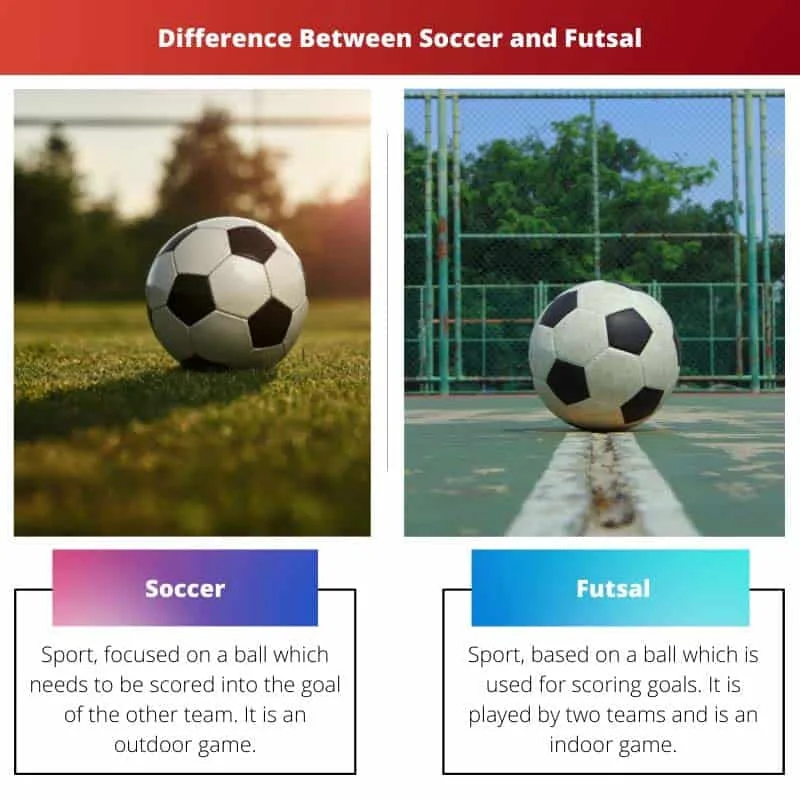
Image source: Web (Bing) / askanydifference.com (Web image (fair-use with source credit))
Futsal Ball vs. Soccer Ball: The Game Changer
The most significant difference you'll immediately notice when comparing soccer and futsal is the ball. This isn't just a minor variation; it's the core element that dictates much of how each game plays out. Manufacturer specifications confirm that the weight and bounce characteristics of these balls are intentionally different.
Futsal Ball Features
The futsal ball is engineered for the sport's specific demands. It's smaller and heavier than a standard soccer ball, with a significantly reduced bounce. This low-bounce characteristic is crucial for maintaining control on the hard indoor court.
Per FIFA's Laws of the Game, a futsal ball for senior play must be between 62-64 cm in circumference and weigh between 400-440 grams. Its reduced bounce means the ball stays closer to the ground, encouraging intricate dribbling and quick, precise passing. You won't see it soaring through the air for long distances like in soccer.
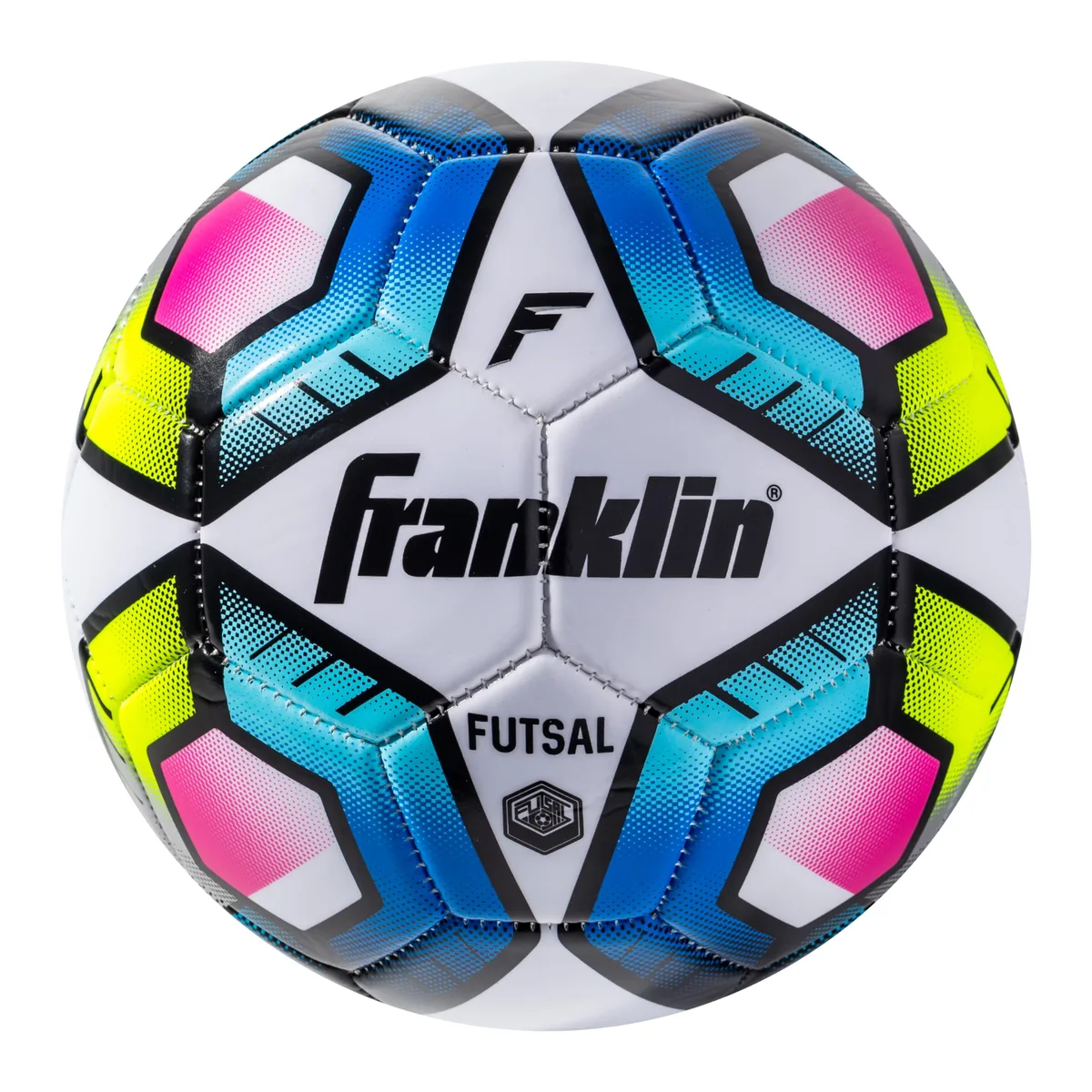
Image source: Web (Bing) / onlinesportsmall.com (Web image (fair-use with source credit))
Soccer Ball Features
In contrast, the soccer ball is designed for the expansive outdoor game. It's larger and has a much higher bounce, allowing for longer passes, aerial play, and dynamic movement across a vast field. A standard size 5 soccer ball, as recognized by FIFA, measures 68-70 cm in circumference and weighs 410-450 grams.
While the weight might seem similar to a futsal ball, its construction allows for greater lift and distance when kicked, supporting a game that relies on covering significant ground and utilizing the third dimension of the air.
Playing the Game: Field, Players, and Pace
Where you play and how many people are on the field are fundamental differences that create two very distinct sporting experiences. The environment directly shapes the style of play, the required skills, and the overall intensity of the game.
Futsal's Compact Arena
Futsal is played indoors on a hard surface, much like a basketball or volleyball court. The dimensions are considerably smaller than a soccer pitch; typically ranging from 25-32 meters in length and 15-18 meters in width. This confined space means there's less room to maneuver and fewer players are needed to cover the area.
As a result, the game is incredibly fast-paced and requires constant player involvement. There's very little downtime, and quick decision-making is paramount. This environment really hones a player's ability to think and act rapidly under pressure.
Soccer's Expansive Pitch
Soccer, by its very nature, is an outdoor sport played on a much larger grass field. The dimensions can vary significantly, but they are generally much larger than futsal courts, often between 100-130 yards (90-120 meters) long and 50-100 yards (45-90 meters) wide. This vastness allows for strategic positioning, long-range passes, and a more spread-out style of play.
The game requires players to have excellent stamina for covering large distances and a keen understanding of positioning to exploit open space.

Image source: Web (Bing) / pexels.com (Web image (fair-use with source credit))
Player Numbers and Their Impact
The number of players on each side dramatically influences the game's dynamics. Soccer features 11 players per team, including a goalkeeper. This large number means each player is responsible for covering a significant portion of the field, and team tactics often revolve around creating and exploiting space between the lines.
In contrast, futsal is played with 5 players per side, one of whom is typically the goalkeeper. With fewer players on a smaller field, everyone is far more engaged in the play. This intense involvement means players must be proficient in both attacking and defending, often switching roles fluidly throughout a match.
This setup is excellent for developing all-around players.
Rule Differences That Shape the Game
Beyond the ball and the field size, the rulebooks for soccer and futsal contain key distinctions that fundamentally alter gameplay. These rules aren't just minor tweaks; they dictate strategy, pace, and the very flow of the game. Understanding these variations is crucial for appreciating why the sports feel so different to play and watch.
Futsal's Key Rule Variations (No Offsides, Kick-ins, Subs)
Futsal operates with several rule sets that speed up the game and increase player involvement. Perhaps the most impactful is the absence of an offside rule. This means players can position themselves anywhere on the court without restriction, leading to more continuous attacking opportunities and less emphasis on defensive offside traps.
When the ball goes out of bounds on the sidelines, it's restarted with a "kick-in" rather than a throw-in. This method ensures the ball is put back into play with the foot, keeping it low and maintaining possession more easily. Furthermore, futsal employs rolling substitutions, allowing players to be subbed in and out frequently without stopping the game.
This keeps players fresh and the pace consistently high, a stark contrast to the limited substitutions in soccer. Per FIFA's Laws of the Game, these rules are designed to promote fluid, attacking play.
Soccer's Standard Rules
Soccer adheres to a more traditional set of rules that have evolved over a longer history. The offside rule is a cornerstone of soccer strategy, forcing teams to be mindful of defensive positioning and preventing forwards from simply camping near the opponent's goal. Substitutions are limited, usually to three or five per match depending on the competition, meaning players often need to manage their stamina over longer periods.
Restarting play from the sidelines involves a throw-in, executed with two hands over the head, which can lead to aerial contests and longer balls being played into the box. These rules, combined with the larger field and player numbers, create a game that is often more tactical and allows for strategic pauses.
Which Sport Develops Which Skills?
The fundamental differences in rules, equipment, and playing environments between futsal and soccer mean they excel at developing distinct, though often complementary, skill sets. Whether you're aiming to become a more complete player or are choosing a sport to start with, understanding what each offers developmentally is key.
Futsal's Skill-Building Powerhouse
Futsal is renowned for its ability to rapidly develop a player's technical proficiency and decision-making under pressure. The smaller, low-bounce ball forces players to keep it close, leading to exceptional improvements in dribbling, close control, and the accuracy of short, sharp passes. Because there's no offside and the field is small, players are constantly in the thick of the action.
This means they must develop quick feet, sharp awareness, and the ability to make split-second decisions. Many professional soccer players credit futsal with significantly enhancing their foundational skills, noting how the game's demands translate directly to better performance on a larger field. It truly is a training ground for dynamic, skillful players.
Soccer's Strategic Demands
Soccer, played on its vast expanses, cultivates different but equally important attributes. The larger field and 11-a-side format emphasize spatial awareness, tactical understanding, and the ability to play long, precise passes. Players develop excellent stamina and endurance, learning to cover large ground while maintaining focus.
The offside rule, for instance, requires a deep understanding of team shape and defensive strategy. While technical skill is vital in soccer, the game also heavily rewards strategic thinking, teamwork, and the ability to read the game at a macro level, coordinating movements across large distances with teammates. It builds players who can command space and dictate play over a wider area.
Who Should Play What? Matching Sport to You
The choice between soccer and futsal often comes down to what you're looking to gain from playing. Both sports offer fantastic physical and mental workouts, but they cater to slightly different player profiles and development goals. If you're leaning towards a faster, more technical game, futsal might be your calling.
For those who enjoy larger spaces and broader strategic play, soccer remains the classic choice. As of 2026, the popularity of both sports continues to grow, offering numerous opportunities to play at various levels.
Futsal: Perfect for Fast Feet and Quick Minds
Futsal is an ideal environment for players who thrive on constant engagement and quick decision-making. If you enjoy having the ball at your feet frequently and relish fast-paced, intricate passing sequences, futsal will feel natural. It's especially beneficial for developing players who need to hone their close control, dribbling skills, and ability to play effectively in tight spaces.
Coaches often use futsal to enhance a player's tactical awareness in a dynamic setting, as the rapid transitions demand constant adaptation. It's a sport where every touch and every pass counts, and where individual skill shines through in quick bursts of action.
Soccer: Ideal for Big-Field Strategy and Endurance
Soccer appeals to those who enjoy the expansive nature of the game and the strategic depth it offers. If you like covering large areas of the pitch, executing long passes, and being part of a larger team dynamic with clear positional roles, soccer is likely a better fit. It's a sport that builds incredible stamina and requires a robust understanding of team formations and movements.
Players who excel in soccer often possess a strong vision for the game, enabling them to anticipate play across the entire field. It's also a sport with unparalleled global reach, offering a vast professional landscape and deep cultural significance.
Common Mistakes When Switching or Starting
Transitioning between soccer and futsal, or starting with either sport, comes with its own set of potential missteps. Understanding these common errors can help you adapt more quickly and avoid unnecessary frustration. For instance, a frequent mistake when moving from soccer to futsal is expecting the ball to behave similarly; it won't.
Its lower bounce and heavier feel require a different touch entirely.
- Expecting Soccer's Ball Behavior: Players accustomed to soccer might overhit passes or struggle with the ball's lack of loft in futsal. The futsal ball requires a more controlled, ground-based approach.
- Playing Too Predictably: In futsal, predictable long balls are often intercepted due to the confined space and quick defenders. Constant movement and short, sharp passes are key.
- Poor Spatial Awareness: On a futsal court, players can easily get caught out of position because the game moves so fast. Understanding defensive responsibilities and quick transitions is vital.
- Underestimating Futsal's Intensity: While smaller, futsal is incredibly demanding due to the continuous action and frequent bursts of speed required. Players often underestimate the fitness needed.
- Ignoring Rule Differences: Not understanding or respecting rules like kick-ins or substitution procedures can lead to turnovers and tactical disadvantages.
FAQs: Your Burning Soccer vs. Futsal Questions Answered
Is Futsal harder than Soccer?
Both sports are challenging but in different ways. Futsal demands exceptional technical skill, quick decision-making, and intense physical conditioning due to its fast pace and tight spaces. Soccer requires greater stamina for covering larger fields, strategic positioning, and dealing with more varied playing conditions.
Can Futsal skills transfer to Soccer?
Absolutely. Futsal is widely recognized as an excellent training tool for soccer players. The close ball control, quick passing, and rapid decision-making honed in futsal directly translate to improved performance on a larger soccer pitch.
Many professional soccer players credit futsal with developing their foundational skills.
Which sport is better for young children?
Futsal is often recommended for younger children because the smaller ball, smaller field, and fewer players make it more manageable and engaging. It helps them develop fundamental skills like dribbling and passing in a less overwhelming environment, building confidence.
Can you play Soccer with a Futsal ball?
You can, but it's not ideal. A futsal ball's low bounce and weight might make it difficult to achieve the long passes and aerial play characteristic of soccer. Conversely, using a soccer ball for futsal can make controlling the ball on the hard court much more challenging due to its higher bounce.

