So, you're diving, and suddenly, a trickle of water finds its way into your scuba diving mask. It's a common hiccup, but knowing how to handle it quickly is key. This guide breaks down the simple technique to keep your vision clear and your dive enjoyable.
Our research shows that mastering mask clearing is a foundational skill for all divers. According to PADI, the Professional Association of Diving Instructors, a flooded mask can be easily managed with proper technique, preventing discomfort and potential panic. It's a skill you’ll practice throughout your training and use on almost every dive.

Today's Exclusive Deals
Limited-time Exclusive Deals. Check current discount on Amazon.
Check Price on Amazon As an Amazon Associate I earn from qualifying purchases.Quick Answer: Clearing Your Scuba Mask in 4 Steps
To clear water from a scuba diving mask, tilt your head back slightly, place your hand over the top of the mask to create a seal, and exhale slowly through your nose. This gently forces water out over the bottom skirt. Repeat if needed.
Why Clearing Your Mask Matters on a Dive
Clearing your mask isn't just about comfort; it's a critical safety skill. Imagine you're admiring a vibrant reef or exploring a historical shipwreck, and suddenly your vision is obscured by water. This can be disorienting and even frightening, especially for newer divers.
Knowing how to swiftly and effectively clear your mask ensures you maintain awareness of your surroundings, your buddy, and any potential hazards.
Manufacturer specifications for masks often detail their low-volume design, which aids in easier clearing, but the technique remains constant. A clear view allows you to appreciate the underwater world, monitor your dive computer, and respond appropriately to your environment. Failing to manage a flooded mask can lead to unnecessary stress, which in turn can affect your air consumption and overall dive experience.
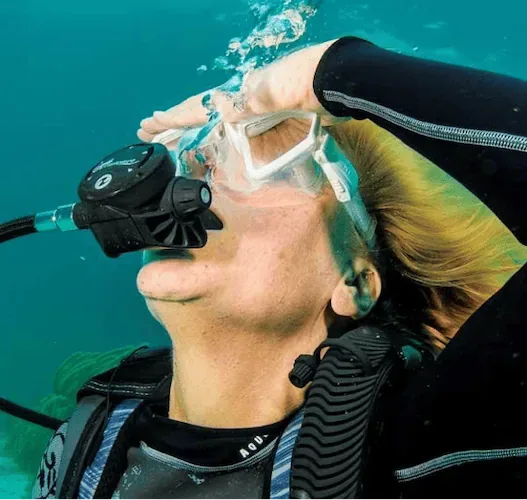
Image source: Web (Bing) / scorpiondive.com (Web image (fair-use with source credit))
Quick Guide: Clearing Your Scuba Mask in 4 Steps
Here’s a streamlined process to get that water out fast. This method is designed to be performed smoothly while you're underwater, breathing through your regulator.
- Tilt Your Head Back: Gently tilt your head backward so the top of your mask is slightly out of the water and the bottom points downwards. This uses gravity to help.
- Seal the Top: Place the palm of your hand flat across the top of your mask, just above your eyebrows. This creates a seal.
- Exhale Through Your Nose: Slowly exhale through your nose. The air from your regulator will travel into the mask.
- Lift the Skirt: As you exhale, your fingers should gently lift the bottom edge of the mask skirt away from your face, just enough to allow the water to escape.
This simple four-step sequence can be performed in seconds, restoring your clear vision and allowing you to continue enjoying your dive.
The Core Technique: Using Your Breath and Nose
The fundamental principle behind clearing a scuba mask is using your own exhaled air to push the water out. It’s an ingenious, low-effort method that relies on basic physics. You’re not trying to force the mask off your face; you’re creating a controlled pressure differential.
When you exhale through your nose while maintaining a seal at the top of the mask and slightly lifting the bottom skirt, the air you breathe out has only one place to go: out the bottom, carrying the water with it.
This technique is universally taught and forms the basis of almost all mask clearing methods. It's effective whether a small amount of water has seeped in or if your mask has flooded significantly. The key is a slow, controlled exhale combined with a gentle lift of the mask skirt.
Most modern masks are designed with low profiles, which further simplifies this process, requiring less air to clear.

Image source: Bing (Web (fair-use with source credit))
Fine-Tuning the Mask Seal
Achieving a good seal is paramount, both for keeping water out initially and for effective clearing. Before you even descend, do a quick mask seal check. Place the mask on your face, inhale gently through your nose, and the mask should stay put without you needing to hold it.
If it falls off, it suggests the skirt isn't forming a proper seal, potentially due to hair, facial hair, or an ill-fitting mask.
When performing the clearing maneuver, the seal you create with your hand at the top is crucial. This isn't a crushing grip; it's just enough pressure to guide the exhaled air downwards. Similarly, lifting the bottom skirt with your fingers needs to be subtle.
You're not prying the mask off; you're creating just enough space for the water to escape. A mask that doesn't seal well can be frustrating, and sometimes it means you need to look for a mask that fits your unique facial structure.
Gentle Pressure vs. Force
It’s really important to emphasize that clearing your mask is about gentle pressure, not brute force. Trying to rip the mask off your face or using a super strong exhale can actually make the problem worse. You might inadvertently push more water in or dislodge the mask entirely, leading to a full flood.
The goal is control. A slow exhale through the nose is sufficient to create the slight internal pressure needed. Think of it like gently blowing air into a balloon to push out any trapped moisture.
When you lift the skirt, it’s a small, deliberate movement. Over-exertion can lead to anxiety, which is the last thing you want when you're submerged. As of 2026, best practices in diver training consistently highlight this gentle approach.
When Water Gets In: Troubleshooting Common Issues
Even with a well-fitting mask and good technique, water can sometimes get in. This might be due to a sudden surge, a shift in position, or simply the nature of diving. When it happens, don't panic.
Instead, think about what might be causing it.
Often, a small amount of water is manageable. You can often clear it with a quick breath and a slight skirt lift. However, if you're experiencing consistent leaks, it’s time to investigate further.
Persistent water ingress can be distracting and potentially lead to a full mask flood, impacting your ability to see and navigate safely.
Dealing with a Leaky Mask
A leaky mask is one of the most common frustrations for divers. The usual culprits are hair trapped under the silicone skirt or a mask that simply doesn't conform perfectly to your facial contours. Before a dive, always ensure your mask strap is snug but not overly tight, and run your fingers around the inside of the skirt to check for any stray hairs.
If you notice a leak during a dive, try to address it calmly. You might be able to adjust your head position or gently press on the leaking area to reseal it. If it persists, perform a mask clear.
If it continues to leak, and especially if it's a significant amount of water, consider ending the dive if you feel uncomfortable or unsafe. Persistent leaks might indicate the need for a new mask.

Image source: Web (Bing) / naturepl.com (Web image (fair-use with source credit))
Hair and Mask Seal Problems
This is a classic diver's dilemma! Strands of hair getting caught between the mask skirt and your skin is a surefire way to invite water in. Before every dive, it’s a good habit to sweep your hair back and out of the way of the mask's silicone skirt.
Some divers even opt for a thin, full-head hood or a skull cap when wearing a wetsuit to keep all hair completely clear.
If you feel a leak starting and suspect hair, you can try to subtly use your regulator mouthpiece to help dislodge it. Sometimes, by tilting your head and gently pulling down on the mask skirt with one hand, you can create enough space with the regulator in your mouth to reach up with a finger and flick the offending hair out. If this is a recurring issue, and you have long hair, consider a mask with a different skirt design or a larger volume that might be more forgiving.
Practice Makes Perfect: Mastering the Skill
Like any skill, mask clearing becomes second nature with practice. The more comfortable you are doing it, the less likely you are to panic if your mask floods. Ideally, you'll get plenty of practice during your initial scuba certification course.
Instructors often have you intentionally flood your mask in shallow water to get you used to the sensation and the clearing process.
Beyond formal training, you can continue to refine this skill. Every dive is an opportunity to reinforce good habits. Even if your mask doesn't leak, you can practice the clearing technique in shallow, safe water just to keep your reflexes sharp.
Consistency is key to ensuring you can handle any mask issue with confidence.
Pool Drills
The swimming pool is the perfect environment for honing your mask clearing. Before or after your formal training dives, or even during a recreational pool session, you can practice this technique repeatedly.
- Controlled Flooding: In waist-deep water, intentionally flood your mask by lifting the bottom skirt slightly. Then, practice the full clearing sequence: tilt head back, seal the top, exhale through your nose, and lift the skirt.
- Depth Progression: As you get more comfortable, try this in deeper water within the pool. This helps simulate open water conditions where you can't just stand up and fix things.
- Buddy Practice: If you’re diving with a buddy, you can practice on each other, offering gentle feedback and encouragement.
These drills build muscle memory and reduce the psychological impact of a flooded mask. It turns a potential distraction into a minor, easily managed inconvenience.
First Open Water Dives
Your initial open water dives are crucial for applying what you’ve learned in a real-world setting. Expect your instructor to have you practice mask clearing as part of your skills review. They’ll likely have you flood your mask in calm, shallow water first.
Pay close attention to how you feel. Are you breathing steadily through your regulator? Is your hand seal firm but not tight?
Is the skirt lift effective? If you’re struggling, don't hesitate to signal your instructor for help or ask to repeat the skill. Building confidence here means you’ll be better prepared for any situation, whether you're exploring a reef or trying out new gear like a different regulator.
Mistakes Divers Make When Clearing Masks
Even with a straightforward technique, it’s easy to fall into common habits that hinder effective mask clearing. One of the most frequent errors is not tilting the head back enough. This prevents gravity from assisting the water’s exit, forcing you to rely solely on your breath pressure.
Another common mistake is holding your breath instead of exhaling through your nose; this is counterproductive as you need to push air into the mask.
Some divers also panic and try to rip the mask off their face. This is rarely effective and can lead to a complete flood, and potentially a loss of the mask. Aggressive or panicked exhales can also cause more water to be pushed past the nose skirt.
Remember, a gentle, controlled exhale is all that's needed.
Over-Tightening the Mask Strap
When a mask leaks, the instinct is often to tighten the strap harder. This can backfire by deforming the mask skirt, preventing it from making a good seal against your face. Over-tightening can also cause discomfort or even create pressure points that make it harder to relax and breathe normally underwater.
A proper mask fit should feel secure but not constricting, allowing the skirt to mold to your skin.
Forgetting to Lift the Nose Skirt
A critical part of the clearing process is creating an exit for the water. If you forget to lift the bottom of the mask skirt away from your nose and upper lip, the water has nowhere to go. It will just pool there, creating a messy, obstructed view.
Ensure you’re consciously creating that small gap.
FAQ: Your Mask Clearing Questions Answered
How often should I clear my mask?
You should clear your mask whenever you feel water inside it. It's best to do this proactively as soon as you notice any ingress, rather than waiting for it to become a significant flood.
What if I can't get all the water out?
If you've tried clearing your mask and there's still some water, try adjusting your head position, ensuring a better seal at the top, and performing a slightly longer exhale. If it persists, it might be a mask fit issue or a hair obstruction.
Can I clear my mask if I wear glasses?
Clearing a mask with prescription lenses inside is significantly more challenging. Standard clearing techniques are difficult because the lenses can trap water. Many divers opt for contact lenses or prescription masks to avoid this complication.
Is it safe to clear my mask while breathing from my regulator?
Yes, this is the standard and safest method. You continue to breathe normally from your regulator, and a controlled exhale through your nose is used specifically for clearing the mask. This ensures you always have a supply of breathable air.
What's the difference between clearing a snorkel mask and a scuba mask?
While the principle of using air to push water out is similar, snorkel masks often have a purge valve at the bottom that allows water to be expelled with a simple puff of air through the nose. Scuba masks typically rely entirely on the manual exhalation method described.