
Rugby versus American Football, they look similar, but these two sports are worlds apart in how they're played and the strategies involved. If you've ever watched a game and felt confused by the rules, the flow, or the sheer physicality, you're not alone. Understanding the core differences is key to appreciating what makes each sport unique.
We've broken down the essential distinctions, from continuous play versus strategic stoppages to the specialized player roles that define each game. For instance, Rugby Union, governed by World Rugby, typically involves 15 players per side and emphasizes fluid, uninterrupted action. American Football, on the other hand, is a game of distinct downs and specialized units.

Today's Exclusive Deals
Limited-time Exclusive Deals. Check current discount on Amazon.
Check Price on Amazon As an Amazon Associate I earn from qualifying purchases.Rugby vs. American Football
The fundamental difference between Rugby Union and American Football lies in their gameplay structure and objectives. Rugby Union, played with an oval ball and a continuous flow, focuses on possession through phases of play like rucks and mauls, with scoring via tries. American Football, often called gridiron, uses a similar ball but incorporates a system of downs, requiring teams to advance a set yardage within a limited number of plays, with scoring through touchdowns.
The Big Picture: Rugby Union vs. Gridiron
At their heart, Rugby Union and American Football are both team sports demanding physical prowess, strategic thinking, and coordination. However, their philosophies diverge significantly. Rugby Union emphasizes fluid, uninterrupted play where possession is constantly contested through tackles and ensuing rucks or mauls.
The goal is to keep the ball moving downfield, with fewer planned stoppages. American Football operates on a stop-start basis governed by the "downs" system. A team has four chances to advance the ball at least 10 yards; failure to do so results in a turnover.
This creates a highly strategic game of set plays, specialized roles, and distinct offensive and defensive units.

Image source: Bing (Web (fair-use with source credit))
Gameplay Flow: Continuous Action vs. Stop-Start Strategy
The most striking difference you'll notice between Rugby Union and American Football is the pace and rhythm of the game. It dictates everything from player endurance to the type of strategic thinking required.
Rugby's Uninterrupted Motion
Rugby Union thrives on continuity. Once the ball is in play, it generally stays in play until a penalty occurs, the ball goes out of bounds, or a try is scored. Tackles don't stop the game; instead, they lead to dynamic turnovers of possession called rucks (when players from both teams contest for the ball on the ground) or mauls (when players from both teams bind together to move the ball forward).
This continuous action requires players to have exceptional cardiovascular fitness and the ability to make split-second decisions without a referee's whistle dictating a pause. The game is divided into two 40-minute halves, but the actual playing time can extend significantly beyond 80 minutes due to these constant engagements.
American Football's Tactical Pauses
American Football is a game of distinct phases and strategic breaks. Each play starts with a huddle or a quick formation, followed by a snap of the ball, a short burst of action, and then a whistle. This stop-start nature is driven by the downs system.
Teams have four downs to gain 10 yards. If they succeed, they get a new set of four downs. If they fail, possession usually changes hands.
These breaks allow for substitutions, strategic adjustments, and for players to regroup. The game is divided into four 15-minute quarters, but the clock stops frequently, often making the actual duration of a game three hours or more. This allows for complex play-calling and a different kind of physical and mental engagement.
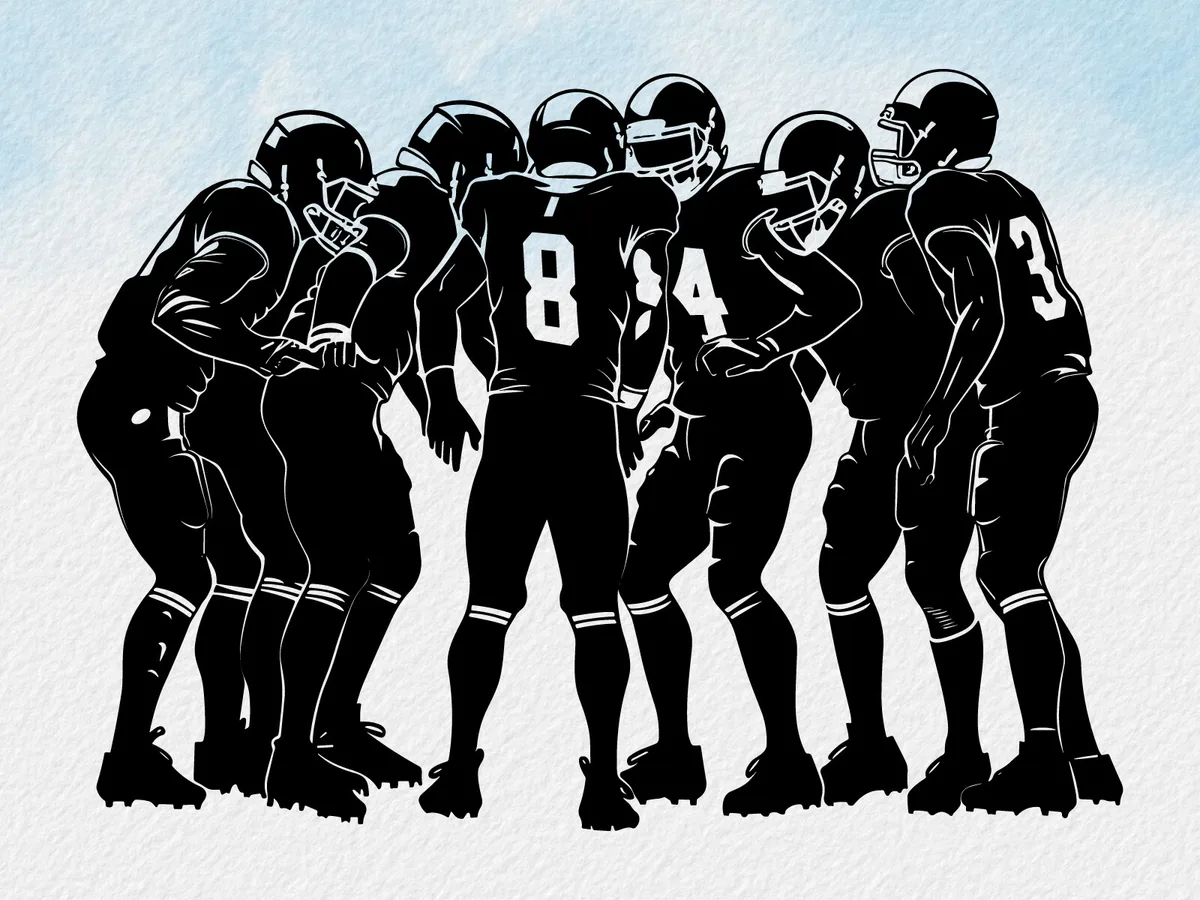
Image source: Web (Bing) / creativefabrica.com (Web image (fair-use with source credit))
Key Rules and How They Shape the Game
The rulebooks for Rugby Union and American Football are the blueprints that define their unique characters. Even seemingly small differences have massive impacts on strategy, player actions, and the overall spectacle.
Scoring: Tries, Conversions, and Touchdowns
Scoring in Rugby Union revolves around grounding the ball in the opponent's in-goal area for a "try," worth five points. After a try, the scoring team gets a chance for a "conversion," a kick at goal from a spot in line with where the try was scored, worth two additional points. Penalties awarded for infringements can be kicked through the posts for three points, and a "drop goal" (kicking the ball as it bounces off the ground during open play) also yields three points.
American Football's primary scoring method is the "touchdown," achieved by carrying the ball into the opponent's end zone or catching it there, worth six points. Following a touchdown, teams attempt an "extra point" kick through the goalposts (worth one point) or a two-point conversion (running or passing the ball into the end zone from a short distance). Field goals, kicked through the uprights during regular play, are worth three points.
The Ball: Shape and Passing Limitations
While both sports use a ball that's generally oval, the nuances are important. Rugby balls are typically more rounded and plump, designed for carrying and kicking effectively in a continuous game. Critically, passes in Rugby Union can only be made backward or sideways.
Any pass forward is illegal and results in a penalty, forcing teams to advance through running, kicking, or careful lateral passing.
American Footballs are more pointed at the ends, designed for aerodynamic throwing. The forward pass is a cornerstone of the game. Teams can throw the ball forward once per play from behind the line of scrimmage, a rule that revolutionized the sport and opened up vast offensive possibilities.
This single rule dictates much of the offensive strategy.
Tackles and Possession: Downs vs. Rucks and Mauls
In Rugby Union, tackles are fundamental to defense, but they don't immediately stop play. A tackled player must release the ball immediately. If the tackler and the tackled player both go to ground, a ruck forms, with other players binding over them to try and gain possession.
If the ball carrier is held up but not brought to ground, a maul can develop. These phases are critical for maintaining possession and advancing the ball, even after a tackle.
American Football uses the "downs" system to manage possession. When a player is tackled and their forward progress is stopped, the ball is placed at that spot, and the team gets another "down." This cycle continues up to the fourth down. If the 10-yard mark isn't reached, possession is typically turned over to the opposing team, often through a punt to push them further back.
Player Roles and Physical Demands
The distinct gameplay of each sport naturally leads to different player specializations and physical requirements.
Specialization in American Football
American Football is characterized by extreme specialization. Players are often categorized as either offensive, defensive, or special teams players, and within those groups, roles are highly defined. For example, on offense, you have quarterbacks who throw the ball, running backs who carry it, offensive linemen who block, and wide receivers who catch passes.
Each position requires a very specific skill set and physical build. A defensive lineman's job is vastly different from a defensive back's. This leads to a team with many different types of athletes, each fulfilling a narrow, crucial function.
Versatility in Rugby Union
Rugby Union, while having distinct positions, demands a broader range of skills from most players. Forwards (typically numbers 1-8) are generally larger and stronger, involved in scrums, rucks, and mauls, but they also need to be able to run with the ball and tackle effectively. Backs (typically numbers 9-15) are usually faster and more agile, responsible for passing, kicking, and scoring, but they must also be capable defenders and tacklers.
There's a greater expectation for all players to possess a good level of general fitness, ball-handling skills, and defensive capability, making it a sport that rewards more rounded athletes.
Equipment: Protection and Practicality
The gear worn by players in Rugby Union and American Football highlights the differences in their contact levels and gameplay styles.
Rugby Union players wear minimal protective equipment by comparison. Mouthguards are standard for all players, and some may wear soft-padded headguards or shoulder pads. However, the absence of hard shells or bulky padding is deliberate; it's part of the sport's design to encourage fair play and reduce the risk of certain types of injury.
The focus is on agility and mobility.

Image source: Bing (Web (fair-use with source credit))
American Football players, however, are heavily armored. Mandatory equipment includes hard helmets with face masks, padded jerseys, shoulder pads, hip and thigh pads, and knee pads. This extensive protection is a direct response to the sport's nature, which involves high-impact collisions, blocking, and tackling designed to stop players with force.
While this gear aims to mitigate injury, the sheer force involved in collisions remains a significant factor in the sport's risk profile.
Who's It For? Choosing Your Game
Deciding which sport might appeal more to you depends on what you're looking for, whether as a player or a spectator.
For the Non-Stop Athlete
If you thrive on continuous physical exertion, constant decision-making under pressure, and a game that flows relentlessly, Rugby Union might be more your speed. It demands high levels of stamina and an ability to stay engaged in the action for extended periods without the reset of frequent whistles. Players who enjoy being involved in every phase of play, from tackling to passing and running, would find Rugby Union rewarding.
For the Strategic Playmaker
American Football appeals to those who love the chess match of sport. The stop-start nature, the complex playbooks, and the distinct roles for every player create a deeply strategic environment. If you enjoy dissecting plays, understanding intricate strategies, and seeing specialized athletes execute precise roles, American Football offers a unique intellectual and tactical challenge.
The excitement of a perfectly executed play or a game-winning drive is a major draw.
For the Casual Spectator
For the casual viewer, both sports offer excitement, but in different ways. Rugby Union can be exhilarating for its pace and unpredictable flow, with tries often coming from dynamic breaks. American Football's appeal lies in its big-play potential, long passes, powerful runs, and dramatic defensive stands, punctuated by moments of intense strategy.
Many find the stop-start nature of American Football easier to follow initially due to the clear breaks and the visual cues of the downs system.
Step-by-Step Process: Understanding Game Progression
The way a Rugby Union match and an American Football game progress is fundamentally different, shaped entirely by their core rules. In Rugby, progression is often about maintaining possession through a series of phases. A team might make several tackles, resulting in rucks and mauls, all while trying to move the ball forward.
Kicking is also a key tactic to gain territory or relieve pressure. Progression isn't measured in yards gained per play but in territory conquered over sustained periods of possession.
American Football's progression is rigidly defined by the downs system. A team’s offensive unit must achieve at least 10 yards within four attempts. If they do, they earn a "first down," resetting their four-attempt count and continuing their drive.
If they fail, possession typically changes hands, often via a punt to push the opposing team further down the field. This system creates a game of calculated risks and strategic field position management, with every down having significant implications.
Common Head-Scratchers and How to Solve Them
Even with a good understanding of the basics, some aspects of Rugby Union and American Football can still cause confusion. One common point of bewilderment is understanding player positioning and flow. In Rugby, the ball must always travel backward or sideways when passed.
If you see a forward pass, it's a penalty. American Football allows a forward pass once per play from behind the line of scrimmage, which is a huge difference in offensive strategy. Another area is the tackling itself.
While both sports involve tackling, the consequences differ. In rugby, a tackle leads to a contest for the ball via rucks or mauls; in American football, a tackle typically stops the play and is part of the downs system. Watching a few full games of each sport, focusing on the referee's signals and player movements, can help clarify these nuances over time.
For deeper dives into specific rules, official governing bodies like World Rugby and the National Football League (NFL) provide comprehensive rulebooks.
Finding Your Sport: A Final Thought
Ultimately, the choice between Rugby Union and American Football as a sport to follow or play is deeply personal. It hinges on what kind of athletic contest you find most engaging. If you appreciate a fluid, physical game where stamina and continuous engagement are paramount, Rugby Union might capture your interest.
Its emphasis on possession through dynamic phases and a broader skillset for players makes for a unique spectacle.
On the other hand, if you're drawn to intricate strategies, specialized roles, and a game of calculated risks and explosive plays, American Football could be your preference. The stop-start nature allows for deep tactical planning and the thrill of observing highly trained athletes execute specific game plans. Both sports offer incredible displays of athleticism, teamwork, and strategic depth, just through very different lenses.
Frequently Asked Questions
How many players are on a Rugby Union team?
A Rugby Union team has 15 players on the field at a time. These players are divided into forwards (typically larger, stronger players involved in set pieces and physical contests) and backs (generally faster, more agile players involved in open play and scoring).
What is a "try" in Rugby?
A try is the primary scoring method in Rugby Union. It's scored when a player grounds the ball in the opponent's in-goal area (behind the goal line). It is worth five points.
How does the "downs" system work in American Football?
In American Football, the offensive team has four attempts, called "downs," to advance the ball at least 10 yards. If they successfully gain 10 yards or more within these four downs, they get a new set of four downs. If they fail to gain the required yardage after four downs, possession of the ball is turned over to the opposing team.
Can you pass the ball forward in Rugby?
No, you cannot pass the ball forward in Rugby Union. Any pass must travel backward or sideways from the player in possession. A forward pass is an infringement that results in a penalty against the offending team.
What is the main difference in player equipment?
American Football players wear extensive protective gear, including hard helmets, shoulder pads, and thigh pads, due to the high-impact nature of collisions. Rugby Union players wear much less protective equipment, typically only mouthguards and sometimes soft headgear or shoulder pads, as the sport's rules and gameplay are designed to minimize certain types of forceful impacts.
Global Reach and Regional Dominance
The popularity and presence of Rugby Union and American Football vary significantly across the globe. Rugby Union boasts a strong international following, particularly in countries with historical ties to the British Commonwealth. Nations like England, Wales, Scotland, Ireland, New Zealand, Australia, South Africa, and France are major hubs for the sport.
Its global footprint also extends to Japan and Argentina, showcasing a diverse and widespread appeal.
American Football, while growing internationally, remains overwhelmingly dominant in the United States. It's deeply ingrained in American culture, with professional leagues like the NFL commanding massive viewership. While there are efforts to expand its reach through international games and developmental leagues in places like Canada (which has its own distinct version of the sport) and Europe, its core fanbase and professional structure are firmly rooted in the U.S.

