
Choosing between strength training exercises can feel overwhelming, especially when two movements look similar but target your body differently. Understanding what is the difference between deadlift and Romanian deadlift is key to building a balanced, effective workout routine. These lifts are foundational for posterior chain development, but their mechanics and primary benefits diverge significantly.
As of 2026, research continues to highlight the efficacy of both the conventional deadlift and the Romanian deadlift (RDL) for building strength and muscle. While they share a hip hinge pattern, their execution and the muscles they emphasize create distinct training outcomes. Let's break down what sets them apart and how you can decide which fits your fitness goals.

Today's Exclusive Deals
Limited-time Exclusive Deals. Check current discount on Amazon.
Check Price on Amazon As an Amazon Associate I earn from qualifying purchases.The Core Difference: Hip Hinge vs. Full Body Pull
At their heart, the difference between a deadlift and a Romanian deadlift lies in how you initiate the movement and the range of motion involved. Both are fundamental hip hinge patterns, meaning they involve bending at the hips while keeping the spine relatively neutral and the legs slightly bent. However, the conventional deadlift is a full-body pull designed to lift the maximum weight off the floor, engaging nearly every major muscle group.
The Romanian deadlift, on the other hand, is a more hamstring and glute-focused exercise, emphasizing the stretch and contraction of the posterior chain.
If you’re looking to build overall power and strength from a dead stop, the conventional deadlift is your go-to. If your primary goal is to develop the muscles at the back of your legs and hips, the RDL takes precedence. The bar path and knee bend are critical distinguishing factors.
In the conventional deadlift, the bar travels in a straighter path upwards and downwards, with a more significant knee bend at the start. The RDL allows for more forward knee travel and the bar path is typically closer to the legs throughout the movement.
Conventional Deadlift: The King of Lifts
The conventional deadlift is often hailed as one of the most effective full-body strength-building exercises. It’s a compound movement where you lift a barbell or other weight off the floor until you are standing upright, and then lower it back down in a controlled manner. This lift demands strength from your legs, back, glutes, and even your grip and core.
It’s a true test of overall physical power.
What It Is & How It Works
The conventional deadlift starts with the weight on the floor. You position yourself with your feet hip-width apart, shins close to the barbell, and hinge at your hips to grip the bar with an overhand or mixed grip. Your hips should be lower than your shoulders, and your back should be straight, not rounded.
To lift the weight, you drive through your heels, extending your hips and knees simultaneously. The bar travels up close to your body, and you finish by standing tall, squeezing your glutes. Lowering the weight involves reversing the motion, hinging at the hips first and then bending the knees once the bar passes them.
Key Features & When You'd Do It
This lift is characterized by its starting position from a dead stop on the floor. It requires a significant amount of coordination and muscle recruitment. You'd typically incorporate conventional deadlifts into your routine when your primary goals are to increase maximal strength, build overall muscle mass, and improve your athletic performance across various sports.
It's a staple in powerlifting competitions.
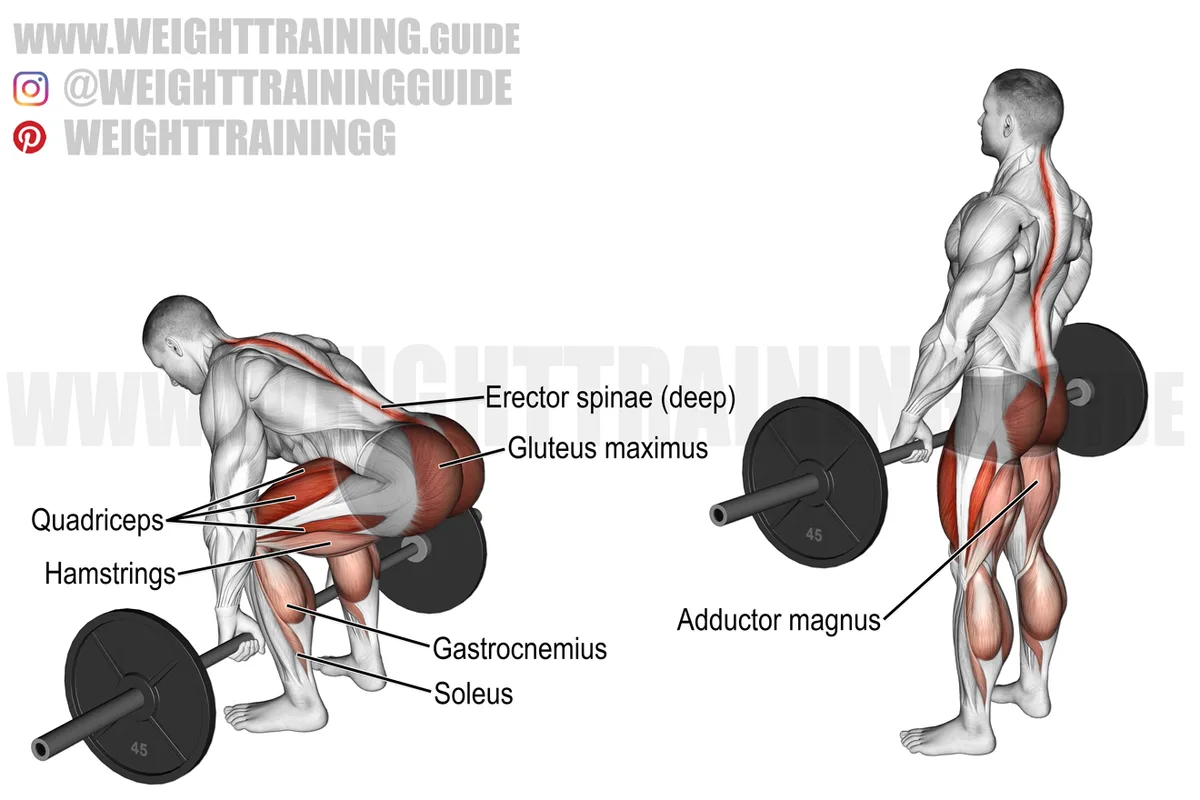
Image source: Web (Bing) / personaltraining-physiotherapie.de (Web image (fair-use with source credit))
This exercise is also great for developing grip strength and improving posture. Because it recruits so many muscles at once, it’s an incredibly efficient way to train. You might see this lift programmed 1-2 times per week for most individuals focused on strength development.
For competitive powerlifters, it's often the primary focus of their training.
Benefits & Potential Pitfalls
The benefits of the conventional deadlift are numerous. It's unparalleled for building overall strength, increasing muscle mass in the legs, glutes, and back, and boosting your metabolism. It also significantly improves grip strength, which is beneficial for many other exercises.
Furthermore, it can enhance bone density and improve functional strength for everyday activities.
However, the risk of injury is also higher if form is compromised. Rounding the lower back during the lift, for instance, can lead to severe spinal strain. Other common pitfalls include using too much momentum, not fully extending at the top, or a failed grip.
Proper coaching and a gradual progression in weight are crucial for safety. If you’ve ever had lower back pain, it’s vital to ensure you can maintain a neutral spine throughout the lift.
Image source: Web (Bing) / stablediffusionweb.com (Web image (fair-use with source credit))
Romanian Deadlift (RDL): The Hamstring & Glute Builder
The Romanian deadlift (RDL) is an excellent accessory exercise primarily targeting the hamstrings, glutes, and lower back. Unlike the conventional deadlift, the RDL starts with the weight already off the floor, typically held at hip height or slightly lower, and the movement focuses on the eccentric (lowering) and stretching phases. It’s less about a maximal pull from the floor and more about controlling the descent and feeling a deep stretch in the hamstrings.
What It Is & How It Works
To perform an RDL, you stand with your feet hip-width apart, holding a barbell or dumbbells in front of your thighs. Your knees should have a slight, soft bend, not locked, but not bent like in a squat. You then hinge at your hips, pushing your glutes backward as you lower the weight.
The barbell or dumbbells should stay close to your legs, almost brushing against them as you descend. You lower the weight until you feel a strong stretch in your hamstrings, typically around mid-shin to just below the knee, while maintaining a neutral spine. To return to the starting position, you drive your hips forward, squeezing your glutes and hamstrings to stand back up.
Key Features & When You'd Do It
The defining feature of the RDL is that the weight never touches the floor during the set. It’s a continuous movement of hinging and standing up. This exercise is perfect for individuals looking to build significant strength and hypertrophy in their hamstrings and glutes.
It’s a staple for bodybuilders and anyone wanting to improve their posterior chain development, which is crucial for athletic power, injury prevention, and overall lower body aesthetics.
Image source: Web (Bing) / liftmanual.com (Web image (fair-use with source credit))
You’ll often see RDLs programmed as a secondary or accessory lift after primary compound movements like squats or conventional deadlifts. They can also be programmed as a standalone hamstring and glute day exercise. The focus here is on the stretch and contraction, rather than moving the heaviest possible weight.
Because the load is typically lighter than a conventional deadlift, it’s often more accessible for beginners once the hip hinge pattern is understood. You can perform RDLs with barbells, dumbbells, or kettlebells, offering versatility in your training.
Benefits & Potential Pitfalls
The RDL is fantastic for developing the hamstrings and glutes, leading to improved power, stability, and even aesthetic development. It's highly effective for improving hip hinge mechanics, which translates to better performance in other lifts and everyday movements. It also strengthens the lower back and improves hamstring flexibility.
For those with tight hamstrings, the RDL can be a powerful tool for increasing range of motion over time.
Common mistakes with the RDL include excessive knee bend, which turns it into a squat variation, or rounding the back. Another pitfall is not allowing the hamstrings to stretch sufficiently, thereby missing out on the primary benefit of the movement. Some lifters also tend to hyperextend their back at the top, which can put unnecessary stress on the spine.
It's important to focus on the hamstring stretch and glute contraction.
Side-by-Side: Deadlift vs. Romanian Deadlift
Let's put these two powerful exercises head-to-head to really hammer home their differences. While both involve hinging at the hips, the mechanics, muscle focus, and purpose are distinct. Understanding these nuances will help you pick the right tool for your training toolbox.
Mechanics and Movement Patterns
- Conventional Deadlift: Starts from the floor, involves a full range of motion from standing to floor and back. It's a powerful, explosive lift that uses leg drive and back strength to overcome gravity from a dead stop. The knees bend significantly at the start, and the bar travels in a relatively vertical line close to the shins and thighs.
- Romanian Deadlift (RDL): Starts with the weight already held, typically at hip height or slightly lower. It emphasizes the hip hinge with a much smaller knee bend. The movement is primarily controlled by the hamstrings and glutes, focusing on the eccentric stretch and a powerful hip extension to return to standing. The bar stays very close to the legs throughout.
Muscle Engagement Differences
- Conventional Deadlift: This is a full-body exercise. Major muscle groups worked include the quadriceps, hamstrings, glutes, erector spinae (lower back), lats, traps, and forearms (for grip). It’s a true test of total body strength.
- Romanian Deadlift (RDL): Primarily targets the posterior chain. The hamstrings and glutes are the star players here, experiencing a significant stretch and contraction. The erector spinae also work hard to maintain a neutral spine, and the upper back (traps, rhomboids) engages isometrically to stabilize the weight.
Load Potential
- Conventional Deadlift: Generally, you can lift significantly more weight in a conventional deadlift than in an RDL. This is because it's a more mechanically advantageous lift that recruits more muscle mass and uses a powerful leg drive from the floor. It’s designed for maximal weight.
- Romanian Deadlift (RDL): The weight you can use for RDLs is typically much lower than your conventional deadlift. The focus is on control, range of motion, and the stretch, rather than maximal weight. Lifting too heavy can compromise form and lead to injury. For instance, an athlete might conventional deadlift 400 lbs but RDL only 200-250 lbs.
Who Should Choose Which Lift?
The decision between incorporating a conventional deadlift or a Romanian deadlift (or both) depends heavily on your individual training goals, experience level, and any physical limitations you might have. Both lifts offer incredible benefits, but they serve different primary purposes within a comprehensive fitness program.
Best For: Conventional Deadlift
The conventional deadlift is ideal for individuals looking to build maximal overall strength and power. If your goal is to lift the heaviest weight possible from the floor, compete in powerlifting, or significantly increase your total body strength, this is the lift for you. It's excellent for building a strong foundation across the entire posterior chain and improving athletic performance that requires explosive power.
This lift is also a fantastic full-body conditioner that can boost your metabolism and contribute to overall muscle mass development efficiently.
It’s a foundational movement for athletes in sports like football, rugby, and weightlifting. Beginners can benefit, but it requires careful attention to form. If you are looking to increase your strength ceiling across multiple muscle groups simultaneously, the conventional deadlift should be a cornerstone of your program.
You can also find variations, such as how to deadlift with dumbbells, which can be more accessible for some.
Best For: Romanian Deadlift
The Romanian deadlift (RDL) is the superior choice for those focused on developing hamstring and glute strength and size. If your aim is to build a powerful, well-developed posterior chain for aesthetic purposes, injury prevention, or to support other lower body movements like squats, the RDL is your go-to. It’s highly effective for improving hip mobility and flexibility while strengthening the muscles responsible for hip extension.
This lift is also excellent for improving posture and strengthening the lower back muscles in a less demanding way than a heavy conventional deadlift.
It’s a great exercise for bodybuilders aiming for hypertrophy in the hamstrings and glutes, and for athletes who need powerful hip extension for sprinting or jumping. Many individuals find that the RDL helps them to feel their hamstrings and glutes more directly than other exercises. Beginners can often learn the RDL pattern more easily than the conventional deadlift, making it a more accessible entry point for hip hinge training.
If you find you need more work on the "back side" of your body, focus here. You can also explore how to do Romanian deadlifts (RDL) to perfect your technique.
Common Mistakes and How to Fix Them
When performing either the conventional deadlift or the Romanian deadlift, form is paramount. Even experienced lifters can develop bad habits. Identifying and correcting these common mistakes will not only improve your results but, more importantly, help prevent injuries.
The biggest risk for both lifts is usually related to spinal position and how the weight is managed.
For Conventional Deadlifts
A major pitfall is rounding the lower back. This puts excessive stress on the lumbar spine. To fix this, focus on bracing your core and maintaining a neutral spine throughout the lift.
Imagine pulling your shoulders down and back, and tucking your hips slightly. Another frequent error is not achieving full hip extension at the top, or conversely, hyperextending the back. Ensure you stand tall, squeezing your glutes without leaning back excessively.
Another common mistake is using too much knee bend at the start, turning the deadlift into a squat. Your shins should be relatively upright with the bar very close to them. Also, make sure you're actually pulling the weight off the floor with your legs and back, not just jerking it up with momentum or your arms.
If your grip is failing, consider using weightlifting straps or a mixed grip for heavier sets.
For Romanian Deadlifts
The most frequent error with RDLs is excessive knee bend. Remember, this is a hinge, not a squat. Your knees should remain mostly fixed with only a slight, soft bend.
Keeping the weight close to your body, almost brushing your shins and thighs, is crucial. If the bar drifts forward, you'll put more strain on your lower back and less on your hamstrings.
Rounding the upper or lower back is just as dangerous here as in the conventional deadlift. Always maintain a flat, neutral spine. Focus on pushing your hips back as far as possible to feel a deep stretch in your hamstrings before initiating the stand-up.
Some people also rush the descent, failing to control the eccentric portion of the lift. This is where much of the muscle-building stimulus comes from, so control is key.
Frequently Asked Questions About Deadlifts
What is the primary difference in muscle focus between a conventional deadlift and an RDL?
The conventional deadlift works the entire body, emphasizing overall strength and power, including quads, glutes, and back. The RDL specifically targets the hamstrings and glutes, with the lower back acting as a stabilizer.
Can beginners safely perform deadlifts and RDLs?
Yes, beginners can safely perform both lifts, but it requires strict attention to form. It's highly recommended to learn the proper technique with an empty barbell or very light weight, and ideally under the guidance of a qualified coach.
How often should I incorporate deadlifts or RDLs into my routine?
For most individuals, performing these lifts once or twice a week is sufficient. Over-training can lead to fatigue and increase injury risk. Listen to your body and allow adequate recovery time between sessions.
Which lift is better for building overall leg strength?
The conventional deadlift engages more of the leg muscles, particularly the quads, and allows for heavier loading, making it superior for building overall leg strength and power. The RDL is more specialized for hamstrings and glutes.
Can I do deadlifts if I have a bad lower back?
If you have a history of lower back issues, proceed with extreme caution. It's crucial to get clearance from a healthcare professional. Proper form and lighter weights are essential, and you may need to focus on RDLs or dumbbell variations first.
If you experience pain, stop immediately.
Your Next Step: Choosing Your Lift
Deciding whether to prioritize the conventional deadlift or the Romanian deadlift comes down to your specific fitness objectives. If raw, maximal strength and overall power are your main goals, the conventional deadlift should be a cornerstone of your training. It’s a formidable exercise for building a strong, resilient physique from the ground up.
However, if your focus is on developing the hamstrings and glutes for strength, aesthetics, or improved athletic performance in movements requiring powerful hip extension, the RDL is likely the better choice. You can also incorporate both lifts into your program, strategically placing them to complement each other. For instance, use the conventional deadlift for strength focus and the RDL for hypertrophy and hamstring development on separate days or as accessory work.

