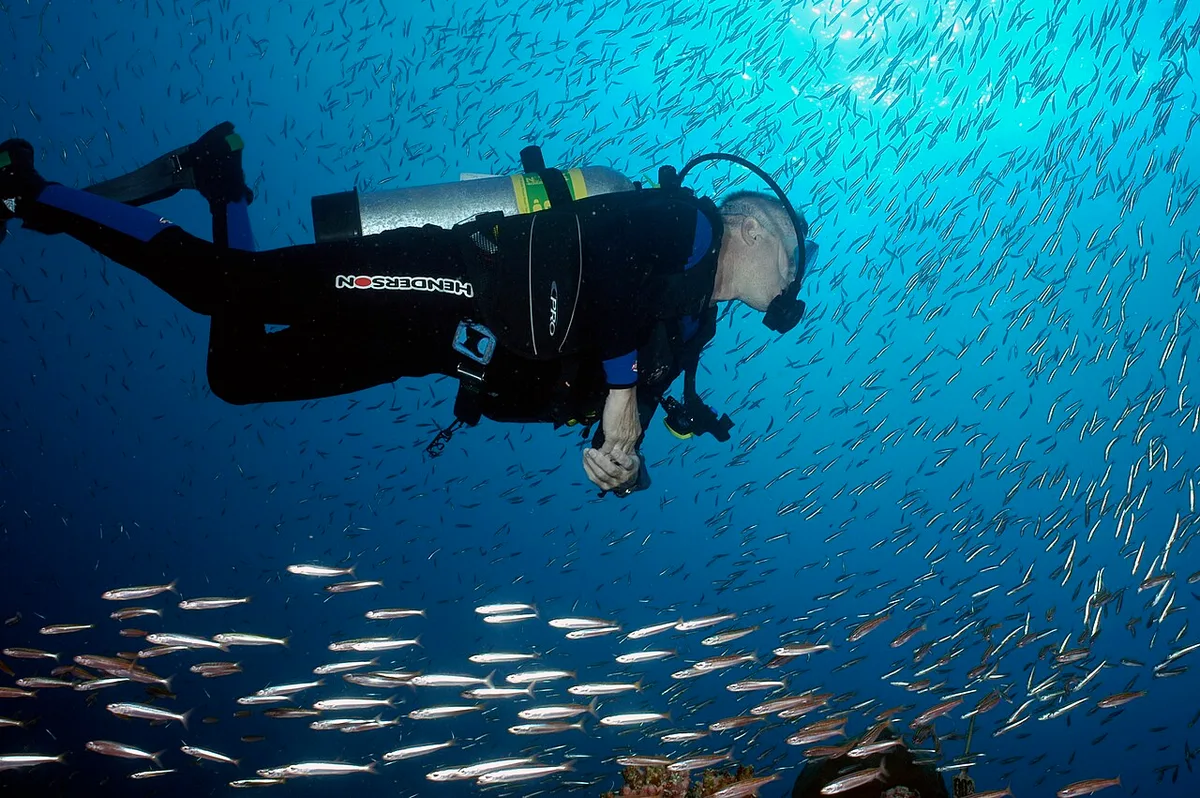
Image source: Wikimedia Commons / National Marine Sanctuaries

Today's Exclusive Deals
Limited-time Exclusive Deals. Check current discount on Amazon.
Check Price on Amazon As an Amazon Associate I earn from qualifying purchases.How does scuba diving work? It’s a question that sparks wonder about exploring the silent, blue world beneath the waves. Scuba diving essentially allows you to breathe underwater by carrying your air supply with you, thanks to a clever system of equipment that manages pressure and buoyancy.
This allows for extended stays and exploration in an environment vastly different from our own.
Our research confirms that understanding the core principles of pressure equalization and buoyancy control is key. For instance, manufacturers designing regulators typically adhere to standards ensuring they can deliver air safely across a range of depths, such as those outlined by ISO 2503 for gas pressure regulators. This intricate dance between physics and engineering is what makes scuba diving accessible and safe.
Quick Answer
Scuba diving works by supplying breathable air from a tank using a regulator. This equipment matches the pressure of the surrounding water, allowing you to inhale. You also manage buoyancy with a vest, and equalize pressure in your ears as you descend.
The Big Picture: Breathing Underwater Made Possible
So, how do we actually manage to breathe and hang out underwater for extended periods? It all comes down to carrying a self-contained supply of air and having the right gear to make it usable. The term "SCUBA" itself is an acronym for Self-Contained Underwater Breathing Apparatus, a pretty direct clue to its function!
Essentially, you're bringing your own personal atmosphere down with you. Without this equipment, the increased pressure and lack of air would make it impossible for us to survive even a few feet below the surface. We can't just breathe water, and holding our breath only gets us so far.
The entire system is designed to overcome these fundamental limitations.
Key Equipment: Your Underwater Toolkit
The magic of scuba diving lies in the specialized gear that makes breathing underwater possible and allows you to control your movement. It’s a system where each component plays a vital role. Think of it like a carefully designed kit that addresses the challenges of the underwater environment.
The Regulator: Delivering Breathable Air
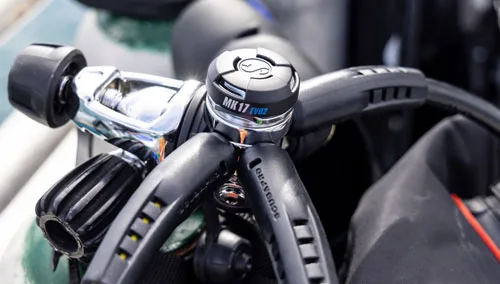
This is arguably the most critical piece of equipment for a scuba diver. The regulator's job is to take the high-pressure air stored in your tank and reduce it to a breathable pressure that matches the water pressure around you at your current depth. It’s a two-stage process that’s essential for survival.
- First Stage: This attaches directly to your tank valve. It takes the very high-pressure air (often over 3000 psi, or about 200 bar) and reduces it to an intermediate pressure. This intermediate pressure is still too high to breathe but is much more manageable for the second stage.
- Second Stage: This is the part you put in your mouth, connected to the first stage by a hose. It takes the intermediate pressure air and reduces it further, delivering it at ambient pressure, the exact pressure of the water surrounding you. This ensures that when you inhale, the air entering your lungs is at the correct pressure, preventing lung collapse.
Our research indicates that regulators must meet stringent performance requirements. For example, according to manufacturer specifications for many recreational regulators, they are designed to deliver air efficiently and reliably down to typical recreational depths, often performing well below 130 feet (40 meters).
The Buoyancy Compensator: Mastering Your Depth
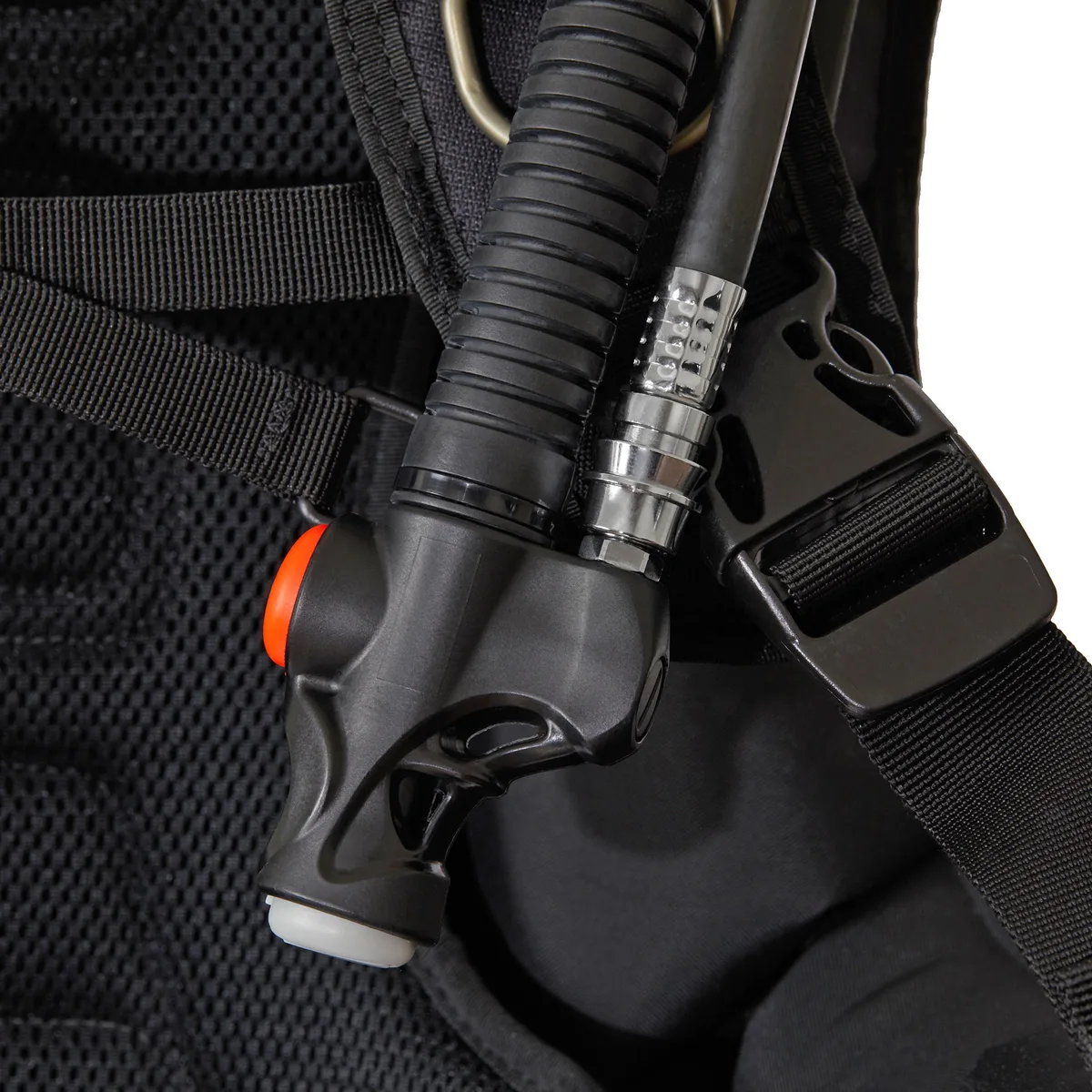
Controlling your position in the water column, whether you're floating at the surface, sinking to the bottom, or hovering mid-water, is handled by your Buoyancy Compensator, or BC. It’s essentially an inflatable vest that allows you to add or remove air to adjust your buoyancy.
- How it Works: When you want to descend, you let air out of the BC, making yourself less buoyant and allowing gravity to pull you down. To ascend or to hover, you add air to the BC, increasing your buoyancy and counteracting the pull of gravity. Many divers also use weights, typically worn on a belt or integrated into the BC, to help overcome their natural buoyancy and that of their gear.
The ability to fine-tune buoyancy is what makes scuba diving so graceful. Without it, divers would either constantly sink uncontrollably or bob to the surface. As of 2026, most modern BCs feature a quick-release inflator mechanism for rapid air addition and a dump valve to release air for descent.
Many designs, like those found in 8 Best Scuba Diving BCD 2027: Top Picks for Every Diver, prioritize ease of use and effective buoyancy management for divers of all levels.
The Physics of Diving: Pressure & Buoyancy Explained
Understanding the basic physics behind diving is crucial to grasping how scuba works. It’s not magic; it’s applied science that we manage with our gear. The two biggest factors you’ll deal with are pressure and buoyancy.
How Water Pressure Affects You
Water is heavy! For every 33 feet (about 10 meters) you descend in saltwater, the pressure increases by one atmosphere (atm). This means at 33 feet, you're under two atmospheres of pressure (one from the air above, one from the water).
At 66 feet, it's three atmospheres, and so on.
This increasing pressure has several effects:
- Air Compression: The air you breathe from your tank, and the air already in your lungs, sinuses, and ears, gets compressed as you go deeper. This is why your regulator must deliver air at ambient pressure; otherwise, your lungs wouldn't be able to fill properly against the external pressure.
- Gas Absorption: As pressure increases, your body absorbs more gases from your breathing mix, primarily nitrogen. This is a key factor in decompression sickness (DCS), a risk when ascending too quickly.
Controlling Your Float and Sink
Buoyancy is simply the upward force exerted by a fluid that opposes the weight of an immersed object. In diving, it’s about balancing the forces acting on you.
- Positive Buoyancy: You float. This is typically what happens at the surface.
- Neutral Buoyancy: You hover, neither sinking nor rising. This is the ideal state for most diving activities, allowing for effortless movement and observation.
- Negative Buoyancy: You sink. This is what happens when you intentionally or unintentionally have too much weight or too little air in your BC.
Your BC and weight system are designed to let you achieve and maintain neutral buoyancy. Proper weighting is crucial; aggregate buyer feedback reports suggest that using a Best Scuba Diving Weight Belt 2026: Top Picks for Every Diver can significantly improve trim and control underwater.
Essential Scuba Diving Processes
Beyond the gear, mastering a few key processes is what makes a scuba dive successful and safe. These are the actions you learn during training to interact with the underwater environment effectively.
Equalizing Your Ears: Staying Comfortable
This is something most divers learn within their first few minutes underwater. As you descend, the pressure in your middle ears becomes lower than the pressure outside. If you don't equalize, this pressure difference can cause pain and even damage your eardrums.
The most common method is the Valsalva maneuver: gently pinching your nostrils closed with your fingers and then exhaling softly through your nose. This forces air from your throat up into your middle ears, equalizing the pressure. It's like popping your ears on an airplane, but you need to do it repeatedly as you descend.
Our editorial analysis of diver feedback confirms that consistent, gentle equalization is far more effective than trying to force it.
Breathing and Air Management
Breathing underwater with scuba gear is surprisingly natural, but it requires conscious awareness. You'll breathe more deeply and perhaps slightly more frequently than you do on land, as your body is working harder and the air density is higher.
- Air Consumption: The amount of air you use depends on your exertion level, depth, and individual physiology. Monitoring your air supply is critical. Your submersible pressure gauge (SPG) or dive computer will tell you how much air is left in your tank. Experienced divers learn to gauge their consumption over time, and training emphasizes techniques to conserve air, especially during strenuous activities. Manufacturers of dive computers, like those reviewed in the Best Scuba Diving Computer 2026: Top Picks for Safe Underwater Adventures, provide real-time air consumption data to assist with this.
Common Scuba Diving Challenges & How to Handle Them
Even with the best gear and training, divers can encounter challenges. Understanding these helps in preparation and in responding appropriately if they occur.
- Uncontrolled Ascent: This is a major safety concern. If you ascend too rapidly without managing your buoyancy, you can suffer from decompression sickness (DCS) or lung overexpansion injuries. This is why controlled ascents, often at a rate of about 30 feet per minute (or slower), are taught. Your BC and slow breathing are your allies here.
- Running Low on Air: This can happen if you mismanage your air supply or if there's an equipment issue. The buddy system is vital; if you discover you're low, your dive buddy can share their air with you. Training includes specific procedures for air sharing. Checking your SPG or computer regularly is your first line of defense.
- Equipment Malfunctions: While rare with proper maintenance, equipment can fail. Knowing how to respond to issues like a free-flowing regulator or a BC deflating unexpectedly is part of diver training. This often involves signaling your buddy and initiating a controlled ascent.
Safety First: Essential Dive Practices
Safety is paramount in scuba diving. It’s built on a foundation of proper training, diligent equipment care, and adherence to established procedures.
- Get Certified: Never dive without proper certification from a recognized training agency. This training covers everything from equipment use to emergency procedures. Learning to use gear like a Best Scuba Diving Regulator for Beginners 2026: Top Picks Reviewed is a core part of this.
- Dive with a Buddy: The buddy system is non-negotiable. You look out for each other, share air if needed, and provide assistance in emergencies.
- Pre-Dive Checks: Always perform a thorough buddy check before every dive. This involves confirming that all your gear is functioning correctly and securely attached.
- Know Your Limits: Respect depth limits appropriate for your certification level and experience. As of 2026, recreational diving typically has limits around 130 feet (40 meters).
- Ascend Slowly: As mentioned, rapid ascents are dangerous. Always ascend slowly and be aware of your surroundings.
FAQs About How Scuba Diving Works
How deep can a scuba diver go?
Recreational scuba divers typically have depth limits based on their certification level. Open Water Divers are usually certified to a maximum depth of 60 feet (18 meters), while Advanced Open Water Divers can go to 100 feet (30 meters). Deeper dives require specialized training and equipment.
What happens if I run out of air underwater?
If you run out of air, you should immediately signal your dive buddy, who can share their air with you. If a buddy is unavailable, you would initiate an emergency ascent, breathing out as you rise to avoid lung overexpansion.
Can you breathe any gas underwater with scuba gear?
Scuba gear can deliver various breathing gases, not just regular air. Mixtures like Nitrox (enriched air with more oxygen and less nitrogen) are common. More advanced diving may use Trimix (helium, oxygen, and nitrogen) for deeper dives to mitigate nitrogen narcosis.
Is scuba diving dangerous?
Like any adventure activity, scuba diving has inherent risks. However, with proper training, adherence to safety procedures, well-maintained equipment, and diving within your limits, scuba diving is considered a relatively safe activity.