Golfers today want the best tools to lower their scores and enjoy the game. When choosing a rangefinder, two names come up again and again: Bushnell and Garmin. Both brands are trusted, but many golfers say Bushnell is better for the golf course. Why is this? The answer is not just about a famous name or fancy technology. It’s about how the rangefinder performs when you need it most.
This article breaks down the reasons why Bushnell rangefinders often beat Garmin. We’ll look at accuracy, ease of use, build quality, battery life, and more. Whether you’re a beginner or an experienced golfer, you’ll find clear answers to help you decide.

Today's Exclusive Deals
Limited-time Exclusive Deals. Check current discount on Amazon.
Check Price on Amazon As an Amazon Associate I earn from qualifying purchases.Along the way, you’ll see real examples, honest comparisons, and practical advice that goes beyond marketing claims.
Understanding Rangefinders: What Really Matters
Before comparing Bushnell and Garmin, it’s important to know what makes a golf rangefinder effective. A rangefinder’s main job is to show the exact distance to your target. But there are other factors that can make a big difference:
- Accuracy: The most important feature. Even a few yards off can mean the wrong club choice.
- Speed: Fast readings help keep up the pace of play.
- Ease of Use: Simple controls matter, especially under pressure.
- Durability: Golf is played outdoors, often in tough conditions.
- Battery Life: No one wants their device to die mid-round.
- Display Quality: Clear, readable numbers help you trust your shot.
- Slope Measurement: Adjusts distance for uphill or downhill shots (if allowed).
- Tournament Legality: Some features must be disabled in official events.
Most rangefinders do the basics, but the details set them apart. Let’s see how Bushnell and Garmin perform in each area.
Key Differences: Bushnell Vs Garmin Rangefinders
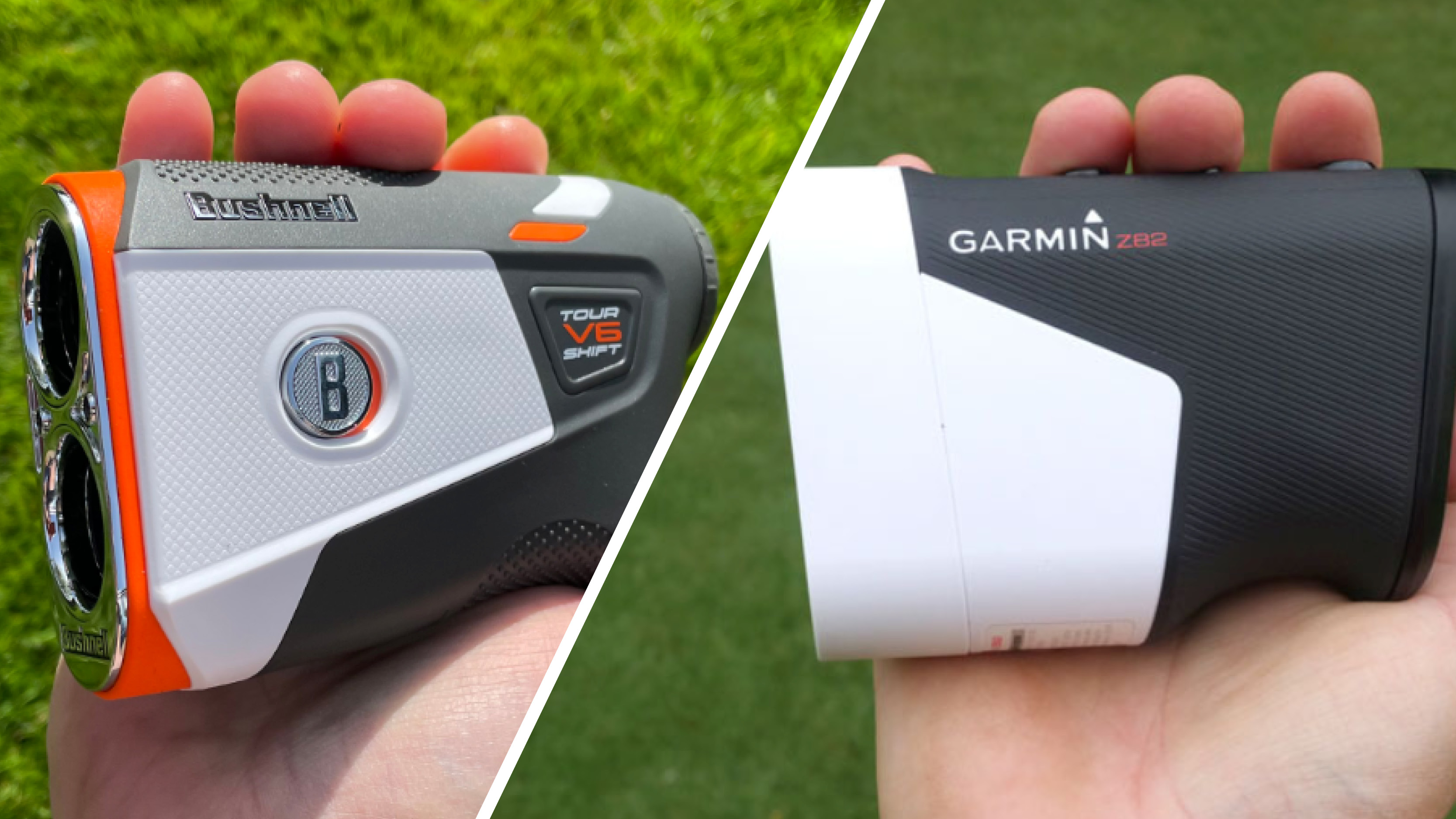
Golfers often compare Bushnell’s laser rangefinders with Garmin’s GPS and hybrid models. To make things clear, here’s a side-by-side look at their most popular devices: the Bushnell Tour V5 Shift and the Garmin Approach Z82.
| Feature | Bushnell Tour V5 Shift | Garmin Approach Z82 |
|---|---|---|
| Technology | Laser | Laser + GPS |
| Accuracy | +/- 1 yard | +/- 1 yard |
| Slope Mode | Yes (with on/off switch) | Yes |
| Course Maps | No | 41,000+ preloaded |
| Display Type | Optical (through lens) | Augmented reality (overlays GPS data) |
| Battery Life | ~1,000 uses (CR2 battery) | ~15 hours (rechargeable) |
| Water Resistance | Yes | Yes |
| Weight | 8.7 oz | 14.6 oz |
| Price (approx.) | $300–$400 | $600–$650 |
Both are advanced devices, but the way they work and feel is very different. Now, let’s look at why many golfers prefer Bushnell.
Accuracy And Reliability: Trust On Every Shot
When it comes to hitting a perfect shot, accuracy is everything. Both Bushnell and Garmin claim to be accurate within one yard. However, Bushnell rangefinders have a long history of real-world reliability. Tour players, coaches, and club fitters often trust Bushnell above all others.
Why is this? Bushnell’s laser system is simple and direct. You point, press, and get a reading—no waiting, no second guesses. The device does not depend on satellites, which can sometimes cause GPS drift or delays. In tournaments and practice rounds, even a one-yard error can mean hitting into trouble.
With Bushnell, you know the number is right.
Garmin’s GPS-laser hybrid is impressive, but it adds layers of technology that can sometimes slow things down or create confusion. For example, on a cloudy day or in areas with weak GPS signals, the device’s readings may take longer or show slight errors.
Non-obvious insight: Many golfers don’t realize that laser rangefinders like Bushnell work on any course, even those not mapped by GPS. This matters when playing at private clubs or new layouts.
Speed: Fast Readings Mean Better Pace
Golfers hate waiting. Fast play keeps everyone happy and focused. Bushnell’s laser system is known for its instant readings. You look through the lens, aim at the flag, press the button, and see the number right away—usually in less than one second.
Garmin’s Z82 is quick too, but its hybrid system sometimes needs a moment to process both GPS and laser data. If you’re playing with friends or in a tournament, those extra seconds add up. It may not seem like much, but for serious players, speed is part of confidence.
Practical tip: If you often play in foursomes or busy courses, every second matters. Bushnell helps you keep up the pace without sacrificing accuracy.
Ease Of Use: Simplicity Wins On The Course
One of the biggest reasons golfers prefer Bushnell is ease of use. The controls are simple—a single main button and sometimes a slope switch. The display is clear, and there’s no need to scroll through menus or wait for GPS signals.
Garmin’s Z82, while powerful, has many extra features. These can be helpful for data lovers, but they may feel overwhelming for many golfers. Touchscreens, menus, and augmented reality overlays sound cool but can distract from the main job: picking a club and hitting the ball.
Non-obvious insight: For golfers with shaky hands or those who wear glasses, Bushnell’s optical display is easier to use than a digital screen. You see the target directly, without eye strain.
Build Quality And Durability: Made To Last
Golf equipment takes a beating. Rain, heat, and the occasional drop are all part of the game. Bushnell devices are famous for their rugged construction. They feel solid in your hand, and the rubber grip helps prevent slips. Many users report their Bushnell rangefinder works perfectly after years of use, even with regular bumps and drops.
Garmin’s rangefinders are well built too, but the extra electronics (GPS, digital screens, battery packs) make them more sensitive to shock and moisture. If you play in harsh weather or tend to be rough on your gear, Bushnell’s simple design means fewer things can go wrong.
Example: A club professional shared that his Bushnell survived a fall onto a cart path with only a scratch, while his previous GPS-based device stopped working after a similar accident.
Battery Life: All-day Confidence
No one wants to run out of battery during a round. Bushnell uses a simple CR2 battery that lasts for months—usually 1,000 uses or more. You can carry a spare in your bag and swap it in seconds.
Garmin’s Approach Z82 uses a rechargeable battery. It lasts about 15 hours, which is enough for two to three rounds. However, if you forget to charge it, you’re out of luck until you find a power source.
Practical tip: For long golf trips, tournaments, or courses without easy access to electricity, Bushnell’s battery system is more reliable and less stressful.
Slope Technology: Smart Adjustments, Simple Use
Slope compensation helps golfers get the “true” yardage for uphill or downhill shots. Bushnell’s Slope Switch lets you turn this feature on or off easily. In tournaments, you simply flip the switch to disable slope, keeping the device legal.
Garmin’s Z82 also has slope adjustment, but it’s managed through software menus. This can be less intuitive and takes extra time. Some golfers worry about accidentally leaving slope mode on during tournament play, which could lead to penalties.
Experience-based advice: If you play in both casual and official events, Bushnell’s physical switch gives you peace of mind. You can see at a glance if the device is legal for competition.
Display Quality: Clear And Readable In Any Light
Bushnell’s optical lens system is bright and easy to read in sunlight or shade. The numbers are crisp, and there’s no glare. Most models include a red or black LCD display inside the viewfinder, making the distance clear even for those with poor eyesight.
Garmin’s digital screen adds GPS overlays, but in very bright or dim conditions, it can be harder to see. Some users find the extra information distracting rather than helpful.
Example: Seniors and players with vision issues often report better results with Bushnell’s traditional lens, especially in late afternoon or early morning rounds.
Size, Weight, And Handling: Designed For Golfers
Bushnell rangefinders are known for their compact size and light weight. They fit easily in one hand or a pocket. Most models weigh between 6–9 ounces, which means less fatigue after 18 or 36 holes.
Garmin’s Z82 is larger and heavier, mainly because of its extra electronics and battery. At almost 15 ounces, it can feel bulky, especially for players with smaller hands or those who walk the course.
Practical note: If you play a lot of golf or walk instead of using a cart, Bushnell’s lighter weight is a big advantage.

Price And Value: What Are You Really Paying For?
Some golfers believe “more features” means “better device.” However, value for money is about getting what you need—not paying extra for things you won’t use.
Bushnell’s top models (like the Tour V5 Shift or Pro XE) cost $300–$500. They focus on accuracy, speed, and ease of use. Garmin’s Z82 is around $600–$650. You get GPS maps, digital scorecards, and more, but many golfers never use these extras.
| Model | Approximate Price | Key Features |
|---|---|---|
| Bushnell Tour V5 Shift | $350 | Laser, Slope, Fast Focus |
| Bushnell Pro XE | $500 | Laser, Slope, Weather Adjustment |
| Garmin Approach Z82 | $650 | Laser, GPS, Course Maps |
If you want a simple, reliable distance tool, Bushnell offers more value. If you love data and maps, Garmin may make sense—but you pay a lot for features you might not need.
Tournament Play: Rules And Trust
Golf tournaments follow strict rules. Rangefinders are allowed, but slope and some features must be disabled. Bushnell’s clear on/off switch for slope makes it easy to comply. Officials can check at a glance.
Garmin’s Z82 has a tournament mode, but switching between modes is done through menus. Some tournament directors are less familiar with digital hybrids, which can lead to questions or delays.
Confident guidance: If you play in many tournaments, Bushnell gives you fewer worries about legality.
Customer Support And Warranty: Peace Of Mind
Bushnell is known for strong customer service. If something goes wrong, their support team is easy to reach, and warranty claims are handled quickly. Many golf shops can also help with repairs or replacements.
Garmin is a large company with support across many products. While their service is good, golf-specific help can sometimes be slower, especially for advanced rangefinder models.
Non-obvious insight: Bushnell’s focus on golf means they understand the needs and frustrations of players better than a general electronics company.
Market Leadership: Used By The Pros
It’s no accident that 99% of PGA Tour players use Bushnell rangefinders for practice and preparation. Their trust comes from years of consistent performance. When you watch professional golfers and caddies, you’ll often see a Bushnell in the bag—not a Garmin.
This doesn’t mean Garmin is bad. But when the world’s best players rely on one brand, it says something about quality and trust.
Example: The Bushnell Pro XE is the “official rangefinder” of many college golf teams and top-level amateur events.
When Might Garmin Be Better?
To be fair, Garmin’s Z82 and similar models have unique strengths. If you want course maps, hazard overlays, and a built-in digital scorecard, Garmin is ahead. The GPS features are great for new golfers learning a course, or for those who want extra data on every shot.
If you play lots of unfamiliar courses, or you enjoy tech gadgets, Garmin’s rangefinders are worth a look. But for most golfers, these extras are not essential—and can sometimes get in the way.
Real-world User Reviews
Golfers who switch from Garmin to Bushnell often mention the following:
- Faster, more reliable distances—especially under pressure.
- Less distraction—they focus more on the shot, not the device.
- Better battery life—they never worry about charging.
- More confidence in tournaments—no rule confusion.
Example: A mid-handicap golfer shared, “I loved the idea of GPS maps, but after a few rounds, I just wanted quick, simple distances. Bushnell gave me that, and my scores improved.”

Common Buyer Mistakes
Many golfers make these errors when choosing a rangefinder:
- Paying extra for features they won’t use (like GPS maps).
- Choosing a device that’s too complicated for their needs.
- Ignoring battery type—rechargeable vs replaceable.
- Not checking tournament legality of all features.
- Overlooking device weight and comfort.
Confident advice: Think about how you actually play golf. Most players want speed, accuracy, and simplicity. Bushnell delivers on all three.
Summary: Why Bushnell Is Often The Better Choice
Bushnell rangefinders stand out because they focus on what golfers truly need: accuracy, speed, reliability, and ease of use. The devices are built to last, trusted by professionals, and offer great value for money. While Garmin’s GPS features are impressive, most players find Bushnell’s laser system more practical for real-world golf.
Remember, the best rangefinder is the one you enjoy using every round. For most golfers, that’s a Bushnell.
If you want to read more on how rangefinders work and their place in golf history, check out the Wikipedia page on rangefinders.
Frequently Asked Questions
Why Do So Many Pros Use Bushnell Instead Of Garmin?
Professional golfers trust Bushnell because it gives fast, accurate readings with no delays. The devices are reliable, simple, and have a long track record on the PGA Tour. Garmin’s extra features are nice but not needed for most pros.
Are Bushnell Rangefinders Legal In Tournaments?
Yes, as long as slope mode is turned off. Bushnell makes this easy with a physical switch. Always check tournament rules, but Bushnell’s compliance is clear and simple.
Is Garmin Better For Beginners?
Garmin’s course maps and hazard overlays can help new golfers learn unfamiliar courses. However, the extra features can also be distracting. Most beginners do better with Bushnell’s simple controls and clear readings.
What Is The Main Weakness Of Bushnell Compared To Garmin?
Bushnell does not offer GPS course maps or digital scorecards in most models. If you want lots of on-screen data or play many new courses, Garmin’s hybrid devices have an edge.
How Long Does The Battery Last In Bushnell And Garmin Rangefinders?
Bushnell’s CR2 battery lasts for months (about 1,000 uses) and is easy to replace. Garmin’s rechargeable battery lasts 2–3 rounds per charge. If you forget to charge Garmin, you may run out during play.
In the end, your best choice depends on what you value most. For most golfers, Bushnell’s accuracy, speed, and ease of use make it the better rangefinder.