
So, you're trying to figure out the difference between wrestling and judo, right? It's a common question for anyone looking to get into martial arts or combat sports. Both are incredibly effective and demanding disciplines, but they have distinct approaches and goals.
Understanding these differences is key to choosing the path that best fits your interests and aspirations.

Today's Exclusive Deals
Limited-time Exclusive Deals. Check current discount on Amazon.
Check Price on Amazon As an Amazon Associate I earn from qualifying purchases.In our research, we found that while both involve close-quarters grappling, their techniques, scoring, and overall feel on the mat are quite distinct. The International Judo Federation (IJF) outlines specific rules that heavily influence judo's dynamic nature, focusing on throws and submissions, while wrestling emphasizes control and pinning. Let's dive into what makes each one unique.
Wrestling vs Judo
The primary distinction between wrestling and judo lies in their objectives and the methods used to achieve them. Wrestling focuses on takedowns and pinning an opponent, emphasizing continuous control and physical dominance. Judo, conversely, centers on using an opponent's momentum to execute powerful throws and employing joint locks and strangles to secure a submission.
What's the Big Picture Difference?
At its core, wrestling is about controlling your opponent through takedowns and pinning them to the mat. Think of it as a constant battle for dominance, trying to get your opponent into a position where they can't escape. You're always looking for that opportunity to bring them down and hold them there.
Judo, on the other hand, is often called "the gentle way," but don't let that fool you, it's anything but soft. It heavily emphasizes throws, joint locks (on arms only), and strangles. The goal is to use your opponent's momentum against them to throw them forcefully onto their back, or to subdue them with a submission hold.
The precision and timing of these techniques are paramount.

Image source: Bing (Web (fair-use with source credit))
Wrestling Focus
Wrestling is a sport that relentlessly demands physical and mental toughness. Its primary objective is to gain and maintain control over an opponent, ultimately aiming to secure a pin, where both of the opponent's shoulder blades are held on the mat for a specified time. This involves a constant exchange of grips, trips, and sprawling to defend against takedowns.
The pace is often furious, with little room for rest. Wrestlers develop immense core strength, explosive power, and incredible stamina. The sheer grit required to push through grueling matches is a hallmark of the sport.

Image source: Web (Bing) / clipart-library.com (Web image (fair-use with source credit))
This focus on control and pressure means that wrestling training often involves a lot of live grappling, or "live wrestling," where practitioners spar with each other under competitive conditions. The emphasis isn't just on executing a single technique, but on applying constant pressure and making tactical adjustments to maintain an advantageous position. It’s a high-stakes game of inches, where a momentary lapse in focus can lead to giving up a takedown or falling behind on points.
Judo Focus
Judo, meaning "the gentle way," is a system of grappling that was developed in Japan by Jigoro Kano. It's characterized by its emphasis on throws and the effective use of leverage and balance. Unlike wrestling's dominant ground control, judo aims to throw an opponent with significant force onto their back.
Points are awarded for the quality of these throws. If a throw is deemed powerful enough, it can end the match instantly with an "ippon."
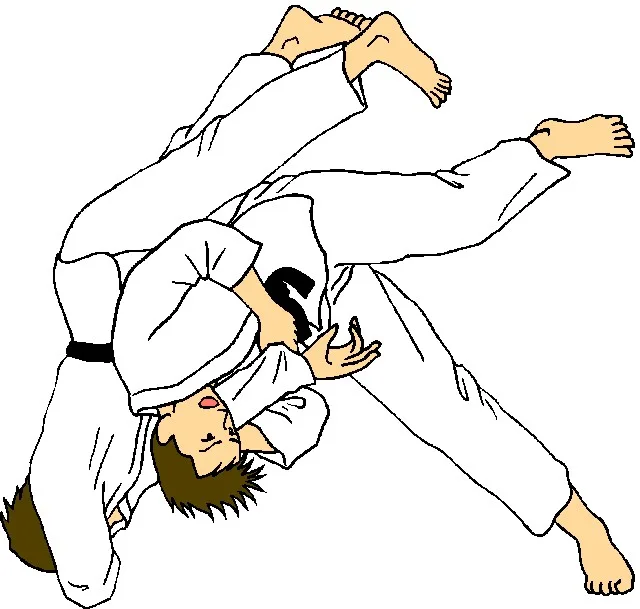
Image source: Web (Bing) / clipart-library.com (Web image (fair-use with source credit))
Beyond throws, judo also incorporates ground techniques, primarily consisting of holding an opponent down (osaekomi-waza) or applying arm locks (kansetsu-waza) and strangles (shime-waza) to force a submission. A key element unique to judo is the gi, the heavy cotton uniform that players wear. This uniform isn't just for show; it's integral to the techniques, as players constantly grip and manipulate each other's gi to set up throws or resist attempts.
Learning to fall safely, known as ukemi, is a fundamental skill drilled from day one in judo, which is crucial given the emphasis on throwing.
Wrestling vs. Judo: Key Features Compared
Let's break down some of the core differences you'll find when you look at wrestling and judo side-by-side.
Wrestling Attributes
- Primary Goal: Takedowns and pinning the opponent.
- Uniform: A tight-fitting singlet. No loose fabric to grip.
- Technique Focus: Explosive takedowns, leg attacks, control on the mat.
- Ground Game: Emphasis on maintaining positional dominance and applying pins.
- Scoring: Points for takedowns, escapes, and controlling positions; a pin ends the match.
- Allowed Techniques: Primarily grappling, with no striking or joint locks permitted.
Judo Attributes
- Primary Goal: Throwing the opponent forcefully or submitting them.
- Uniform: A thick, loose-fitting gi (uniform) which is used for gripping and control.
- Technique Focus: Throws (nage-waza), sweeps, arm locks (kansetsu-waza), and strangles (shime-waza).
- Ground Game: Holding techniques (osaekomi-waza) and submissions.
- Scoring: Points for throws (ippon, waza-ari) and holds; submission also ends the match.
- Allowed Techniques: Throws, arm locks, and strangles; no leg locks or striking.
The Feel of Each Sport: An Inside Look
The experience of training wrestling versus judo can feel quite different. It's about the atmosphere, the flow of a practice session, and the types of physical and mental challenges you encounter.
The Intensity of Wrestling
Wrestling is often described as a high-octane, back-and-forth struggle from the moment the whistle blows. You're constantly engaged, looking for openings, and defending against your opponent's attempts to gain an advantage. There’s a raw, physical pressure involved that can be relentless.
It requires incredible conditioning and a strong will to push through fatigue. Many practitioners report that wrestling builds a unique kind of mental toughness, forged in the crucible of constant, close-quarters combat. The focus is very much on outworking and out-muscling your opponent through sheer grit and applied pressure.
The Flow of Judo
Judo, while physically demanding, has a more pronounced emphasis on technique, timing, and leverage. You'll spend a lot of time learning how to grip your opponent's gi effectively, as this is crucial for setting up your throws. The movement can feel more fluid and circular, as you work to unbalance your opponent and use their own momentum against them.
When you execute a clean throw, it’s a deeply satisfying experience. Even the ground fighting, while different from wrestling, requires a specific skill set. Learning ukemi, or how to fall safely, is a fundamental skill drilled from day one in judo, which is crucial given the emphasis on throwing.
Who Should Train Wrestling?
You might find wrestling a great fit if you're drawn to raw physical competition and the constant battle for control. It demands a high level of athletic conditioning, explosive power, and sheer grit. If you enjoy a sport where every second involves intense engagement, strategic pressure, and a deep dive into perfecting takedowns and pins, wrestling could be your calling.
This discipline builds incredible resilience.
Consider wrestling if you thrive on direct physical confrontation and enjoy the challenge of constantly outmaneuvering an opponent on the mat. It’s a sport that truly tests your physical limits and mental fortitude. If your goal is to develop superior control and a relentless will to win through superior conditioning and tactical pressure, then wrestling is likely your best path.
The foundational strength and balance gained are transferable to many other athletic pursuits.
Who Should Train Judo?
Judo might be more your speed if you're fascinated by the art of movement, leverage, and using an opponent's energy against them. The emphasis on dynamic throws and the strategic use of the gi makes for a unique training experience. If you appreciate a martial art that combines striking and ground elements with a deep philosophical background, judo offers a rich tradition.
Learning to fall safely (ukemi) is a core skill that builds confidence.
This art is particularly appealing if you enjoy the puzzle-like nature of gripping and finding the right moment to execute a throw. The inclusion of arm locks and strangles adds a submission aspect that differentiates it from wrestling. As of 2026, judo continues to grow globally, celebrated for its effectiveness and its emphasis on mutual welfare and benefit.
If you seek a comprehensive grappling art that teaches both powerful takedowns and submission skills, judo is an excellent choice.
Safety Considerations in Wrestling and Judo
Both wrestling and judo are combat sports where safety is paramount, especially when practiced under qualified instructors. While injuries can occur, proper training protocols significantly mitigate risks. In wrestling, common concerns involve joint sprains, particularly in the knees and ankles, due to explosive movements and the constant pressure applied.
Wrestlers are trained to maintain control and avoid compromising positions.
In judo, the emphasis on ukemi (breakfalls) is a cornerstone of safety. This training teaches practitioners how to land safely from throws, distributing impact and preventing injury to themselves and their partners. While throws can be powerful, the skill of falling correctly minimizes harm.
Joint locks are typically restricted to the elbow, and strangles are taught with care to ensure they are released before causing serious harm. As with any contact sport, understanding your limits and communicating with your training partners is essential for a safe and rewarding experience.
Making Your Choice: Wrestling or Judo?
Deciding between wrestling and judo ultimately comes down to what you're seeking in a martial art or combat sport. If your primary interest lies in intense, continuous grappling with a focus on takedowns and positional control leading to pins, wrestling is likely the better fit for you. It's a sport that rewards physical strength, conditioning, and a tenacious will to dominate.
You'll build incredible core strength and explosive power through its demands.
On the other hand, if you're drawn to the art of throwing, using an opponent's momentum, and employing both standing and ground submission techniques, judo might be your preferred path. The strategic use of the gi and the emphasis on precise timing and balance make it a unique discipline. The structured learning of ukemi ensures you can engage in dynamic techniques with a focus on safety.
Both sports offer immense physical and mental benefits, so consider which approach resonates most with your personal goals and preferences.
Wrestling for You?
You might find wrestling aligns with your interests if you enjoy a very direct, physical contest. The emphasis is on driving forward, securing takedowns, and maintaining a dominant position to achieve a pin. This means a lot of explosive effort and a continuous battle for control.
If you're looking to build raw strength, power, and an unyielding mental attitude, wrestling is an excellent choice. It's a sport that truly tests your limits and demands a high level of athleticism.
Judo for You?
Judo could be the right choice if you're more attracted to the dynamic and strategic aspects of martial arts. The focus on elegant throws, using leverage, and the intelligent application of grips offers a different kind of challenge. If you appreciate a discipline that teaches you to use your opponent's energy and momentum, and you're interested in learning submissions like arm locks and strangles, judo provides a comprehensive system.
The ability to fall safely and the structured progression are key components.
Frequently Asked Questions
Which sport is better for self-defense?
Both wrestling and judo provide excellent self-defense skills. Wrestling teaches you to control an attacker and prevent them from overpowering you, while judo's throws and submissions can neutralize a threat quickly. Many MMA practitioners cross-train in both for a well-rounded skill set.
Is judo harder to learn than wrestling?
Learning the basics of both sports requires dedication. Judo's emphasis on throws and the complex grip fighting can have a steep learning curve initially. Wrestling's constant intensity and demand for physical dominance also present unique challenges.
The "harder" one often depends on individual aptitude and learning style.
Can I do both wrestling and judo?
Absolutely. Many athletes successfully train in both disciplines, as they complement each other well. For example, wrestling takedowns can set up judo throws, and judo ground skills can enhance a wrestler's control.
Combining them offers a very comprehensive grappling foundation.
How long does it take to get good at wrestling or judo?
"Good" is relative, but expect to train consistently for several years to achieve a high level of proficiency in either sport. Significant progress in understanding techniques and building conditioning can be seen within the first year of regular practice.

