When you're learning to scuba dive or just thinking about your first underwater adventure, a key piece of equipment you'll encounter is the Buoyancy Control Device, or BCD. This isn't just a fancy life vest; it's your primary tool for controlling how you float, sink, or hover beneath the waves. Mastering its use is fundamental to enjoying your dives safely and comfortably.
Understanding what a scuba diving BCD is and how it works is essential for any diver. Manufacturer specifications often detail lift capacity in pounds or Newtons, with recreational BCDs typically offering between 20 to 50 lbs (9 to 23 kg) of lift as of 2026, ensuring enough buoyancy for a diver and their gear. Let's dive into what makes this gear so crucial.
Today's Exclusive Deals
Limited-time Exclusive Deals. Check current discount on Amazon.
Check Price on Amazon As an Amazon Associate I earn from qualifying purchases.
Image source: Bing (Web (fair-use with source credit))
Quick Answer
A scuba diving BCD is a jacket or vest that controls your buoyancy underwater. It allows you to inflate or deflate an internal bladder to ascend, descend, or hover at a neutral position. This critical piece of gear ensures you can float comfortably on the surface and maneuver with ease beneath the water.
How a BCD Lets You Control Your Dive
The core function of any Buoyancy Control Device (BCD) boils down to manipulating air within an inflatable bladder to adjust your overall buoyancy. Think of it like this: the more air you have inside the BCD, the more volume it displks, making you more buoyant. Conversely, less air means less displacement and less buoyancy.
This principle is what allows you to achieve neutral buoyancy, that perfect state where you neither sink nor float upwards.
This control is vital for everything from your initial descent to your controlled ascent and maintaining a stable position while exploring. Without it, you’d be constantly fighting to stay at the right depth, making the experience exhausting and potentially unsafe.
The Heart of Buoyancy: How Inflation and Deflation Work
The magic behind buoyancy control happens through a simple yet effective system of adding and removing air from the BCD's internal bladder. This process is managed by two main methods: your regulator's low-pressure inflator and your own breath.
- Low-Pressure Inflator: This is the most common way to manage your BCD's air. A corrugated hose connects this device to your regulator's first stage, drawing low-pressure air from your scuba tank. You typically have an "inflate" button to add air and a "deflate" button or a rapid-exhaust pull on a valve to let air out. Small, controlled additions of air allow for micro-adjustments to your buoyancy, essential for precise depth control.
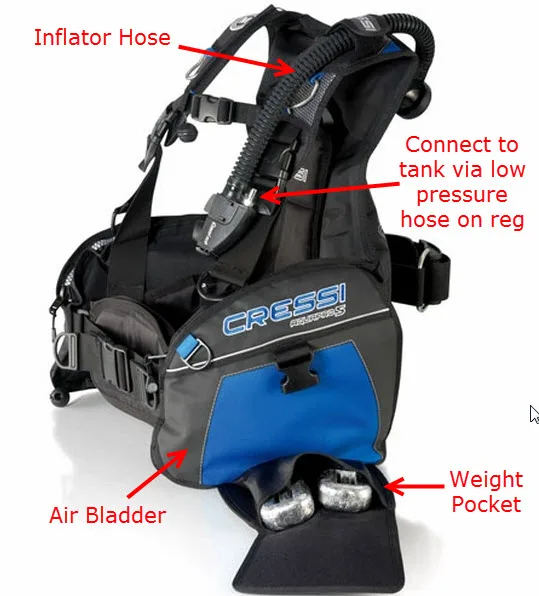
Image source: Web (Bing) / myscubadivinggearguide.com (Web image (fair-use with source credit))
- Oral Inflation: As a backup, every BCD has a mouthpiece connected to the bladder. You can blow into this to add air, which is particularly useful if your tank is empty or if you need a quick buoyancy boost on the surface. It’s a reliable method, though it requires a bit more effort than the powered inflator.
The key is to use these functions subtly. For a descent, you'll vent air until you begin to sink. To maintain a depth, you add small puffs of air until you feel that "weightless" sensation of neutral buoyancy.
For ascent, you release air gradually. Aggressive inflation or deflation can lead to uncontrolled ascents or descents, which are dangerous. For instance, per standard diving safety protocols, divers should ascend at a controlled rate, typically no faster than 30 feet per minute (9 meters per minute), which is facilitated by careful BCD management.
What Makes Up Your BCD?
A scuba diving BCD might look like a jacket, but it’s built with several key components working in harmony. Understanding these parts helps you appreciate how the device functions and how to operate it effectively. It's a piece of equipment designed for both comfort and crucial buoyancy management.
The main structure is the vest itself, often made from durable nylon, which houses the critical inflatable bladder. This bladder is usually made from a material like polyurethane. Attached to this are various straps and buckles for a secure fit.
Key Features: From Bladder to Inflator
Here’s a breakdown of the essential parts you'll find on most BCDs:
- Inflatable Bladder: This is the sealed bag within the BCD that fills with air. Its size determines the maximum lift capacity.
- Harness System: This includes shoulder straps, a cummerbund (waist strap), and often a sternum strap. It’s designed to hold the BCD securely and comfortably on your body, distributing the weight of your tank.
- Low-Pressure Inflator/Deflator: As discussed, this device connects via a hose to your regulator and allows you to add or release air from the bladder using buttons or levers.
- Oral Inflator: A built-in mouthpiece for manual inflation, serving as a vital backup.
- Deflator Valves: Usually located at the top of the BCD, these allow you to rapidly expel air from the bladder, often activated by pulling a cord.
- D-Rings: These are metal or plastic loops typically found on the shoulders and waist, used for clipping on accessories like your dive computer or best scuba diving knife.
- Pockets: Many BCDs feature zippered pockets for stowing small items or keeping things secure.
- Weight Integration System (Optional): Some BCDs have pockets designed to hold removable weight pouches, allowing you to ditch weights easily in an emergency.

Image source: Bing (Web (fair-use with source credit))
The specific design and number of these features can vary significantly between different models, which is why exploring different options, like those found in guides to the 8 best scuba diving BCD 2027, is a good idea when you're ready to purchase.
Why You Absolutely Need a BCD Underwater
It’s easy to think of a BCD as just another piece of gear, but in reality, it's indispensable for almost every aspect of scuba diving. Without it, your ability to control your depth, stay safe at the surface, and even comfortably carry your tank would be severely compromised. It's the unsung hero that transforms a potentially difficult experience into a smooth, enjoyable one.
Beyond basic flotation, the BCD plays a crucial role in diver comfort and efficiency. It allows you to manage your position in the water column with precision, which is not just about ease of movement but also about environmental responsibility and safety.
The Perks of Perfect Buoyancy Control
Mastering your BCD's capabilities offers significant advantages:
- Achieving Neutral Buoyancy: This is the holy grail for divers. It’s the state where you hover motionless in the water, neither rising nor sinking. This allows for effortless gliding, easy photography, and precise observation of marine life without disturbing the environment.
- Safe Surface Floatation: Once your dive is complete, or during surface intervals, the BCD ensures you remain comfortably afloat without expending energy. This is critical, especially with the added weight of tanks and other equipment.
- Streamlined Movement: A BCD helps distribute the weight of your tank evenly, making it feel more balanced and less cumbersome. This improved stability translates into more graceful and efficient finning.
- Environmental Protection: By allowing you to maintain a stable, neutral position, your BCD prevents you from accidentally bumping into or damaging delicate coral reefs or other underwater structures. This is a cornerstone of responsible diving.
- Efficient Air Consumption: When you're not fighting to control your depth, you tend to use air more efficiently. This can translate into longer bottom times.
Having a properly fitting BCD, one that supports your tank comfortably and doesn't restrict your movement, makes a world of difference. When looking at different options, consider how it feels with your tank on; guides for the best scuba diving gear for beginners 2026 often highlight fit as a primary factor.
Different Types of BCDs: Jacket, Back-Inflate, and Wings
When you start looking into BCDs, you'll notice they aren't all the same. The design can significantly impact how the BCD feels, how it distributes weight, and how it controls your buoyancy. While the core function remains the same, the form factor varies to suit different diving styles and preferences.
Generally, BCDs fall into three main categories: jacket-style, back-inflate, and wing-style. Each has its own set of characteristics that make it better suited for certain situations or types of divers. Understanding these differences can help you choose the right one for your needs.
Which Style is Right for Your Dives?
Here’s a quick look at the common types:
- Jacket-Style BCDs: These are the most popular for recreational divers. They resemble a vest that wraps around your torso and inflates around your waist and back. They provide good stability on the surface and are generally very comfortable. Many come with ample pockets for accessories.
- Best for: Beginners, warm water diving, general recreational use.
- Back-Inflate BCDs: In this design, the entire inflation bladder is located on your back. This gives you a more streamlined profile underwater, as your chest and torso are free from the bulk of the bladder. It also tends to encourage a more horizontal diving posture.
- Best for: Divers who want a more streamlined experience, warmer water diving where less torso coverage is preferred.
- Wing-Style BCDs: These are often seen in technical diving but are also used by recreational divers. They consist of a harness and a donut-shaped bladder that wraps around the back of your tank. They offer superior buoyancy control and a highly streamlined profile, but may require more practice to master.
- Best for: Advanced divers, technical divers, sidemount diving, or anyone prioritizing a minimalist, streamlined setup.
When selecting, consider where you'll be diving most often. For instance, if you plan on exploring wrecks or caves, a more streamlined setup might be beneficial, potentially pointing you towards back-inflate or wing styles. However, for general exploration, a comfortable jacket-style BCD is often the go-to, and many find they are perfect for carrying essential gear like a best scuba diving compass.
Mistakes to Avoid
Even with the best intentions, divers can make mistakes with their BCDs that range from minor annoyances to significant safety concerns. Understanding these common errors helps you dive smarter and safer. Many issues stem from not understanding the BCD's core function: precise buoyancy management.
For instance, consistently over-inflating your BCD on ascent can lead to a rapid, uncontrolled rise. This is dangerous because your body needs time to adjust to pressure changes. Similarly, neglecting to vent enough air for a descent means you might struggle to get below the surface, wasting air and energy.
Here are some critical mistakes to avoid:
- Over-Inflating for Ascent: Adding too much air too quickly can cause a bouncy, uncontrolled ascent. This risks lung over-expansion injuries.
- Under-Inflating for Descent: Not releasing enough air makes it hard to sink. This can lead to a feeling of being stuck, wasting precious air and time.
- Rapid Deflation: Dumping all air at once can lead to a sudden, uncomfortable drop in depth. It's better to vent in stages.
- Incorrect Fit: Wearing a BCD that's too loose or too tight compromises comfort and control. A poorly fitting harness can also lead to tank slippage.
- Neglecting the Oral Inflator: Relying solely on the power inflator leaves you without a crucial backup. Always know how to use your oral inflator.
- Ignoring Weight System: Forgetting to add weights or adding too few can make it impossible to descend or maintain depth. Conversely, too many weights create other buoyancy problems.
It’s important to practice BCD control in a pool with an instructor before relying on it in open water. This hands-on experience is invaluable. Many divers also find that using a best scuba diving weight belt in conjunction with their BCD allows for even finer buoyancy adjustments.
Essential BCD Care and Maintenance
Just like any piece of scuba gear, your BCD needs regular care to ensure it performs reliably and lasts for years. Neglecting its maintenance can lead to problems like leaks, corrosion of parts, or malfunctioning inflators, which you definitely don't want happening underwater. A little bit of effort after each dive and some periodic checks can go a long way.
The most critical aspect of BCD maintenance is rinsing it thoroughly with fresh water after every dive, especially if you've been in saltwater. Salt crystals can degrade materials and clog valves over time.
Here’s what’s involved:
- Rinse Thoroughly: After each use, rinse the entire BCD inside and out with fresh, clean water. Pay special attention to the inflator/deflector mechanisms and any zippers or buckles.
- Dry Properly: Hang the BCD to dry in a shaded, well-ventilated area. Avoid direct sunlight, as UV rays can damage the fabric and plastic components over time. Ensure the inside of the bladder is dry before storing to prevent mildew.
- Check for Leaks: Periodically, or if you suspect an issue, inflate the BCD fully and listen for any hissing sounds. You can also submerge it (without weights) in shallow water to look for bubbles escaping from the bladder or seams.
- Inspect Inflator/Deflator: Check that the buttons and levers on your low-pressure inflator work smoothly. Ensure the oral inflator mouthpiece is clean and seals properly.
- Inspect Straps and Buckles: Look for any signs of wear and tear on the harness, straps, and buckles. Ensure they are functioning correctly and securely.
- Service Regularly: Most manufacturers recommend an annual service by a qualified technician, especially for the inflator and deflator valves, to ensure they are functioning optimally. This is also a good time to check for any internal bladder wear or potential issues.
Following these steps will help ensure your BCD, whether it’s a compact travel model or a heavy-duty one, remains a dependable part of your dive kit. For a more complete picture of gear upkeep, looking into guides for best scuba diving gear bag 2027 can offer broader tips on protecting all your equipment.
Frequently Asked Questions About Scuba BCDs
How much air can a BCD hold?
The amount of air a BCD can hold, known as its lift capacity, varies by size and type. Recreational BCDs typically range from 20 lbs to 50 lbs (9 to 23 kg) of lift. This capacity is designed to support the diver and their gear.
Do I need to buy my own BCD, or can I rent one?
You can rent a BCD from most dive shops or charter operators, which is a great option for occasional divers or while you're deciding what you prefer. However, owning your own BCD ensures a consistent fit and feel, which can enhance comfort and performance. For frequent divers, purchasing is often more economical and convenient.
How do I choose the right size BCD?
BCD sizing generally corresponds to standard clothing sizes (S, M, L, XL), but always check the manufacturer's sizing chart. Fit is crucial: it should feel snug and secure without restricting your breathing or movement. You should be able to adjust the straps comfortably.
Can I use my BCD for snorkeling?
While a BCD can help you float on the surface while snorkeling, it's generally not recommended for this purpose. Snorkel vests are designed for surface-only flotation and are much simpler and less bulky. Using a BCD for snorkeling is often overkill and can be cumbersome.
How important is the BCD's material?
BCD materials are chosen for durability, abrasion resistance, and their ability to hold air. Common materials include different deniers of nylon, like Cordura, for the outer shell, offering robust protection against tears and punctures. The internal bladder is typically made of polyurethane.
These materials are chosen to withstand the rigors of diving environments.