If you want to get faster, train the specific qualities that produce speed: technique, acceleration, maximal sprint mechanics, strength, power, and recovery. The most effective speed training is not “just run more.” It is a planned mix of short, high-quality sprints, strength work, and enough rest to keep each rep fast. For athletes in the United States, that means building speed around your sport season, practice schedule, and available equipment.
Speed improves when you reduce braking, improve force application into the ground, and practice moving with better mechanics at high intent. That applies whether you are a high school football player, a college track athlete, a soccer midfielder, or an adult recreational runner trying to improve 40-yard dash time.

Today's Exclusive Deals
Limited-time Exclusive Deals. Check current discount on Amazon.
Check Price on Amazon As an Amazon Associate I earn from qualifying purchases.What Speed Training Actually Means
Speed training is the practice of improving how quickly you accelerate, reach top speed, and maintain efficient movement at high velocity. In practical terms, it usually includes three pieces:
- Acceleration: how fast you can build speed from a start
- Max-velocity sprinting: how fast you can move once you are already running
- Speed endurance: how well you maintain near-top speed over repeated efforts
The key difference between speed training and conditioning is intensity. Speed work demands full or near-full effort with long enough rest to keep quality high. If the workout turns into fatigue-based running, it stops targeting true speed.
For most athletes, the best speed gains come from combining:
- Sprint practice with good mechanics
- Strength training for force production
- Plyometrics or jumps for elastic power
- Recovery that allows the nervous system to adapt

How to Train for Speed: The Core Method
To train for speed effectively, use short sprints, full recovery, and a progressive plan built around your current level. The simplest approach is:
- Warm up thoroughly
- Sprint with full intent
- Rest long enough to preserve speed
- Lift weights or do power work on separate or paired days
- Increase volume gradually
- Stop the session before your mechanics break down
1) Start With a Proper Warm-Up
A good warm-up prepares the joints, muscles, and nervous system for fast running. It should raise body temperature and rehearse sprint positions.
A practical warm-up can include:
- 5 to 10 minutes of easy movement
- Dynamic mobility drills
- Running drills such as A-skips, high knees, and leg swings
- 2 to 4 progressive buildups at 60% to 90% effort
The goal is not to tire yourself out. The goal is to feel springy, coordinated, and ready to sprint.
2) Train Acceleration First
Acceleration training matters because most sports require rapid first-step speed, not just top-end sprinting. Use short distances and powerful starts.
Good acceleration options:
- 10-yard sprints
- 20-yard sprints
- Hill sprints with a moderate grade
- Resisted sprints using light sleds
Focus cues:
- Push hard into the ground
- Keep your torso angled forward
- Drive your arms aggressively
- Stay low and powerful in the first steps
A useful rule: if the load or hill changes your mechanics too much, it is too heavy or steep for speed work.
3) Develop Max Velocity Separately
Top-speed training uses slightly longer sprint distances and upright mechanics. This work is different from acceleration because the body position changes as you rise taller and cycle the legs faster.
Useful max-velocity methods:
- Flying 10s or flying 20s
- Build-up sprints with a fast middle segment
- Wicket runs or spacing drills for rhythm and posture
Main cues:
- Tall posture
- Relaxed face, shoulders, and hands
- Fast ground contacts
- Front-side mechanics, meaning the knee and foot recover efficiently in front of the body
4) Use Strength Training to Support Sprint Speed
Strength training helps speed by improving your ability to apply force quickly. This is especially relevant for athletes who need acceleration, change of direction, and repeated sprint ability.
Best lower-body lifts for speed development often include:
- Squats or front squats
- Trap-bar deadlifts
- Romanian deadlifts
- Split squats
- Hip thrusts
- Calf work and hamstring work
You do not need a complicated program to benefit. You do need consistent progression, good form, and enough recovery.
5) Add Plyometrics Carefully
Plyometrics help train stiffness, reactivity, and ground contact efficiency. These exercises are useful when the athlete already has basic strength and landing control.
Examples:
- Jump rope
- Pogos
- Box jumps
- Bounds
- Hurdle hops
Start with low-volume, low-to-moderate intensity work. If landings get noisy, slow, or unstable, cut the volume.
6) Recover Enough to Keep Speed High
Speed adaptation depends on quality. That means rest matters more than in many conditioning workouts.
For sprint work:
- Take 1 to 3 minutes between short reps
- Take 3 to 8 minutes between higher-quality or longer reps
- Leave the workout when speed clearly drops
For strength work:
- Sleep 7 to 9 hours when possible
- Eat enough protein and total calories
- Avoid stacking too many all-out sessions back-to-back
A Simple Speed Training Plan That Works
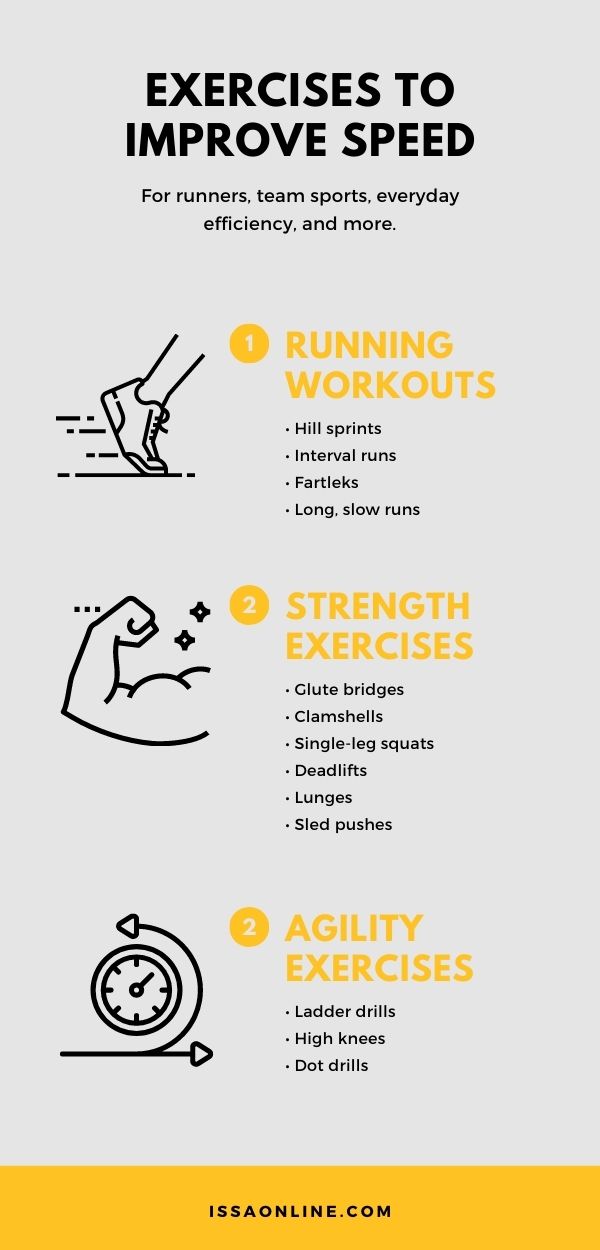
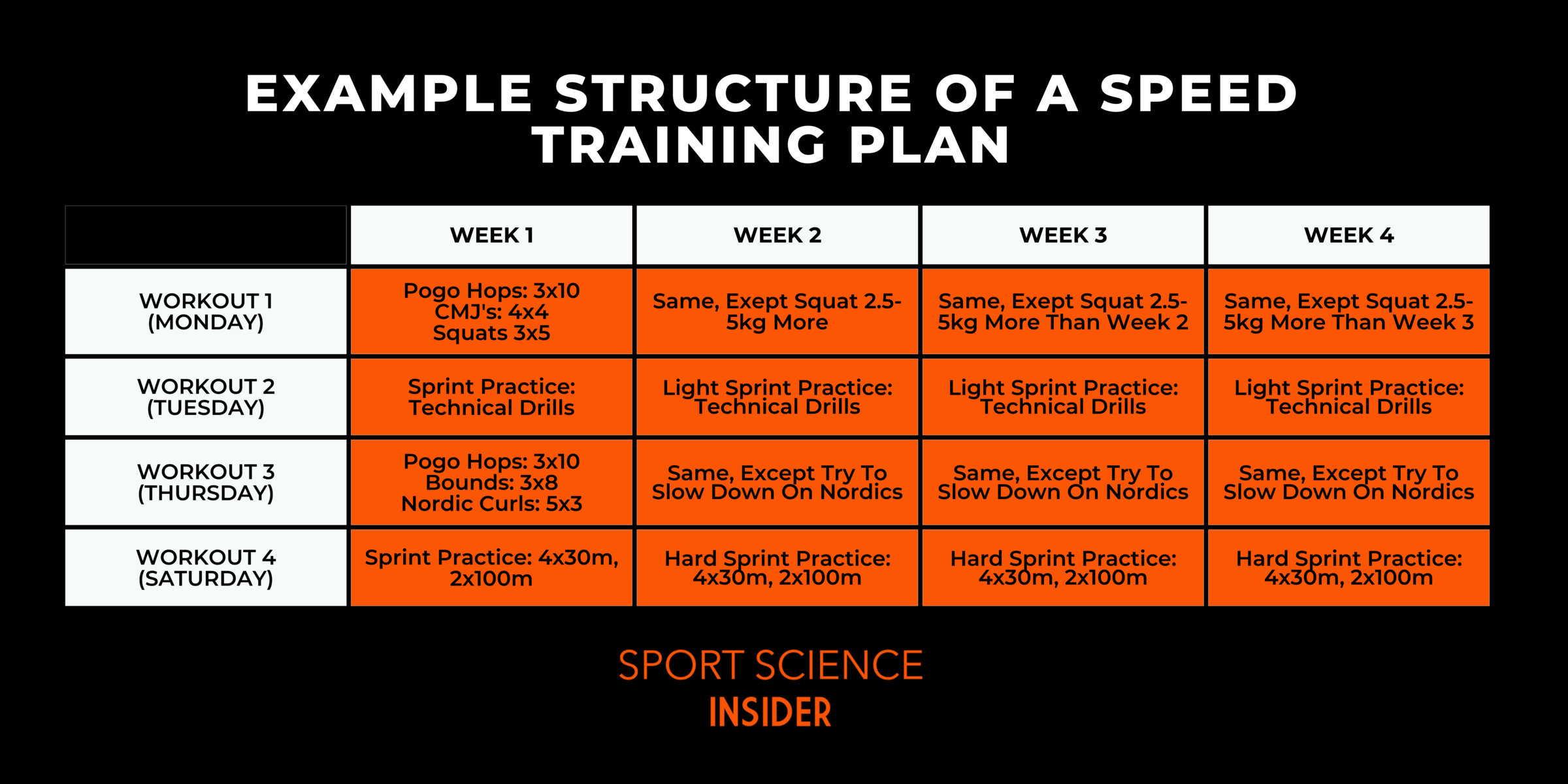
A useful speed plan follows a weekly structure that balances sprinting, lifting, and recovery. For many athletes, 2 to 3 speed-focused sessions per week is enough.
Sample Weekly Structure
| Day | Main Focus | Example Work |
|---|---|---|
| Monday | Acceleration + lower-body strength | 6 x 10 yards, 4 x 20 yards, squat work |
| Tuesday | Recovery or skill practice | Light movement, mobility, easy sport skill work |
| Wednesday | Max velocity + plyometrics | Flying 10s, wickets, low-volume jumps |
| Thursday | Upper-body or total-body strength | Pressing, pulling, core work |
| Friday | Speed endurance or sport-specific sprinting | 4 x 60 yards or repeated game-like bursts |
| Saturday | Light practice or optional tempo | Easy technique work, mobility |
| Sunday | Rest | Full recovery |
This is only a template. A football player in-season, for example, needs less total sprint volume than an off-season track athlete. A soccer player may need more repeat-sprint exposure than a sprinter.
How Much Speed Work Is Enough?
For most non-elite athletes, quality matters more than quantity. A reasonable starting point is:
- Acceleration work: 6 to 12 high-quality short sprints
- Max-velocity work: 4 to 8 fast runs with full rest
- Plyometrics: 20 to 40 total ground contacts for beginners
- Heavy lifting: 2 to 5 main sets per lift
If you are still learning sprint mechanics, begin at the lower end and progress slowly.
Variables That Change the Best Speed Program
The best speed program depends on the athlete, the sport, and the season. These factors matter most:
Training Age
A beginner usually improves fastest from basic sprint practice, coordination drills, and simple strength work. Advanced athletes need more precise programming and often more recovery.
Sport Demands
- Track sprinters need top speed and speed endurance
- Football players need acceleration and repeat power
- Soccer and basketball players need frequent short bursts and deceleration control
- Baseball and field sport athletes often need first-step speed and change-of-direction ability
Season Timing
- Off-season: more volume, more strength development
- Preseason: more speed specificity, less general volume
- In-season: maintain speed with reduced volume and high quality
Injury History
If you have a history of hamstring strains, groin pain, Achilles problems, or low-back issues, your progression should be more conservative. Pain that worsens with sprinting needs evaluation.
Common Mistakes That Slow Speed Progress
The biggest speed-training mistakes are predictable and fixable.
1) Turning speed work into conditioning
If each rep is so tiring that mechanics collapse, you are training fatigue tolerance more than speed.
2) Skipping the warm-up
Cold muscles and unprepared joints raise the chance of poor mechanics and unnecessary strain.
3) Using too much resistance
Heavy sleds, steep hills, or overloaded sprint drills can change movement too much and reduce speed transfer.
4) Doing too many hard sessions
Speed adapts through recovery. More is not always better.
5) Ignoring strength
Poor force production limits acceleration, especially in athletes who are not yet strong relative to body size.
6) Chasing drills instead of outcomes
Drills help only if they improve sprint mechanics. The real test is faster, cleaner sprinting.
Signs Your Speed Training Is Working
You should look for practical signs of improvement, not just how hard a workout feels.
Good signs include:
- Faster first steps
- Better posture during sprinting
- Less visible tension in the shoulders and face
- More explosive starts
- Improved sprint times or faster game bursts
- Better repeatability across sessions
If you track timing, compare like with like:
- Same surface
- Same footwear
- Same distance
- Similar rest
- Similar weather when possible
Small timing gains matter. Even a modest improvement can make a noticeable difference in sport.
What to Do If Speed Training Is Not Working
If you are not getting faster, check the most common causes first.
If you are always tired
Reduce total sprint volume, increase rest, and look at sleep, calories, and weekly practice load.
If your form falls apart
Shorten the sprint distance, lower the number of reps, and return to technical work.
If you are strong but not fast
You may need more sprint specificity. Strength helps, but speed still has to be practiced at high velocity.
If you are fast in training but not in games
The issue may be transfer. Add reactive drills, sport-specific movement, and decision-making under light pressure.
If you have pain
Do not push through sharp pain or recurring hamstring, groin, Achilles, or back pain. Get evaluated by a qualified sports medicine professional or physical therapist.
A Practical Beginner Speed Session
Here is a simple session for someone new to sprint training:
- Warm up for 10 to 15 minutes
- Do 2 to 3 sprint drills
- Perform 4 x 10-yard starts
- Perform 4 x 20-yard sprints
- Rest 2 to 3 minutes between reps
- Finish with 3 sets of 3 jumps or pogo hops
- Cool down with light movement
This is enough to build a foundation without overloading a beginner.
A Practical Advanced Speed Session
For a more experienced athlete:
- Warm up thoroughly
- Do technical buildups
- Perform 4 x 20-yard accelerations
- Perform 4 flying 10s with full rest
- Add 3 to 5 sets of explosive lifts
- Finish with low-volume plyometrics
Advanced athletes usually need stricter control over total volume and better timing of sprint days relative to lifting days.
Safety Boundaries You Should Not Ignore
Speed training is high intensity. That means safety matters.
Be cautious or seek professional guidance if you:
- Have a recent hamstring strain
- Have recurring groin or Achilles pain
- Feel sharp pain during acceleration
- Notice one-sided weakness or instability
- Are returning from a lower-body injury
- Have not trained consistently for months
For youth athletes, supervision and age-appropriate loading are important. The goal is quality movement, not maximal fatigue.
FAQs
How many times per week should I train for speed?
Most athletes do well with 2 to 3 speed-focused sessions per week, depending on sport demands and recovery.
Is sprinting better than treadmill running for speed?
Yes, for speed itself. Actual sprinting teaches the mechanics, force, and timing that treadmill running does not fully reproduce.
Should I lift weights before or after sprinting?
If speed is the priority, sprint first on that day so you are fresh. Lift afterward or on another day.
Do sled sprints build speed?
Light sled sprints can help acceleration if the load does not distort mechanics. Heavy sleds are less useful for pure speed.
Can older adults train for speed?
Yes, many can, but progress should be conservative and medically appropriate if there are joint, balance, or cardiovascular concerns.
Final Takeaway
To train for speed, sprint with full quality, rest enough to keep rep speed high, and support the work with strength, power, and recovery. The best program for most U.S. athletes is simple: accelerate, sprint upright, lift for force, and avoid turning speed sessions into conditioning. If you want faster results, improve the basics first and keep every fast rep truly fast.