
Tennis is a sport known for its strict rules and high level of sportsmanship. While the game looks simple—hit the ball over the net and keep it inside the lines—many official rules shape every match. For new and even experienced players, understanding these rules is essential.
Breaking them, even by accident, can lead to lost points, penalties, or even disqualification. The world’s top tournaments—like Wimbledon, the US Open, and the Olympics—enforce these rules carefully. Whether you’re playing casually or dreaming of going pro, knowing what counts as a rule violation in tennis will help you play fair, avoid penalties, and appreciate the game’s traditions.

Today's Exclusive Deals
Limited-time Exclusive Deals. Check current discount on Amazon.
Check Price on Amazon As an Amazon Associate I earn from qualifying purchases.Let’s explore the most common rules violations in tennis, from simple mistakes to serious infractions, and learn how to avoid them on the court.
Foot Faults
One of the most frequent and misunderstood violations in tennis is the foot fault. This happens during the serve when a player’s foot touches the baseline or the court inside the baseline before hitting the ball. It might sound minor, but it can change the outcome of a point, especially in tight matches.
Foot faults are easy to commit, especially under pressure, because players naturally step forward to put more power into their serve. The rules are clear: the server’s feet must not touch the baseline, the court inside the baseline, or the imaginary extension of the center mark until the ball is struck. Even a small toe over the line counts as a fault. In professional tennis, line umpires or electronic systems like Hawk-Eye monitor these closely.
For club and recreational players, foot faults often go unnoticed due to the lack of officials. However, players who develop the habit early can avoid trouble later. Practicing a consistent serving stance and paying attention to where your feet land can help prevent this violation.
Double Faults
A double fault is another common violation that can be frustrating for players at all levels. When serving, you have two chances to get the ball into the correct service box. If you miss both attempts—either by hitting the net, sending the ball out, or committing any serving violation—you lose the point.
The pressure of serving can lead to rushed or nervous attempts. Statistically, double faults often happen in high-pressure situations, like break points or tiebreaks. For example, in the 2022 US Open, the average double fault rate among professional women was about 4.
2% per service game.
To avoid double faults, focus on a smooth, relaxed service motion. Many beginners try to serve too hard, sacrificing control for speed. Remember, consistency is more important than power, especially under pressure.
Ball Touching The Player Or Equipment
In tennis, the ball must not touch the player’s body (other than the racket) or anything the player wears or carries. If the ball touches your hand, head, or even your clothing, you lose the point. This rule also applies if your racket slips out of your hand and hits the ball after you’ve let go.
It’s also a violation if you intentionally hit the ball with anything other than the racket. While accidental contacts can happen, especially during fast net exchanges, players must be careful not to let the ball touch anything except the strings of their racket.
Racket Abuse
Racket abuse is one of the most visible violations in tennis, often seen when frustration boils over. Players who smash or throw their racket in anger risk penalties, warnings, or even fines in professional tournaments.
The rules prohibit players from intentionally damaging their racket, the court, or any other equipment. Even if you don’t break your racket but throw it against the ground or fence, it still counts as a violation. In professional tennis, repeated racket abuse can lead to point or game penalties.
For example, in the 2019 Miami Open, Nick Kyrgios was penalized for smashing his racket after losing a point.
Self-control is key. If you feel frustration building, take a deep breath, and remember that damaging your equipment won’t help your game—and can cost you points or money.
Time Violations
Tennis matches have a strict pace of play. Players are allowed 25 seconds between points at ATP and WTA events. Taking longer than this is a time violation. The umpire may give a warning for a first offense, then award a point penalty for repeat violations.
Time violations also apply to the warm-up period before the match (usually five minutes), and the changeovers (90 seconds between games, 120 seconds between sets). If you’re not ready to serve or receive when time is up, you risk being penalized.
Some players use time as a tactic to break an opponent’s rhythm, but this is against the spirit of the game. Keep an eye on the clock and be ready to play promptly to avoid unnecessary penalties.
Code Violations (unsportsmanlike Conduct)
Code violations cover a range of bad behaviors, including swearing, arguing with officials, making obscene gestures, or showing disrespect to opponents. The rules expect players to act professionally and respectfully at all times.
Umpires give code violations as warnings first. If the behavior continues, they can escalate to point penalties, game penalties, or even disqualification. High-profile players like Serena Williams and Novak Djokovic have received code violations for on-court outbursts.
Even in casual play, respect for your opponent, the umpire, and the game itself should always come first. Tennis is known for its tradition of sportsmanship; violating this not only brings penalties but also damages your reputation.
Hindrance (distracting Opponent)
Hindrance violations happen when a player intentionally distracts or interferes with their opponent during a point. This can include shouting, making loud noises, waving arms, or even deliberate coughing. Sometimes, even a loud grunt or scream during a shot can be called a hindrance if the umpire thinks it was done on purpose.
Players are allowed to encourage themselves quietly, but any action that distracts the opponent is not allowed. If a hindrance is called, the point is usually awarded to the opponent. In some cases, an accidental hindrance (like a ball falling out of your pocket) may result in a replay of the point, but intentional distractions are penalized more harshly.
Ball Bounces Twice
The ball is only allowed to bounce once on your side before you must return it. If it bounces twice, you lose the point, even if you manage to hit it back over the net. This rule is straightforward but can be missed in fast rallies or when chasing drop shots.
In professional tennis, umpires or line judges watch closely, but in recreational matches, players are expected to call this on themselves. Always be honest—calling a double bounce against yourself is a mark of good sportsmanship.
Touching The Net
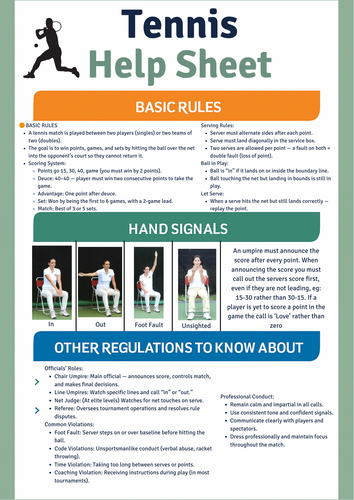
Touching the net, posts, or the opponent’s side of the court with your body, clothing, or racket during a point is a violation. This applies even if the contact is accidental or happens after the ball is struck.
For example, if you hit a volley and your momentum carries you into the net before the point is over, you lose the point. The rule prevents players from gaining an advantage or interfering with the net. In doubles, this rule also applies to your partner.
Staying balanced and aware of your position on the court can help avoid this common mistake, especially when rushing to the net for a volley.
Crossing The Net
Players must not cross the net to hit the ball, even if their body or racket goes over the imaginary plane of the net. The only exception is when the follow-through of a swing naturally carries the racket over (but not before contact with the ball).
If you reach over the net to strike the ball before it crosses into your side, it’s a violation and you lose the point. This often happens when players try to intercept a slow-moving ball close to the net. Always wait until the ball passes over the net before hitting it.
Ball Touching Permanent Fixtures
If the ball touches any permanent fixture before landing in the court, the point is lost. Permanent fixtures include the umpire’s chair, net posts (not including the actual net or posts within the singles sticks), or anything outside the playing area.
For example, if your shot hits a roof beam or an overhead light and then lands in, it’s out. These situations are rare in outdoor matches but can happen in indoor tennis. Always be aware of your surroundings, especially when playing in unfamiliar venues.
Incorrect Service Order
In doubles, and sometimes in singles, serving order is important. If players serve out of turn, it’s a rules violation. The correct order must be followed throughout the set, and mistakes must be fixed as soon as they are noticed.
If the error is found during the game, the correct server takes over, but any points played stand. In high-level matches, the umpire keeps track of the order, but in recreational play, it’s up to the players. Always communicate with your partner to avoid confusion.
Receiving Out Of Turn (doubles)
Like serving, the receiving order in doubles is fixed at the start of each set. If partners receive out of turn, it is a violation. The game continues with the correct order as soon as the mistake is discovered.
This rule ensures fairness and prevents teams from gaining an advantage by switching receivers based on the server. Double-check your position before each game.
Illegal Coaching
In most tournaments, coaching during play is not allowed. Coaches, friends, or family members cannot give advice or signals to players during a match. If a player receives coaching, even through subtle gestures, it is a violation and can lead to penalties.
Some tournaments, like the US Open, now allow limited coaching from the stands, but most events still ban it. Be sure to check the rules of your tournament. In professional tennis, violations have led to high-profile disputes and penalties, such as the famous Serena Williams incident at the 2018 US Open.

Delay Of Game
Apart from time violations, other actions can delay the game, such as taking too long to change sides, frequently requesting medical timeouts without a real injury, or arguing repeatedly with officials.
These actions disrupt the flow of the match and are considered unsportsmanlike. Umpires can issue warnings or penalties for delay of game. Keeping the match moving shows respect for your opponent and the sport.
Illegal Equipment
Players must use approved equipment—this includes rackets, balls, shoes, and clothing. Using a non-regulation racket or ball can lead to disqualification. For example, rackets must not exceed specific length and width limits, and balls must meet certain size and bounce standards.
Some players try to modify their equipment for an advantage, like using a racket with altered strings. Tournament officials check equipment regularly at professional events. In club play, follow the rules to avoid disputes.
Playing Before The Ball Is In Play
The server must wait until the receiver is ready before serving. Serving before the receiver is prepared is a violation and the point is replayed. This rule prevents surprise serves and ensures both players have a fair chance.
This often happens when players are in a hurry or not paying attention. Always make eye contact or confirm with your opponent before serving, especially in informal matches.
Failing To Announce The Score
In tennis, the server should announce the score before each point. While not announcing the score does not always result in a penalty, failing to do so can lead to confusion and disputes.
In tournaments, the umpire calls the score, but in recreational play, this is the server’s job. Keeping the score clear helps avoid arguments and mistakes.
Ball Abuse
Ball abuse refers to hitting or throwing the ball in anger, especially after losing a point. Players who smash balls against the fence or out of the court can be penalized. This is similar to racket abuse and is taken seriously in professional matches.
Besides being dangerous, ball abuse disrupts the game and can damage property or injure spectators. Always handle the ball calmly, even when frustrated.
Not Returning Balls Promptly
After a point, players should return balls to their opponent or the server quickly and safely. Deliberately holding on to balls, or tossing them away to delay the game, is a violation.
Proper etiquette is to roll or toss balls directly to the server’s side between points. In professional matches, ball kids handle this, but in club play, it’s up to the players.
Failing To Respect Let Calls
A let is called when a serve touches the net but lands in the correct service box, or when play is interrupted by an outside factor (like a ball rolling onto the court from another match). If a player continues playing after a let is called, it’s a violation.
Let calls are meant to stop play and replay the point. Ignoring them or refusing to replay the point is against the rules and can cause confusion or disputes.
Touching Opponent Or Opponent’s Side
Players must not touch their opponent or step onto their opponent’s side of the court during a point. Doing so is a violation, even if accidental.
This rule prevents interference and ensures each player stays in their own area. It’s especially important in doubles when players may chase balls near the center line.
Playing Outside The Correct Court
Players must stay within the boundaries of their court. Hitting the ball while standing outside the court (beyond the doubles sidelines in singles, or over the fences) is not allowed.
While rare, this can happen when chasing wide shots. If your feet are completely outside the legal court area when you hit the ball, the point is lost.
Using Obscene Language Or Gestures
Tennis is strict about language and gestures on court. Swearing, making obscene gestures, or using abusive language toward officials, opponents, or spectators is a serious violation.
Umpires may issue immediate code violations for this behavior, leading to warnings, point penalties, or even expulsion from the match. In junior and amateur tennis, this rule helps set standards for sportsmanship.
Faking Injury
Pretending to be injured to gain a break or disrupt your opponent’s rhythm is considered unsportsmanlike and is a violation. Medical timeouts are only for real injuries, and abusing this rule can lead to penalties or disqualification.
Tennis authorities have become more vigilant about fake injuries, especially after several high-profile cases in recent years. Honesty is crucial—faking injuries not only risks penalties but also damages your reputation.
Comparison Of Selected Tennis Violations
To better understand how these violations impact a match, here’s a look at some key differences:
| Violation | Penalty | Frequency (Pro Level) | Possible Escalation |
|---|---|---|---|
| Foot Fault | Loss of Serve (Fault) | Occasional | None |
| Racket Abuse | Warning, Point/Game Penalty | Rare | Disqualification |
| Time Violation | Warning, Point Penalty | Common | Game Penalty |
| Hindrance | Loss of Point | Rare | None |
Examples From Professional Tennis
Some of the most famous moments in tennis history involve rule violations. In 2020, Novak Djokovic was defaulted from the US Open after accidentally hitting a line judge with a ball, which is considered ball abuse. Serena Williams received code violations for arguing with umpires at the 2018 US Open.
These examples show that even top professionals can fall foul of the rules—and the consequences are severe.
Tips To Avoid Common Violations
Avoiding rule violations starts with knowledge and good habits:
- Practice your serve to avoid foot faults and double faults.
- Stay calm under pressure to prevent racket or ball abuse.
- Communicate with your partner in doubles to avoid service and receiving order errors.
- Respect time limits and always be ready to play.
- Listen to officials and respect their decisions.
- Stay focused—many violations happen when players lose concentration.
Learning the rules may take time, but it pays off with fair matches, fewer disputes, and more enjoyment on the court.
Data: Offense Frequency In Amateur Vs. Professional Tennis
Understanding how often these violations occur can help players know what to watch for. Here’s a comparison:
| Violation | Amateur Frequency | Professional Frequency |
|---|---|---|
| Foot Fault | Common | Less Common |
| Double Fault | Common | Common |
| Code Violation | Rare | Occasional |
| Hindrance | Rare | Rare |
| Illegal Coaching | Very Rare | Occasional |
Non-obvious Insights For Beginners
Many new players focus only on hitting the ball, but two areas often go unnoticed:
- Ball Return Etiquette: Returning balls smoothly and quickly can keep the match flowing and avoid time violations.
- Order of Play in Doubles: Mixing up the serve or receive order is more common than you think, especially after long rallies or during tense moments. Always double-check with your partner.
Another point most beginners miss is how momentum and frustration can lead to repeated violations. Taking a short pause and breathing deeply can help you reset and maintain self-control, reducing the risk of code violations and equipment abuse.
Why Rules Matter In Tennis
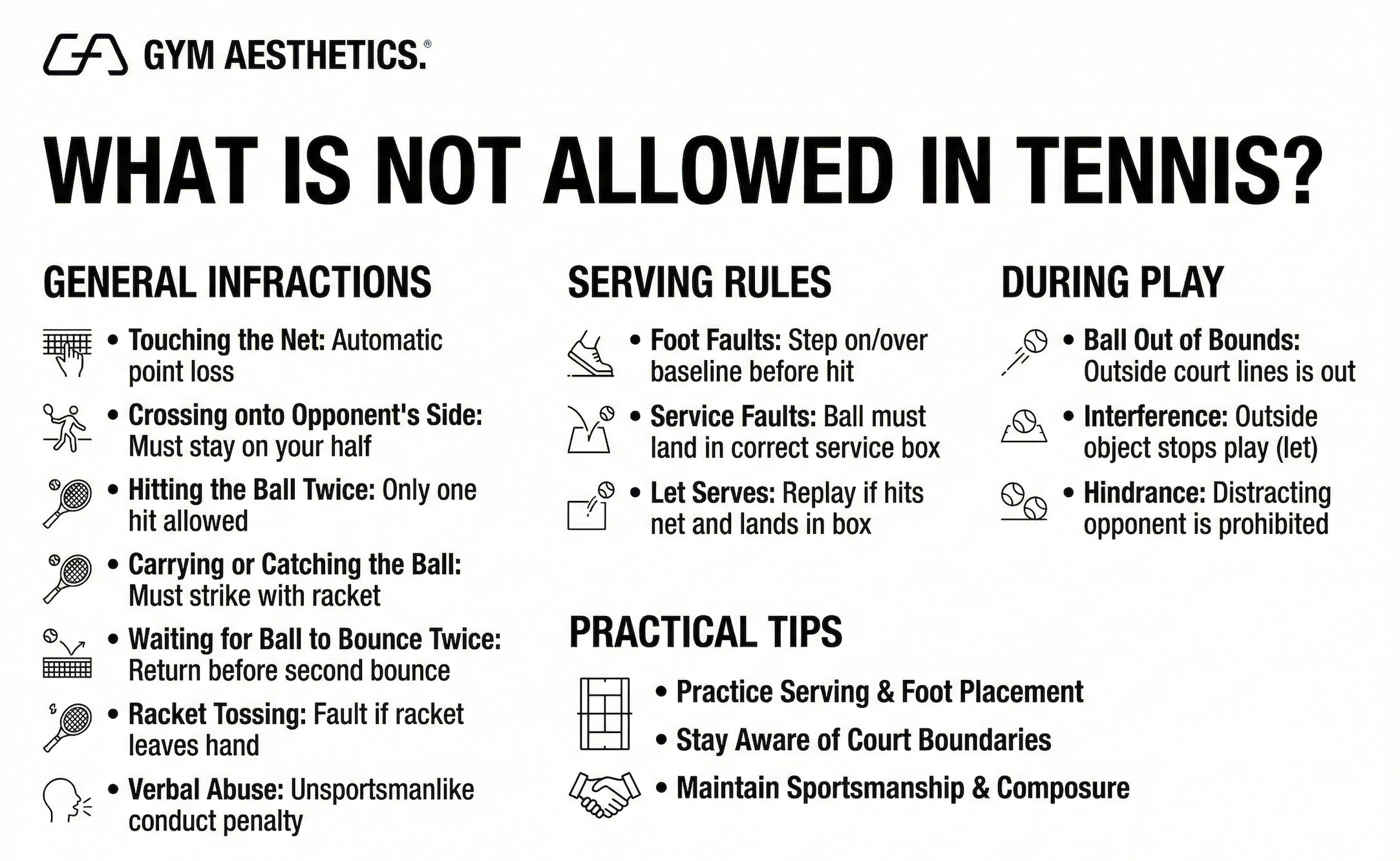
The strict rules in tennis are not just about penalties—they protect fairness, safety, and sportsmanship. Following them builds trust between players and ensures the best player wins, not just the most aggressive or the one who bends the rules. Whether you’re aiming for the pros or just want to enjoy a weekend game, mastering these rules will help you play with confidence and integrity.
For those who want to study the official rules in detail, the International Tennis Federation (ITF) maintains the up-to-date rulebook. You can read the full rules on the ITF website.
Frequently Asked Questions
What Is The Most Common Rules Violation In Tennis?
The most common violation is the foot fault during serving, especially among beginners. Double faults and time violations also happen frequently at all levels of play.
Can You Lose A Match For Too Many Code Violations?
Yes, repeated code violations can lead to game penalties or even disqualification, especially in professional tournaments. Umpires follow a clear escalation: warning, point penalty, game penalty, then default.
Are You Allowed To Talk To Your Coach During A Match?
In most tournaments, coaching during play is not allowed, and receiving advice can result in penalties. Some events are now experimenting with limited coaching, but always check the specific rules.
What Happens If The Ball Hits The Net Post And Lands In?
If the ball hits the net post and lands in the correct court, the point continues as normal (if the post is within the singles sticks). If it hits a post outside the singles sticks or any permanent fixture, the point is lost.
Do The Rules Change For Wheelchair Tennis?
Wheelchair tennis follows most of the same rules, but allows two bounces of the ball before return. The second bounce can be outside the court. For all other violations, the rules are the same.
Mastering the rules of tennis helps you play better, avoid penalties, and enjoy the game to its fullest. Whether you are a beginner or an experienced player, knowing what counts as a violation gives you an edge—and shows respect for this great sport.