
Every sport has its own unique field, but few are as distinctive and varied as the cricket field. If you’ve ever wondered why cricket grounds look different from stadium to stadium, or why some matches have huge boundaries while others seem smaller, you’re not alone. The size of a cricket field isn’t fixed, and understanding its dimensions can help you enjoy the game more, whether you’re a casual viewer, a beginner player, or just curious about the sport. Let’s explore what makes a cricket field’s size special, how it’s measured, and why it matters for the game.
Basic Shape And Structure Of A Cricket Field
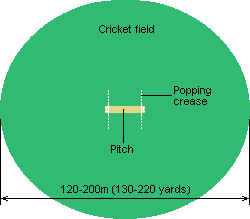
A cricket field is almost always oval or sometimes circular, but you won’t find perfect shapes. The field isn’t just grass; it includes the pitch, the outfield, and the boundary. The pitch is the small, flat rectangular area in the center where most of the action takes place, but the field stretches far beyond.
What’s important to know is that the rules of cricket, set by the Marylebone Cricket Club (MCC) and the International Cricket Council (ICC), allow for a range of field sizes. This flexibility is quite different from sports like football or basketball, where field sizes are more standardized.
Official Dimensions: What The Rules Say
The Laws of Cricket give clear minimum and maximum sizes, but also leave room for local variations. Here’s what the ICC says about the size of a cricket field:
- The minimum boundary from the center of the pitch to the boundary should be 59.43 meters (65 yards)
- The maximum boundary should be 82.29 meters (90 yards)
So, a field’s diameter (distance across) is typically between 137 meters (150 yards) and 150 meters (164 yards).
But these numbers only tell part of the story. Not all stadiums can fit a perfect oval, so there are often small adjustments. The ICC also allows for exceptions in older stadiums, especially in countries with long cricket history.
Let’s compare the minimum and maximum boundaries visually:
| Type | Minimum (meters) | Maximum (meters) | Minimum (yards) | Maximum (yards) |
|---|---|---|---|---|
| Boundary from pitch | 59.43 | 82.29 | 65 | 90 |
| Total field diameter | 137 | 150 | 150 | 164 |
Key Parts Of The Cricket Field
To understand the field size, you need to know its main sections:
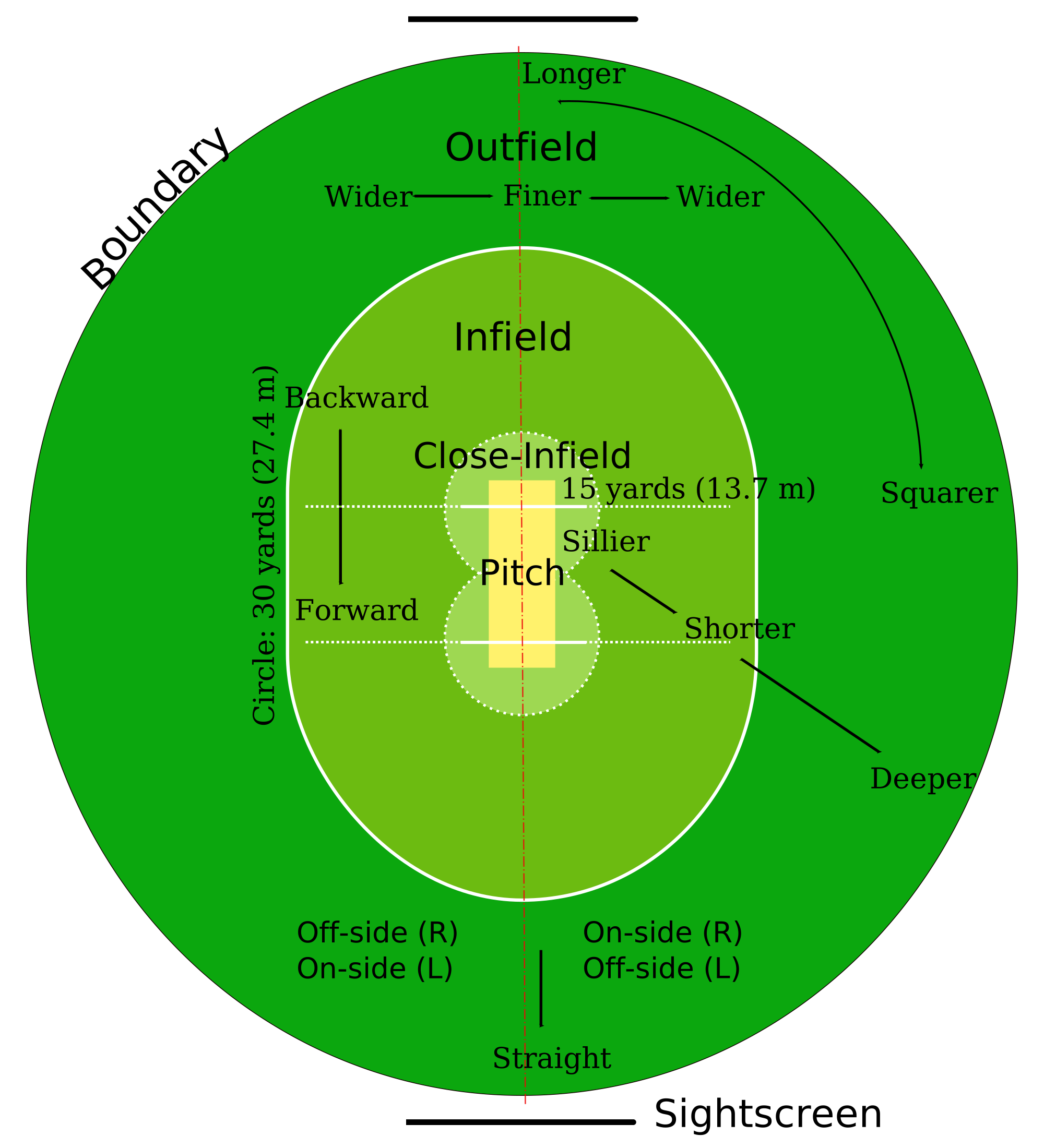
- Pitch: The center strip, 22 yards (20.12 meters) long and 10 feet (3.05 meters) wide.
- Infield: The area close to the pitch, usually within a 30-yard circle.
- Outfield: The area between the infield and the boundary.
- Boundary: The rope or line marking the edge of the field.
The pitch size is always standard. The boundary and outfield are the parts that change between grounds.
Why Aren’t All Cricket Fields The Same Size?
There are several reasons why cricket fields are not all identical:
- Historical stadiums: Many famous grounds, like Lord’s in London, were built before modern rules existed, so their fields are unique.
- Geography and available space: Some cities have limited space, so the field fits the land.
- Tradition: Cricket values history, and changing a field’s shape is a big deal.
This variety adds excitement and challenge to the game. For example, a batter who likes big shots may find it hard to clear a 90-yard boundary, but could score easily on a smaller field.
Comparing Cricket Field Sizes: International Examples
Cricket fields can look very different depending on where you are. Here are some examples from around the world:
| Stadium | Country | Shortest Boundary (m) | Longest Boundary (m) | Comments |
|---|---|---|---|---|
| Melbourne Cricket Ground (MCG) | Australia | 65 | 86 | One of the largest fields in the world |
| Lord’s | England | 65 | 82 | Famous for its slope and unique shape |
| Eden Gardens | India | 66 | 76 | Historic stadium with passionate fans |
| Newlands | South Africa | 64 | 76 | Picturesque with mountains as backdrop |
| Dubai International Stadium | UAE | 64 | 78 | Modern stadium, used for many T20 matches |
As you can see, there’s no single “standard” size, but all these fields fall within the ICC’s allowed range.
The 30-yard Circle: Its Role And Importance
Many new fans are confused by the white painted circle you see on the field. This 30-yard circle has a key role in limited overs cricket (like ODIs and T20s).
- It marks the infield.
- Fielding rules, called “powerplays,” depend on how many players stand inside or outside this circle.
- The circle is always 27.43 meters (30 yards) from the center of the pitch, forming a true circle.
This part of the field is important for strategy. For example, in the first overs of a T20 match, only two fielders are allowed outside this circle, making it easier for batters to score boundaries.
Comparing Cricket Fields To Other Sports
Cricket fields are much bigger than most sports fields. For example, a football (soccer) field is about 100 meters long and 64 meters wide.
Here’s a quick comparison:
| Sport | Field Length (m) | Field Width (m) | Shape |
|---|---|---|---|
| Cricket | 137–150 (diameter) | Oval/circular | Oval/circular |
| Football (Soccer) | 100–110 | 64–75 | Rectangle |
| Baseball | ~122 (outfield) | Varies | Diamond |
| Rugby | 100 | 70 | Rectangle |
Cricket fields are not only larger, but also more flexible in shape. This is why adapting to different grounds is a big skill for professional cricketers.
Boundary Types: Straight, Square, And More
Not all boundaries are equal. The straight boundary (from the pitch down the ground) is often longer, while square boundaries (sideways from the pitch) can be shorter or vice versa, depending on the stadium.
- Straight boundary: Runs parallel to the pitch, often the longest.
- Square boundary: Runs perpendicular, usually shorter.
- Third man and fine leg boundary: Behind the batter, can be much shorter in some stadiums.
This variation changes batting strategies. For example, some batters look for shorter square boundaries to play “pull” and “cut” shots, while others favor the straight hit when that boundary is shorter.
The Impact Of Field Size On The Game
Field size affects almost every part of cricket:
- Scoring rates: Smaller fields mean more fours and sixes.
- Bowling strategies: Bowlers may bowl differently on larger grounds to force batters to hit to longer boundaries.
- Team selection: Teams may pick more power hitters for small grounds or more spin bowlers for bigger ones.
- Spectator experience: Some fans love high-scoring games, others prefer the challenge of big fields.
A non-obvious insight here is how field size can influence the outcome of a tournament. For example, in the Indian Premier League (IPL), some teams have a big home advantage because their ground has a unique size or shape.
Field Size In Different Formats: Test, Odi, T20
You might think all international matches use the same field size, but this isn’t always true. The requirements can change a little depending on the format:
- Test matches: Usually played on the largest possible fields, as there are no powerplay rules.
- ODIs and T20s: The ICC requires at least a 59.43-meter boundary, but organizers try to keep boundaries as close as possible to the maximum allowed, except in older stadiums.
Shorter boundaries are common in T20 leagues to entertain fans with more sixes, but this is sometimes criticized for making it too easy for batters.
Field Size For Women’s And Junior Cricket
Women’s and junior cricket often use smaller boundaries to match their physical abilities and skill levels. For example:
- Women’s international cricket: Boundaries are usually between 60 and 70 meters.
- Under-19 cricket: Boundaries may be reduced further, sometimes to 50–60 meters.
This makes the game fairer and more exciting, allowing players to show their best skills.
Setting Up A Field: Practical Steps
Setting up a cricket field isn’t just about measuring a circle. Groundskeepers follow these steps:
- Mark the pitch in the center.
- Measure the minimum boundary in all directions, making sure nothing is less than 59.43 meters.
- Draw the 30-yard circle from the center of the pitch.
- Place the boundary rope at the correct distance, adjusting for obstacles (like stands or walls).
- Check for safety—the area beyond the boundary should be clear and safe.
One mistake beginners make is thinking the boundary is always the same distance all around; in reality, it often varies to fit the stadium.
Field Size Records: The Largest And Smallest
- Melbourne Cricket Ground (Australia): Often called the largest field used for international cricket, with boundaries up to 86 meters.
- Eden Park (New Zealand): Famous for some of the shortest straight boundaries, around 55–60 meters, making high scores common.
These extremes show how much the size of a cricket field can shape a match.
How Technology Helps Measure Fields
Today, stadiums use laser equipment and GPS to make sure boundaries are accurate. This technology helps umpires, groundskeepers, and TV broadcasters get exact measurements, which is important for fairness and safety.

Adapting To Different Cricket Fields
One of the most underrated skills in professional cricket is adapting to different field sizes and shapes. Visiting teams often arrive early to practice hitting to different boundaries and to adjust their field placements and strategies.
Amateur cricketers often overlook this. If you play at a new ground, always walk around and check the boundaries before your match. This can help you avoid surprises and make better decisions during the game.
Frequently Asked Questions
What Is The Standard Size Of A Cricket Field?
There is no single standard size. International cricket fields must have boundaries at least 59.43 meters from the pitch and no more than 82.29 meters. Most fields have a diameter between 137 and 150 meters.
Why Do Some Cricket Grounds Have Short Boundaries?
Short boundaries are often the result of limited space, historical design, or the need to fit a stadium in a city. Some leagues, like the IPL, also use shorter boundaries to encourage more high-scoring games.
Can The Boundary Be Different Distances In The Same Stadium?
Yes, many stadiums have boundaries that are different lengths on different sides. This is especially common in older grounds or those built on unusual land shapes.
How Does Field Size Affect Batting And Bowling?
Smaller fields make it easier for batters to hit fours and sixes. On larger fields, bowlers can use the extra space to their advantage, forcing batters to take risks.
Where Can I Find Official Rules About Cricket Field Size?
The official rules are published by the Marylebone Cricket Club (MCC) and the International Cricket Council (ICC). You can read the full details at the Cricket Field Wikipedia page.
The size of a cricket field is more than just numbers—it shapes the way the game is played and enjoyed. Whether you’re a fan, player, or just curious, knowing these details can deepen your appreciation for cricket’s rich variety and tradition.
