
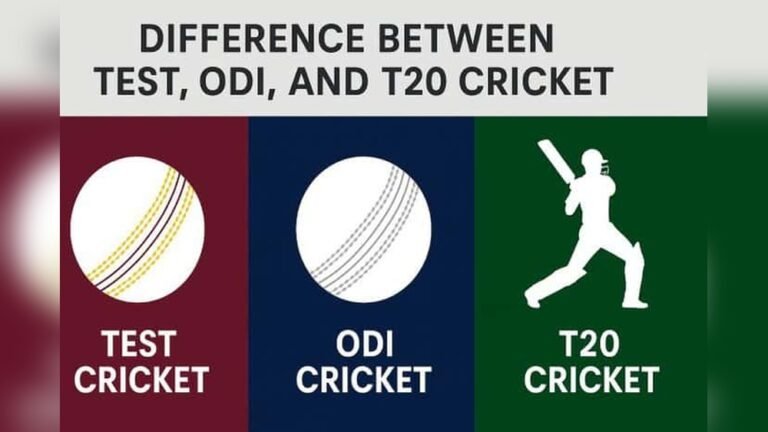
Cricket is a sport with many formats, but three stand out: Test, One Day International (ODI), and Twenty20 (T20). While all are cricket at their core, these versions have unique rules, strategies, and experiences for players and fans. If you are new to cricket, you may wonder: what is the difference between Test, ODI, and T20 cricket? Understanding these differences will help you enjoy the game more, follow matches closely, and even join conversations with experienced fans.
This article explains all the key differences between Test, ODI, and T20 cricket. You will learn about their history, match duration, team structure, tactics, and much more. We will also cover less obvious details that many beginners miss, such as how weather affects each format, the role of fitness, and even how players earn money in each version. By the end, you will see cricket in a whole new way.
1. Match Duration
The length of the match is one of the biggest differences between Test, ODI, and T20 cricket. Test cricket is the oldest format and takes the longest time.
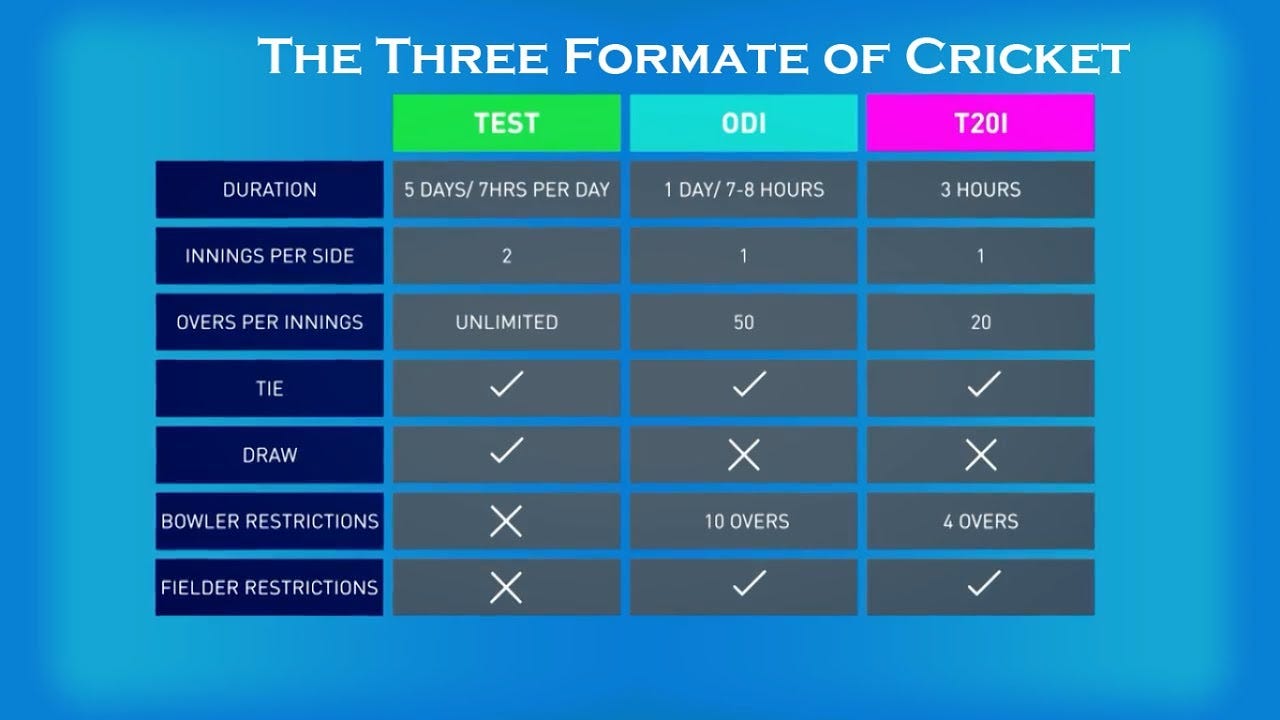
- Test matches last up to 5 days, with each day having 6 hours of play (usually 90 overs per day).
- ODI matches are much shorter, with each team playing 50 overs. The whole match is finished in about 7–8 hours, usually in a single day.
- T20 cricket is the quickest format. Each team plays 20 overs, and matches are done in around 3 hours.
This difference in duration changes how teams plan their game and how fans experience the match.
2. Number Of Overs
The number of overs per team is fixed in ODIs and T20s, but not in Tests.
- In Test cricket, there is no limit to the number of overs. Teams play until they are all out or the captain declares.
- In ODIs, each team gets exactly 50 overs.
- In T20s, each team has just 20 overs.
This rule shapes the pace and excitement of each format. T20s are fast and aggressive, while Tests allow for slow, careful play.
3. Innings Structure
The number of innings each team gets is another big difference.
- Test matches: Each team has two innings. This means a team can bat, bowl, then bat again, and bowl again.
- ODIs and T20s: Each team gets only one innings.
This double chance in Tests allows for comebacks and deep strategy, which is missing in ODIs and T20s.
4. Batting Approach
Batting style changes a lot between the formats.
- Test cricket: Batters play carefully, defending their wicket and waiting for bad balls. Patience is key.
- ODIs: Batters mix defense with attack. They must score faster than in Tests but also protect their wickets.
- T20s: Batters are aggressive from the start. Big hits and quick runs are the aim.
Some players, known for their patience, do better in Tests, while explosive batters shine in T20s.
5. Bowling Tactics
Bowlers also change their style based on the format.
- Test matches: Bowlers use swing, seam, and spin to break down batters over many overs. They can bowl longer spells.
- ODIs: Bowlers focus on limiting runs and taking wickets. Each bowler can bowl a maximum of 10 overs.
- T20s: Bowlers have only 4 overs each, so they try tricks like slower balls and yorkers to stop big hits.
In T20s, a single bad over can decide the match, so pressure is high.
6. Fielding Restrictions
Field settings are tightly controlled in limited-overs cricket.
- Tests: Few restrictions. Captains can place fielders anywhere.
- ODIs and T20s: Strict fielding circles and powerplays limit where fielders can stand, especially in the first few overs.
This makes it easier for batters to score quickly in the early part of ODIs and T20s.

7. Result Possibilities
The outcome of matches can vary by format.
- Test cricket: A match can end in a win, draw, tie, or even no result (if weather interrupts).
- ODIs and T20s: Matches usually end with a win, tie, or no result (rain). Draws are almost impossible.
The chance of a draw makes Tests unique, as teams sometimes play for a draw in difficult situations.
8. Use Of Colors And White Ball
The ball and clothing are different in each format.
- Test cricket: Played with a red ball and teams wear white clothes.
- ODIs and T20s: Played with a white ball and teams wear colored uniforms.
The white ball is easier to see under lights, which is important for day-night games.
9. Day Vs. Day-night Matches
Match timing has become a feature in modern cricket.
- Tests: Traditionally played during the day, but some day-night Tests use a pink ball.
- ODIs and T20s: Often played as day-night matches, starting in the afternoon and ending at night.
Lights add excitement and attract more fans after work hours.
10. Toss Importance
Winning the toss can be more or less important depending on the format.
- Test matches: The toss can decide strategy for five days. Pitch conditions change a lot over time.
- ODIs/T20s: The toss still matters, but conditions change less in a short match.
In T20s, teams often choose to chase, believing it is easier to know the target in a short game.
11. Squad Size And Substitutes
The rules for team selection and substitutes are different.
- All formats: Teams consist of 11 players.
- Tests: Substitutes are allowed only for fielding (except for concussion substitutes).
- ODIs and T20s: Same rule, but more use of specialist fielders, especially in T20s.
New rules like concussion substitutes are now used in all formats for player safety.
12. Points And Ranking System
The way teams earn points and world rankings is unique for each format.
- Test cricket: The ICC World Test Championship gives points for wins, draws, and ties.
- ODIs: Teams earn points for the ICC ODI rankings and World Cup qualification.
- T20s: Separate rankings and a T20 World Cup.
Each format has its own world champion and top teams.
13. Role Of Weather
Weather can affect all formats, but the impact is different.
- Tests: Rain can wash out whole days, often leading to draws.
- ODIs/T20s: Rain rules (like the Duckworth-Lewis method) allow for shortened matches and results are still possible.
This is one reason why limited-overs cricket is popular in places with unpredictable weather.
14. Audience And Popularity
The fans and the atmosphere are different for each format.
- Test cricket: Loved by traditional fans and purists. Matches have fewer crowds, except for famous rivalries.
- ODIs: Popular with a wide range of fans, especially during World Cups.
- T20s: Attracts the largest crowds and TV viewers, especially young people and families.
T20’s short format is perfect for busy modern life.
15. Strategy And Captaincy
Team strategy is shaped by the format.
- Tests: Captains must think many moves ahead. A mistake can be costly over five days.
- ODIs: Balance between attack and defense. Field changes are frequent.
- T20s: Quick decisions are crucial. Captains have little time to react.
Many experts say T20 captaincy is the most stressful due to its fast pace.
16. Player Selection And Specialization
Players do not always play all formats.
- Test specialists: Some players are picked only for Tests due to their technique and patience.
- ODI/T20 specialists: Others excel in hitting big shots or bowling fast, making them valuable in shorter formats.
Teams now have coaches and trainers for each format, helping players specialize.
17. Commercial Value And Sponsorship
There is a big difference in money and sponsorship.
- T20 cricket: Leagues like the IPL make huge profits. Players earn big money for short tournaments.
- ODIs: Still popular for advertisers, especially during World Cups.
- Tests: Less commercial, but historic rivalries (like the Ashes) still attract sponsors.
Some players now choose T20 careers because of the earning potential.
18. Impact On Player Fitness
Fitness needs change with the format.
- Test cricket: Requires stamina and mental toughness for long matches.
- ODIs: Balance of endurance and speed.
- T20s: Explosive power and quick recovery are key.
Injuries are common when players switch formats without enough rest.
19. Use Of Technology
Technology is changing all formats, but the focus is different.
- Tests: DRS (Decision Review System) is used for checking close calls. Technology helps with LBW and catches.
- ODIs/T20s: Hawk-Eye, Snickometer, and ball-tracking are used for fast decisions.
T20s often have more cameras for better TV experience, including Spidercam and ultra-motion replays.
20. Tournament Structure
Each format has different types of tournaments.
- Test cricket: Mostly played as series between countries, and the World Test Championship is a league system.
- ODIs: Includes World Cups, Champions Trophy, and bilateral series.
- T20s: Features World Cups, T20 leagues (like IPL, Big Bash), and international series.
T20 leagues have transformed cricket, giving unknown players a chance to become stars.
Side-by-side Comparison
Here’s a quick look at some differences using real match data:
| Format | Match Duration | Overs per Team | Innings per Team | Ball Color | Uniforms |
|---|---|---|---|---|---|
| Test | Up to 5 days | No limit | 2 | Red (sometimes pink) | White |
| ODI | 7–8 hours | 50 | 1 | White | Colored |
| T20 | ~3 hours | 20 | 1 | White | Colored |
Real-world Examples
- In 2016, the T20 World Cup final lasted just 3 hours, with West Indies chasing England’s score in the last over.
- The famous 2019 ODI World Cup final between England and New Zealand took a whole day and ended in a Super Over.
- The Ashes Test matches between England and Australia have lasted five days, with some matches ending in dramatic draws or close wins.
These examples show how format impacts drama, excitement, and result.
Common Mistakes By Beginners
Many new fans make two main mistakes:
- They think cricket is always slow or always fast. In reality, each format has its own speed and excitement.
- They believe the best T20 players will always succeed in Tests or vice versa. In fact, success often depends on adapting your style.
It’s important to watch all formats to appreciate the full beauty of cricket.
Frequently Asked Questions
What Are The Main Differences Between Test, Odi, And T20 Cricket?
Test cricket is played over up to five days with no limit on overs and each team bats twice. ODIs are one-day games with 50 overs per team and only one batting turn. T20 is even shorter, with just 20 overs per team and matches lasting about three hours.
Why Do Players Wear White In Test Matches But Colored Clothes In Odis And T20s?
Tests use a red ball, which is hard to see with colored clothes, so players wear white. ODIs and T20s use a white ball, so colored clothes are easier to see and look better on TV.

Is T20 Cricket More Popular Than Test Matches?
T20 cricket is more popular with younger fans and for TV because it is short, exciting, and has more big hits. Test matches are still loved by traditional fans for their deep strategy and history.
Can A Player Play All Three Formats?
Yes, but it is rare. Some players are good in all formats, but many specialize in one or two. The skills and fitness needed are different, so teams often pick different players for each format.
Where Can I Learn More About The Rules For Each Format?
You can find official rules and more details on the International Cricket Council website: ICC Rules and Regulations.
Cricket’s three main formats—Test, ODI, and T20—each offer a unique way to enjoy the sport. Whether you like long, strategic battles or fast, high-energy games, there is a format for you. The more you watch, the more you will learn to appreciate their differences and what makes each one special.
