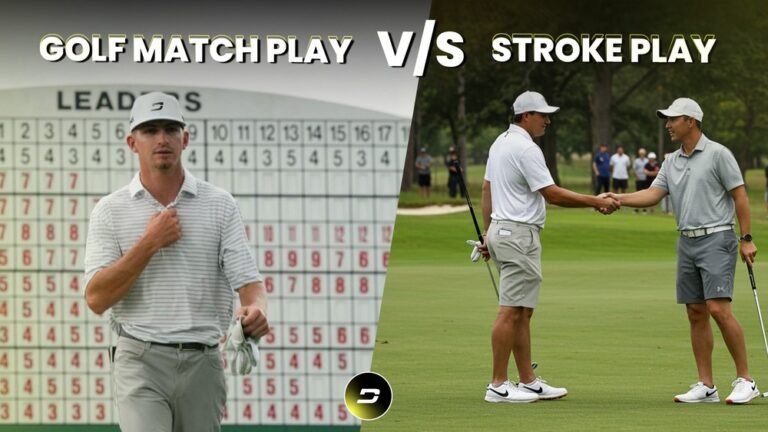
Golf is a sport loved by millions across the world. However, newcomers often feel confused by the many formats the game can take. Two of the most popular are stroke play and match play. These formats are used in amateur competitions, professional tournaments, and even friendly games between friends. But what makes them different? And how do these differences affect the way you play, score, and win? This article will break down the key features, rules, and strategies of stroke play and match play to help you understand which format suits your style and why it matters.
What Is Stroke Play?
Stroke play is the format most people see on TV during big golf tournaments like the Masters or the U.S. Open. In stroke play, every shot counts. Players keep track of the total number of strokes taken over one or more rounds, and the person with the lowest total score wins.
How Stroke Play Works
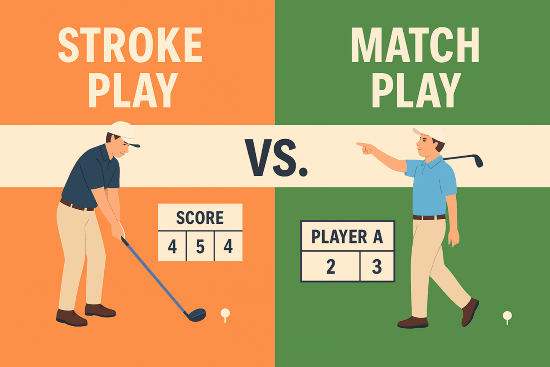
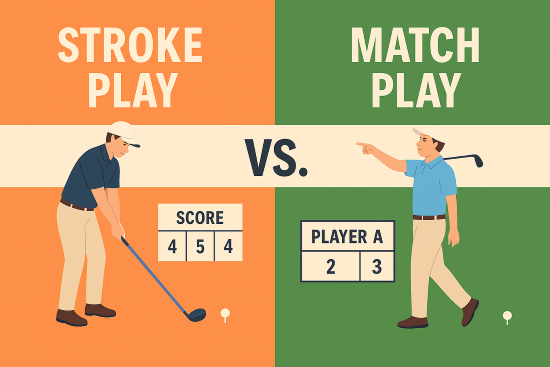
In a typical 18-hole round, you add up all your strokes for each hole. For example, if you take 5 shots on the first hole and 4 on the second, your score after two holes is 9. This continues until you finish the course.
The main idea is simple: every shot matters. A bad hole can set you back, but a great hole can help you catch up. At the end of the round (or tournament), the player with the lowest total wins.
Where Stroke Play Is Used
- Most professional tournaments: PGA Tour, European Tour, and the Olympics use stroke play.
- Club championships and many amateur events.
- Often used in golf handicapping systems.
Example
If four players finish 18 holes with scores of 72, 75, 70, and 77, the player with 70 is the winner.
What Is Match Play?
Match play is a head-to-head format. Instead of counting every stroke, players or teams compete to win individual holes. Whoever completes a hole in fewer shots wins that hole. The match is decided by who wins the most holes, not who takes the fewest strokes overall.
How Match Play Works
Each hole is like a separate contest. For example, if Player A takes 4 shots and Player B takes 5, Player A wins the hole and goes “1 up. ” If they both take the same number of shots, the hole is “halved,” and the score stays the same.
The match continues until one side is ahead by more holes than there are holes left to play. If a player is “3 up” with two holes to play, the match ends because the other player can’t catch up.
Where Match Play Is Used
- Famous tournaments like the Ryder Cup and Presidents Cup.
- Some club and amateur events.
- Friendly games, especially when playing in pairs or teams.
Example
If Player A wins 5 holes, Player B wins 3 holes, and they tie 10 holes, Player A wins the match “2 & 1” (2 holes up with 1 to play).
Key Differences Between Stroke Play And Match Play
Understanding the differences goes beyond the scoring system. Let’s compare some of the most important distinctions.
| Aspect | Stroke Play | Match Play |
|---|---|---|
| Scoring | Total strokes over all holes | Holes won, lost, or tied |
| Opponent Focus | Compete against the whole field | Compete directly with one opponent or team |
| Effect of a Bad Hole | Can ruin your round | Only lose one hole |
| Strategy | Consistency is key | Risk-taking can pay off |
| Length of Game | Always play all holes | Match can end early |
Scoring Methods Explained
The way scores are kept in each format shapes the entire game.
In Stroke Play
You write your score for each hole on the scorecard. At the end, you add them up. If you make a big mistake on one hole (for example, a 9 on a par 4), that mistake counts against your total.
In Match Play
Winning or losing a hole is all that matters. If you have a nightmare hole and take a 10, but your opponent takes 11, you still win the hole. Bad holes hurt less, but every hole is a new chance.
Strategies: How You Play Changes
Stroke play and match play require different mindsets and tactics.
Stroke Play Strategy
- Focus on steady, safe play.
- Avoid big mistakes; every shot affects your final score.
- Playing “par golf” (matching each hole’s expected score) is often enough to win.
- You compete with the entire field, not just one person.
Match Play Strategy
- Aggression can pay off: If you’re behind, you might take risky shots to win a hole.
- A disaster on one hole only costs you that hole.
- Pay close attention to your opponent’s position; if they make a mistake, you can play safer.
- Psychological tactics are common, such as conceding short putts to build goodwill.
Common Rules Differences
Stroke play and match play use the same core golf rules, but some differences matter:
| Situation | Stroke Play | Match Play |
|---|---|---|
| Penalties | Added to your score | You may lose the hole |
| Conceded Putts | Not allowed | Allowed (you can “give” a putt) |
| Order of Play | Must follow strict order | More flexible, but can lose hole if order is wrong |
| Disqualification | Disqualified from the event | Usually lose the hole |
Impact Of A Bad Hole
This is one of the most important practical differences for golfers.
In Stroke Play
A single bad hole (like a triple bogey or worse) can destroy your chances. Every stroke is counted, so mistakes are costly. Recovering from a disaster is hard, especially in professional tournaments.
In Match Play
A bad hole only costs you one point (the hole). You can bounce back quickly. This makes match play more forgiving for risk-takers and beginners. You can even lose a hole by a large margin, but the next hole is a fresh start.
When To Choose Stroke Play Or Match Play
The best format depends on your goals, skills, and group.
Stroke Play Is Best For
- Large groups or tournaments.
- Measuring overall skill and consistency.
- Players who want to compare themselves to a big field.
Match Play Is Best For
- Head-to-head challenges.
- Friendly games or rivalries.
- Players who enjoy risk and quick comebacks.
Pressure And Psychology
The mental side of golf is huge, and the format changes what you feel.
Stroke Play Pressure
- Pressure builds with each hole.
- One mistake can add stress for the rest of the round.
- Players may play more cautiously to avoid big numbers.
Match Play Pressure
- Every hole is a new battle.
- If you fall behind, you can take more chances.
- Short putts may be conceded, making some holes less stressful.
Famous Tournaments Using Each Format
Some events are famous for their use of one format over the other.
Stroke Play Examples
- The Masters (Augusta National)
- U.S. Open
- PGA Championship
- Olympics
These tournaments are about consistency and skill over four days. The winner is the lowest total score.
Match Play Examples
- Ryder Cup
- Presidents Cup
- WGC-Dell Technologies Match Play
These events feature team and individual matches, with excitement coming from the head-to-head battles.
Unique Rules Only In Match Play
Some rules only apply in match play:
- Conceded Putts: You can “give” your opponent a putt. If you say, “That’s good,” they don’t have to putt.
- Giving a Hole: You can concede a hole or even the match at any time.
- Playing Out of Turn: If you play out of turn, your opponent can force you to replay the shot.
These rules add strategy and sportsmanship to the game.
How Handicaps Work In Both Formats
Handicaps level the playing field for golfers of different skill levels.
Stroke Play Handicaps
You subtract your handicap from your total score. For example, if your score is 90 and your handicap is 18, your net score is 72.
Match Play Handicaps
Handicap strokes are given on the hardest holes. For example, if Player A is a 10 handicap and Player B is a 20, Player B gets one stroke on the 10 hardest holes.

Real-world Example: Amateur Vs. Professional Play
An amateur golfer might prefer match play with friends, as it allows for fun and quick games. Mistakes hurt less, and you can enjoy each hole as a new challenge.
A professional golfer must master stroke play to succeed in major championships. Every shot counts, and they must stay focused for all 18 (or more) holes.
Common Mistakes Beginners Make
- Confusing the Scoring Systems: New golfers often mix up how to keep score. Always check the rules before you start.
- Not Adjusting Strategy: Playing too safe in match play or too risky in stroke play can hurt your chances.
- Ignoring Handicaps: Forgetting to use handicaps can create unfair matches, especially among players of different skill levels.
- Overreacting to Bad Holes: In match play, a bad hole isn’t the end; in stroke play, try to minimize damage and move on.
- Misunderstanding Concessions: In stroke play, you must finish every hole; in match play, you can accept a conceded putt.
How To Improve At Each Format
- Practice both styles to become a well-rounded golfer.
- In stroke play, focus on consistency and mental toughness.
- In match play, learn to read your opponent and know when to take risks.
- Watch professional tournaments to see how the best handle each format.
Data: Which Format Is More Popular?
According to the United States Golf Association (USGA), over 90% of professional events use stroke play. Match play is more common in club competitions and social games. The Ryder Cup (match play) is one of the most watched golf events in the world, showing both formats have passionate fans.
Quick Comparison: Pros And Cons
| Format | Pros | Cons |
|---|---|---|
| Stroke Play | – Measures total skill – Fair for big fields – Easy to compare scores | – One bad hole can ruin round – Pressure builds over time |
| Match Play | – Exciting head-to-head play – Every hole is a new chance – Mistakes hurt less | – Not ideal for large groups – Less focus on overall consistency |
Frequently Asked Questions
What Is The Main Difference Between Stroke Play And Match Play?
The main difference is how you win. In stroke play, the winner is the player with the lowest total strokes after all holes. In match play, the winner is the one who wins the most holes, regardless of the total strokes taken.
Can You Concede A Putt In Stroke Play?
No, conceded putts are not allowed in stroke play. Every shot must be played until the ball is holed. In match play, you can concede putts, holes, or even the match.
Which Format Is More Forgiving For Beginners?
Match play is often more forgiving. A bad hole only costs you one point, and every hole gives you a fresh start. In stroke play, every mistake adds to your total score.
Are The Rules Different In Match Play And Stroke Play?
The basic rules of golf are the same, but some rules are applied differently. For example, penalties, order of play, and concessions are handled differently in each format.
Where Can I Learn More About The Rules Of Golf?
For full, official rules and examples, visit the R&A Rules of Golf. They cover both stroke play and match play in detail.
Golf is a game of skill, strategy, and mental strength. Understanding the difference between stroke play and match play can help you choose the right format, improve your tactics, and enjoy the game even more. Whether you prefer the steady challenge of stroke play or the head-to-head excitement of match play, knowing the rules and strategies for each will make you a better, more confident golfer.
