Golf is a sport that blends skill, precision, and strategy. If you are new to the game, you might feel confused by the many types of golf clubs players use. Each club has its own shape, length, and purpose. Knowing the difference is important if you want to play better golf and make smart choices when buying clubs.
In this guide, you’ll discover all the different types of golf clubs, what makes each unique, and when to use them. By the end, you’ll have a clear idea of which clubs belong in your golf bag and how they can help you on the course.
The Main Types Of Golf Clubs
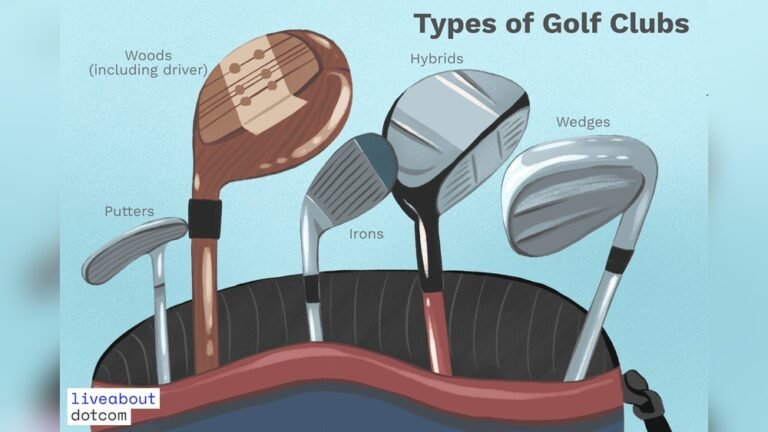
A standard set of golf clubs usually includes several different types, each with a specific job. The main categories are woods, irons, hybrids, wedges, and the putter. Let’s look closely at each one.
Woods
Woods are called this because they were originally made of wood, but today most use metal like titanium or steel. Woods are used for long-distance shots, usually from the tee or fairway.
Driver (1-wood)
The driver is the longest club in your bag, with the biggest clubhead. It’s designed for maximum distance. Golfers mostly use it on the first shot of a hole, especially on par 4 and par 5 holes. The large head and low loft (usually 8-13 degrees) help send the ball far down the fairway.
Fairway Woods (3-wood, 5-wood, Etc.)
Fairway woods have smaller heads and shorter shafts than drivers. They are easier to control and are great for shots from the fairway or light rough. The 3-wood and 5-wood are most common. Their higher loft helps get the ball airborne and adds control for long approach shots.
Key Differences: Driver Vs. Fairway Woods
| Feature | Driver | Fairway Wood |
|---|---|---|
| Typical Loft | 8-13° | 15-22° |
| Shaft Length | 45-48 inches | 42-43 inches |
| Use | Tee shots | Fairway, rough, sometimes tee |
Irons
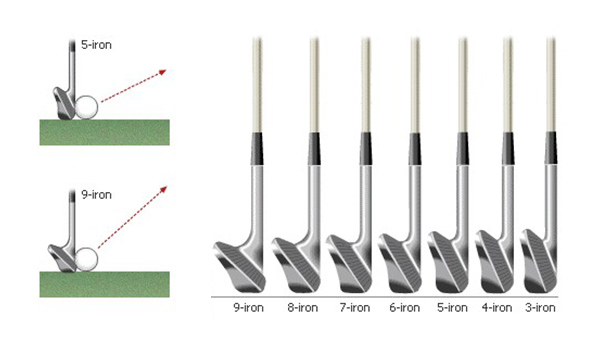
Irons are numbered from 1 to 9. The smaller the number, the longer the club and the lower the loft. Irons are used for a variety of shots, mostly from the fairway or rough, and for approach shots to the green.
Long Irons (2-4 Irons)
Long irons are difficult to hit for many golfers because of their low loft and longer shafts. They are used for long approach shots but are often replaced by hybrids nowadays.
Mid Irons (5-7 Irons)
Mid irons are more versatile. They offer a balance of distance and control. Golfers use them for approach shots from 130-170 yards, depending on skill and strength.
Short Irons (8-9 Irons)
Short irons have higher lofts. They are used for shots that need height and accuracy, usually for approaches from less than 130 yards.
Iron Numbers And Distances
| Iron Number | Typical Loft | Average Distance (Men) | Average Distance (Women) |
|---|---|---|---|
| 3-iron | 19-21° | 180-210 yards | 125-170 yards |
| 5-iron | 24-27° | 160-185 yards | 110-150 yards |
| 7-iron | 34-36° | 140-165 yards | 90-130 yards |
| 9-iron | 41-43° | 110-135 yards | 70-110 yards |
Hybrids
Hybrids are a mix of woods and irons. They have the shape of a small wood but the length and loft of an iron. Hybrids are easier to hit than long irons and help get the ball in the air more easily. Many golfers replace their 3, 4, and even 5-irons with hybrids. They are especially useful for beginners or players who struggle with consistency.
A hidden benefit of hybrids is their ability to help in tricky lies, like thick rough or uneven ground. The wider sole lets the club glide through grass instead of digging in.
Wedges
Wedges are a special type of iron with the highest lofts. They are designed for short shots around the green, from sand, or for hitting the ball high with a lot of spin.
Pitching Wedge (pw)
Pitching wedges have a loft of 44-48 degrees. They are great for approach shots from 100-130 yards and for chip shots near the green.
Gap Wedge (gw)
The gap wedge fills the “gap” between the pitching wedge and sand wedge, usually 50-54 degrees. It’s useful for distances where the pitching wedge is too much, but the sand wedge is not enough.
Sand Wedge (sw)
Sand wedges have a loft of 54-58 degrees and a heavy sole. They are designed to help you escape from bunkers (sand traps) but are also good for chips and pitches around the green.
Lob Wedge (lw)
The lob wedge has the highest loft, usually 58-64 degrees. It is used for very short shots where you need to hit the ball high and stop it quickly, like hitting over a bunker or stopping near the flag.
Comparing Wedges
| Wedge Type | Typical Loft | Main Use |
|---|---|---|
| Pitching Wedge | 44-48° | Approach shots, chipping |
| Gap Wedge | 50-54° | Short approaches, bridging gaps |
| Sand Wedge | 54-58° | Bunker shots, chips |
| Lob Wedge | 58-64° | High, soft shots, flop shots |
Putter
The putter is used on the green to roll the ball into the hole. It has a flat face and is designed for accuracy, not distance. There are many shapes and sizes, but all are designed to help you control the ball on smooth grass.
Some putters have a blade shape, which is slim and simple. Others have a mallet shape, which is larger and offers more forgiveness on off-center hits. Using the right putter can make a huge difference in your score, since putting is often half of all strokes taken in a round.
How Many Clubs Can You Carry?
The rules of golf allow you to carry up to 14 clubs in your bag during a round. Most golfers use a mix of different types:
- 1 Driver
- 2 Fairway Woods (e.g., 3-wood, 5-wood)
- 4-6 Irons (e.g., 5-iron to 9-iron)
- 2-3 Wedges (PW, SW, maybe GW or LW)
- 1-2 Hybrids (as replacements for long irons)
- 1 Putter
Choosing which clubs to carry depends on your skill, swing speed, and personal preferences. Beginners often benefit from more hybrids and fewer long irons.

Special Types Of Golf Clubs
While the five main categories cover most needs, there are some specialty clubs that are less common but useful in certain situations.
Driving Iron
A driving iron is a low-lofted iron designed for long shots from the tee or fairway. It offers more control than a driver but is harder to hit than a hybrid. Some advanced players like it for windy conditions.
Chipper
A chipper looks like a putter but has a lofted face, usually 30-37 degrees. It helps players with chip shots around the green, making it easier to lift the ball over the grass and get it rolling.
Utility Iron
Utility irons are a cross between long irons and hybrids. They have a thicker sole and are easier to hit than a traditional 2 or 3-iron, but they provide a lower ball flight than a hybrid.
Tips For Choosing The Right Golf Clubs
Picking the right mix of golf clubs can improve your game. Here are some tips to help you make better choices:
- Try before you buy: Visit a golf store or range that lets you test clubs. Clubs feel different in your hands, and the right fit can boost your confidence.
- Consider club fitting: A professional club fitting checks your height, swing speed, and skill. Custom-fit clubs can make a real difference, even for beginners.
- Don’t skip hybrids: Many new players avoid long irons and choose hybrids instead. They are much easier to hit and more forgiving.
- Check your distances: Know how far you hit each club. This helps avoid “gaps” in your set where two clubs go the same distance.
- Wedges matter: Having the right mix of wedges gives you more options for scoring shots around the green.
A common beginner mistake is using clubs that are too stiff or too long. This makes it hard to control shots and can slow your improvement.
Golf Club Materials And Design
Modern golf clubs use a mix of materials for performance:
- Drivers and woods: Titanium or carbon fiber for lightness and strength.
- Irons: Steel or stainless steel for solid feel and durability.
- Shafts: Graphite shafts are lighter and help generate more clubhead speed, while steel shafts offer more control.
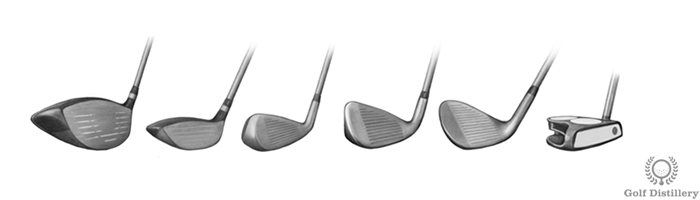
The design of the clubhead also affects performance. Larger heads are more forgiving, while smaller “blade” heads give advanced players more control but are harder to hit.
The Evolution Of Golf Clubs
Golf clubs have changed a lot over the years. Early clubs had wooden heads, and iron clubs were rare. Today, almost all clubs use advanced metals and scientific designs. Even the putter has seen big changes, with new shapes and alignment aids.
Some players still prefer classic shapes, but most benefit from modern “game-improvement” clubs. These are designed to help with off-center hits and make the game more enjoyable for everyone.
Cost And Value
Golf clubs can be expensive. A new set of clubs can cost anywhere from $300 to $2000. Beginners do not need the most expensive models. Many brands offer “starter sets” at a lower price.
If you’re on a budget, consider used clubs or last year’s models. The technology does not change much year to year, and you can save a lot of money. Remember, the most important thing is how the club feels to you and how well you can control it.
For more information on club rules and history, you can check the official Wikipedia entry on golf clubs.
Frequently Asked Questions
What Is The Difference Between A Wood And An Iron?
Woods are designed for long-distance shots and have large, rounded heads. Irons have smaller, flat heads and are used for more controlled shots from the fairway or rough. Woods are usually lighter and longer, making them best for tee shots and long fairway shots.
Can I Play Golf With Just A Few Clubs?
Yes, you can play with a smaller set, such as a half set (e. g. , 1 driver, 1 fairway wood, 3 irons, 1 wedge, and a putter). This is common for beginners or when traveling. However, having more clubs gives you more options for different shots.
Why Do Some Players Use Hybrids Instead Of Long Irons?
Hybrids are easier to hit than long irons. They help get the ball airborne, especially from rough or uneven lies. Many golfers, especially beginners and those with slower swing speeds, find hybrids more forgiving and reliable.
How Often Should I Replace My Golf Clubs?
Most golfers replace clubs every 5-10 years, depending on how much they play and advances in technology. If you notice worn grips, dents, or a drop in performance, it may be time for new clubs.
Are Expensive Clubs Always Better?
Not always. The best club is the one that fits your swing and feels comfortable. Many mid-priced clubs offer excellent performance. Getting fitted and practicing your swing is more important than buying the most expensive model.
Golf clubs are the tools of the game, and understanding each type helps you play smarter and enjoy the sport more. Whether you’re just starting or looking to upgrade, knowing what each club does will give you confidence on every shot.
