
Golf is a sport that captures the imagination of millions around the world. Whether you’re a weekend player or a professional, you’ve probably wondered: How many holes are in a standard golf course? The answer might seem simple, but the history and reasons behind it are fascinating. This article explores the classic golf course design, explains why the number is what it is, and looks at variations and exceptions. If you want to understand golf better, knowing about the holes is a great place to start.
The Classic Number: 18 Holes
A standard golf course has 18 holes. This is the number you’ll find at most professional and amateur tournaments. Each hole is unique, with its own length, design, and challenges. The player’s goal is to complete all 18 holes in as few strokes as possible.
Why 18? The answer goes back to the origins of modern golf in Scotland. The famous Old Course at St Andrews set the standard in the 1700s. Before that, courses had different numbers of holes—some had 12, 22, or even 24. In 1764, St Andrews reduced its course from 22 to 18 holes, and other clubs began to follow. Over time, 18 became the worldwide standard. Today, this number is so central to golf that many rulebooks, competitions, and golf course designs revolve around it.
Anatomy Of A Golf Course
Each of the 18 holes on a golf course has its own character. Holes are not all the same length or difficulty. Most courses have a mix of:
- Par 3 holes: Shorter, usually under 250 yards.
- Par 4 holes: Medium length, between 251 and 470 yards.
- Par 5 holes: Longer, over 471 yards.
“Par” is the expected number of strokes a skilled player needs to complete the hole. A typical 18-hole course might have:
- Four par 3 holes
- Ten par 4 holes
- Four par 5 holes
But the exact mix can change, depending on the course.
Example: Par Distribution
Here’s how the par breakdown might look on a standard course:
| Hole Type | Number of Holes | Total Par |
|---|---|---|
| Par 3 | 4 | 12 |
| Par 4 | 10 | 40 |
| Par 5 | 4 | 20 |
| Total | 18 | 72 |
A par 72 course is the most common, but some courses are par 70 or par 71.

Why 18 Holes? The History
The story of how 18 holes became the standard is full of tradition. In the early days of golf, there were no rules about course length or the number of holes. For example, Musselburgh Links, an old Scottish course, had only 9 holes.
Everything changed in 1764. The St Andrews Links reduced their course from 22 to 18 holes. They did this by combining shorter holes into longer ones. The new format was popular, and soon other courses copied the idea. By the mid-1800s, 18 holes had become the normal setup for new courses.
Interestingly, some say the number 18 was inspired by practicality. After 18 holes, the bottle of whisky shared by golfers was usually empty! While this is a fun story, the real reason is about balance and tradition.
Variations: 9-hole Courses And More
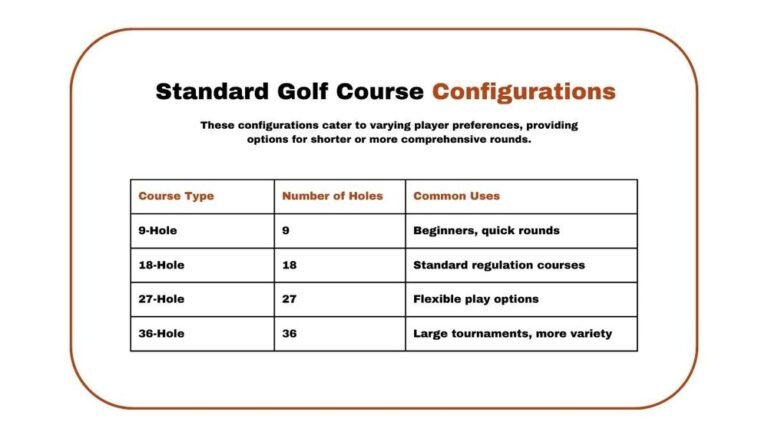
Not all golf courses have 18 holes. Many smaller clubs and community courses offer 9-hole layouts. These are popular for beginners, people with less time, or areas with limited land. On a 9-hole course, you can play one round, or go around twice to make 18 holes.
Other variations exist too:
- Executive courses: Shorter courses, often with 9 or 18 holes, designed for quicker play.
- Par-3 courses: Every hole is a par 3, great for learning or practicing.
- Pitch & Putt: Very short courses, usually just for fun or practice.
Some famous courses, like Augusta National, have special 9-hole “par-3” courses in addition to their main 18-hole course.
Comparison: 18-hole Vs. 9-hole Courses
Here’s a quick look at the differences:
| Course Type | Holes | Typical Par | Time to Play |
|---|---|---|---|
| Standard Course | 18 | 70-72 | 4-5 hours |
| Half Course | 9 | 34-36 | 2-2.5 hours |
| Par-3 Course | 9 or 18 | 27-54 | 1-3 hours |

How Are Holes Designed?
Each golf hole is unique. Designers, called golf architects, think about the shape of the land, wind, trees, and water. They want to make the course both fair and fun. The 18 holes are often divided into two groups:
- Front nine: Holes 1 to 9, usually starting close to the clubhouse.
- Back nine: Holes 10 to 18, finishing near where you started.
This layout helps with flow and lets players take a break after 9 holes if needed.
Some holes are straight, others curve left (dogleg left) or right (dogleg right). Many have lakes, bunkers (sand traps), or hills. The aim is to test different skills—driving the ball far, hitting accurate short shots, and putting on the green.
Example: Famous Holes
Some holes are so famous they’re known worldwide. The 12th hole at Augusta National is a short par 3, but wind and water make it tough even for top players. The 18th at St Andrews is iconic, finishing in front of the historic clubhouse.
Scoring Across 18 Holes
Playing all 18 holes is called a “round of golf.” In official tournaments, players often play four rounds (72 holes) over four days. The scorecard records the number of strokes on each hole, and the total gives the final score.
Here’s how a sample scorecard looks:
| Hole | Par | Player’s Score |
|---|---|---|
| 1 | 4 | 5 |
| 2 | 3 | 3 |
| 3 | 5 | 6 |
| … | … | … |
| 18 | 4 | 4 |
| Total | 72 | 90 |
A player who scores less than par is doing very well. For example, a total score of 68 on a par 72 course is excellent.

Special Formats And Course Types
Golf has grown to include many formats and course types:
- Mini-golf: Fun courses with short holes, windmills, and creative obstacles. Not the same as standard golf, but inspired by it.
- Pitch and putt: Holes are very short (under 100 yards).
- Footgolf: A newer sport combining soccer and golf, often played on modified golf courses.
Some tournaments use 9-hole formats, especially for juniors or casual play. But professional events almost always use 18 holes.
Interesting Facts And Insights
- Longest golf course: The International Golf Club in Massachusetts has a course over 8,000 yards long with 18 holes.
- Shortest 18-hole course: Some par-3 courses have 18 holes but are less than 2,500 yards total.
- World’s oldest 18-hole course: The Old Course at St Andrews is considered the oldest, dating back to the 15th century.
- Unique designs: Some courses have “double greens” (two holes on one green) or shared fairways.
- Not all countries use 18 holes: In Japan, “double-9” courses are common, with two 9-hole layouts used in different combinations.
Beginners often miss that the mix of par 3, 4, and 5 holes is carefully balanced to test all aspects of a player’s game. Also, some holes are “signature holes” because of their beauty or challenge, making them more memorable.
How To Approach Playing 18 Holes
If you’re new to golf, the idea of playing 18 holes might sound tiring. Here are a few practical tips:
- Start with 9 holes: You don’t have to play all 18 at first. Many courses let you pay for just 9.
- Pace yourself: Take breaks, drink water, and enjoy the scenery.
- Don’t rush: Golf is about patience and enjoying the game.
- Track your score: Keeping score helps you see improvement and understand your strengths and weaknesses.
The Importance Of Standardization
Having a standard number of holes means that scores and results can be compared fairly between players, courses, and even countries. It also helps with organizing tournaments and setting up rules. The 18-hole standard is recognized by governing bodies like the R&A and USGA.
If you want to learn more about how golf rules and courses have evolved, the Wikipedia page on golf courses has excellent historical details.
Frequently Asked Questions
How Many Holes Are In A Standard Golf Course?
A standard golf course has 18 holes. This has been the worldwide standard for over 200 years, based on the tradition set by St Andrews in Scotland.
Are There Golf Courses With More Or Fewer Than 18 Holes?
Yes. Many smaller courses have 9 holes, and some special courses might have 12, 27, or even 36 holes (two 18-hole courses). But 18 is the standard for most full courses.
Why Do Some Courses Have Only 9 Holes?
9-hole courses are often built where there is less land or for players who want a shorter game. They are popular in urban areas or for beginners, and you can play them twice to complete 18 holes.
Do All Professional Tournaments Use 18 Holes Per Round?
Almost all professional tournaments use 18-hole rounds, usually over four days for a total of 72 holes. Some fun or charity events may use different formats, but 18 holes is the official standard.
What Is A “par” In Golf, And How Is It Related To The Number Of Holes?
“Par” is the number of strokes an expert golfer is expected to take on each hole. A standard 18-hole course usually has a par of 70 to 72, made up of a mix of par-3, par-4, and par-5 holes.
Golf is a sport of tradition and careful design. The 18-hole standard has stood the test of time, shaping the way the game is played and enjoyed. Whether you play all 18 or just a quick 9, understanding the reason behind the number of holes adds a new level of appreciation for the game.
Next time you step onto the course, you’ll know you’re part of a history that stretches back centuries—one hole at a time.
