
Cricket is a sport loved by millions, but for newcomers, one thing can be confusing—how long does a cricket match last? If you’ve watched a game on TV or attended one at a stadium, you might have noticed that not all matches are the same length.
Some finish in a few hours, while others can go on for days. This variation can make cricket fascinating, but also a bit hard to understand for beginners.
In this article, you’ll discover the different types of cricket matches and how long each one usually lasts. You’ll learn about the rules that affect match duration, including breaks, weather delays, and special playing conditions. We’ll also look at how time is managed in both professional and local matches.
By the end, you’ll know exactly what to expect—whether you’re watching a quick T20 or a classic Test match.
Main Types Of Cricket Matches
The length of a cricket match depends mostly on the format. There are three main types: Test matches, One Day Internationals (ODIs), and Twenty20 (T20). Each has its own rules and traditions that affect how long the game takes.
Test Matches
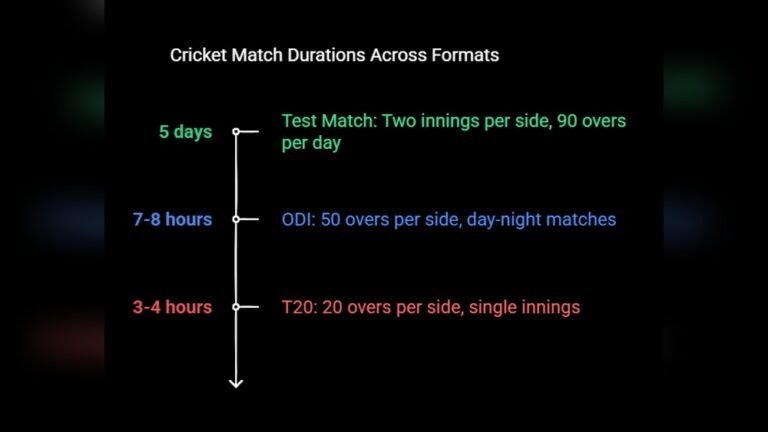
Test matches are the oldest and most traditional form of cricket. They can last up to five days, with each day including around six hours of play. In a standard Test match:
- Teams play two innings each.
- Each day is split into three sessions, with breaks for lunch and tea.
- Play usually starts at 10: 30 or 11:00 am and ends around 5:30 or 6:00 pm.
- There are 90 overs (sets of six balls) scheduled each day.
So, a full five-day Test match can last about 30 hours of play. However, not all matches go the distance—some finish earlier if one team wins quickly. Draws are also possible if time runs out.
One Day Internationals (odis)
ODIs are much shorter than Tests. Each team gets one innings of 50 overs. Usually, an ODI match lasts about 8 hours from start to finish:
- First team bats: About 3.5 hours
- Lunch or dinner break: 30-40 minutes
- Second team bats: About 3.5 hours
This means most ODIs start in the late morning or afternoon and finish by evening. Sometimes matches run longer if there are delays, but the structure is quite fixed.
Twenty20 (t20) Matches
T20 cricket is the fastest format. Each team plays one innings of 20 overs. The whole match usually takes around 3 to 4 hours. This makes T20 games popular for evening entertainment, similar to other sports like soccer or basketball.
Structure of a T20 match:
- First innings: About 80-90 minutes
- Short break: 10-20 minutes
- Second innings: About 80-90 minutes
Because T20s move quickly, there are strict time limits for teams to finish their overs.
How Match Rules Affect Duration
Each format has its own rules, but some factors can change how long a match takes, even within the same format.
Overs And Innings
- In Test cricket, there’s no limit to the number of overs per innings, but there is a set number of days.
- In ODIs and T20s, the number of overs is fixed (50 and 20 per team).
An over is a set of six balls bowled by one player. The time to bowl one over can change based on the bowlers, how many runs are scored, and how quickly fielders move.
Scheduled Breaks
There are planned breaks in every cricket match. These include:
- Lunch and tea breaks in Test matches
- Lunch or dinner break in ODIs
- Short interval in T20s
These breaks are important for players but also add to the total match time.
Weather And Light Conditions
Cricket is an outdoor game, so rain or bad light can stop play. Sometimes, matches lose time because of this. In professional games, there are rules for making up lost time, like starting early the next day or extending play in the evening.
Slow Over Rates And Penalties
Teams are expected to bowl a certain number of overs per hour. If they are too slow, they may get penalties or lose points in tournaments. This encourages teams to keep the game moving.
Real Match Duration Examples
To understand better, here are examples from famous matches:
- 2019 ICC World Cup Final (ODI): Lasted about 9 hours (with a Super Over and rain delays), starting at 10:30 am and ending after 7:00 pm.
- 2016 T20 World Cup Final: Lasted just under 4 hours, starting at 7:00 pm and ending around 11:00 pm.
- 2021 India vs. England Test Match: Finished in 2 days (very rare), with about 13 hours of play total.
These examples show that actual match length can change due to special events, delays, or exciting finishes.
Women’s And Junior Cricket Match Lengths
Women’s and youth cricket often use similar formats, but the match length can be different:
- Women’s ODIs: 50 overs per side, usually about 7 hours.
- Women’s T20s: 20 overs per side, about 3 hours.
- Youth matches: Sometimes 40, 30, or even 20 overs per side, usually finishing in 2 to 5 hours.
Shorter matches make it easier for younger players and help keep the game fun.

Domestic And Local Cricket Match Durations
Not all cricket is international. In local clubs, schools, or amateur leagues, match lengths can be very flexible:
- Club T20: Often 2.5 to 3 hours, with quick turnarounds.
- Weekend Leagues: 35 to 45 overs per side, lasting 6 to 7 hours.
- Friendly matches: Can be any length, depending on agreement.
These shorter matches are common, especially where time is limited.
Comparing All Major Cricket Formats
Here’s a simple comparison of the three main formats and how long they usually last:
| Format | Innings | Overs per Side | Average Duration |
|---|---|---|---|
| Test | 2 per team | No fixed limit | Up to 5 days (30 hrs play) |
| ODI | 1 per team | 50 | 7-8 hours |
| T20 | 1 per team | 20 | 3-4 hours |
Factors That Can Shorten Or Extend A Match
Several things can make a cricket match finish earlier or go longer than planned:
Early Finishes
- Team all out quickly: If one team loses all its wickets fast, the match can end early.
- One-sided games: If one team dominates, the other may not need to bat for long.
Tied And Super Over Matches
- In limited-overs cricket, a tie sometimes leads to a Super Over (one extra over per team) to find a winner. This adds about 20-30 minutes.
Weather Interruptions
- Rain delays: Can pause matches for minutes or hours. In some cases, matches are shortened using the Duckworth-Lewis-Stern method (DLS).
- Bad light: In Test matches, play can stop early if it’s too dark.
Slow Play And Penalties
- If teams don’t bowl overs fast enough, umpires can add extra time or punish teams by reducing their overs or runs.
Extra Time In Test Matches
- In Tests, lost time can be made up by starting earlier or ending later on the following days.
Key Insights Beginners Often Miss
- Draws in cricket: Unlike most sports, Test matches can end with no winner if time runs out. This is called a draw, not a tie.
- Over rates matter: Teams must bowl a minimum number of overs per hour. Slow over rates can cause fines or point deductions, so teams are under pressure to keep the game moving.
How Tv And Leagues Manage Time
With the rise of T20 leagues like the Indian Premier League (IPL), managing match time has become more important. TV broadcasters, sponsors, and fans all want matches to finish on time.
- Strategic time-outs: In T20 leagues, short breaks are planned for advertisements and team talks.
- Strict penalties: If teams are too slow, captains can be fined or banned for future matches.
This focus on time management has made cricket more watchable and helped attract new fans.
Cricket Vs. Other Sports Match Lengths
To see how cricket compares, here’s a look at the average length of matches in other popular sports:
| Sport | Average Match Length |
|---|---|
| Cricket (Test) | 30 hours (5 days) |
| Cricket (ODI) | 8 hours |
| Cricket (T20) | 3-4 hours |
| Football (Soccer) | 2 hours |
| Baseball | 3 hours |
| Basketball | 2-2.5 hours |
As you can see, only Test cricket is much longer than most sports, while T20 matches are similar in length to football or baseball.

Tips For Watching Or Attending Cricket Matches
If you plan to watch or attend a cricket match, here are some practical tips:
- Check the format before going. Test matches are a big time commitment; T20s are much shorter.
- Arrive early if you want a good seat, especially for popular T20 games.
- Bring snacks and drinks—especially for long matches.
- Weather matters: Bring sunscreen, a hat, or rain gear, depending on the forecast.
- Understand breaks: Use intervals to rest or get refreshments.
- Don’t worry if you can’t stay all day: Many fans come and go during Test matches.
Frequently Asked Questions
What Is The Longest Possible Cricket Match?
Test matches can last up to five days, with about 30 hours of play. In the past, there were timeless Tests that lasted even longer, but now five days is the maximum for official matches.
How Long Does A T20 Match Usually Take?
A typical T20 match lasts about 3 to 4 hours. Each innings takes around 90 minutes, with a short break in between.
Can A Cricket Match End Early?
Yes, matches can finish before the scheduled time if one team wins quickly or if bad weather makes it impossible to continue. In T20 and ODI cricket, teams can finish the match in much less time if one team dominates.
What Happens If It Rains During A Match?
If rain stops play, umpires can reduce the number of overs or use special rules like the Duckworth-Lewis-Stern method to decide the winner. Sometimes, matches are postponed or replayed if there is too much rain.
Are Women’s Cricket Matches Shorter Than Men’s?
Women’s matches usually follow the same format, but sometimes the total match time is shorter due to fewer delays and faster play. For example, women’s ODIs are 50 overs per side, just like men’s, but often finish in less time.
Cricket’s variety of formats means there’s a match length for everyone. Whether you have a few hours for a T20 or a whole weekend for a Test, you can enjoy the excitement of the game. For more details about cricket match rules and durations, visit the official Wikipedia Cricket page.
Cricket is more than just a sport—it’s an experience. Knowing how long each type of match lasts helps you plan your day and enjoy the action, whether you’re a new fan or a lifelong supporter.
