Cricket is a sport where weather can change everything. One moment, a team is chasing a big total under clear skies. The next, dark clouds and rain interrupt play, and the match must be shortened. How do you make sure the match stays fair for both teams when time is lost? This is where the Duckworth-Lewis Method comes in. Known by fans as the D/L Method, it’s a mathematical system that keeps limited-overs cricket games (like One Day Internationals and T20s) balanced and fair, even when rain or bad light cuts play short.
Many new fans are confused by D/L scores. Why does a team need 220 in 30 overs instead of the 250 in 50 overs? How does the calculation work? Why do some teams find it harder to win after rain?

Today's Exclusive Deals
Limited-time Exclusive Deals. Check current discount on Amazon.
Check Price on Amazon As an Amazon Associate I earn from qualifying purchases.Let’s break down the Duckworth-Lewis Method, how it works, why it matters, and what makes it both brilliant and sometimes controversial.
The Origins Of The Duckworth-lewis Method
In the 1990s, cricket had a problem. Rain often interrupted matches, especially in England and the subcontinent. Before D/L, several methods tried to adjust targets, but none were truly fair.
- Average Run Rate Method: Only looked at the runs scored per over. It ignored how many wickets had fallen, which made it easy for teams to manipulate the system.
- Most Productive Overs Method: Picked the best overs bowled, but this again ignored wickets and encouraged defensive play.
The worst example was the 1992 World Cup semi-final between England and South Africa. Rain left South Africa needing 22 runs off 1 ball—an impossible task due to a flawed system. The cricket world demanded a better solution.
Enter two British statisticians, Frank Duckworth and Tony Lewis. They created a method that considered both overs remaining and wickets lost—the two most important resources in limited-overs cricket. Their system was first used in 1997 and became the international standard soon after.
What Is The Duckworth-lewis Method?
At its core, the D/L Method is a way to set a fair target for the team batting second when a limited-overs match is interrupted and overs are lost. It considers:
- How many overs the team has left to bat
- How many wickets the team has lost
The method assumes that a team’s ability to score runs depends on these two things. For example, if you have 10 wickets in hand and 20 overs left, you can score faster than if you only have 3 wickets left and 10 overs.
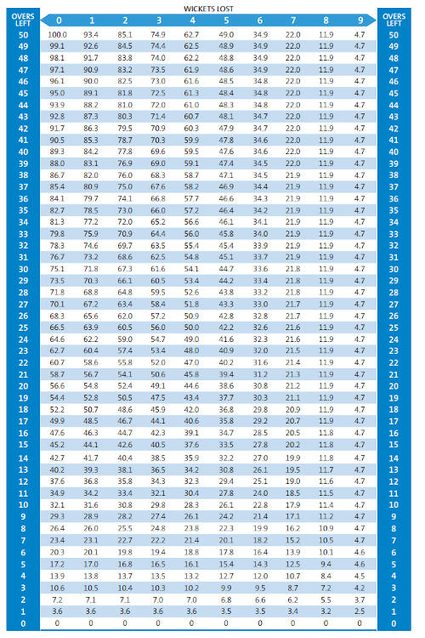
The D/L Method uses complex mathematical tables to calculate the “resources” available to each team. When rain or other interruptions reduce the number of overs, the method adjusts the target for the second team based on the resources they have compared to the team that batted first.
How The Duckworth-lewis Method Works
To understand D/L, you don’t need to know all the math, but you do need to grasp the basic ideas.
Step-by-step Process
- Team 1 bats first and scores as many runs as possible in their allotted overs (usually 50 or 20, depending on the format).
- Team 2 starts their chase. If weather interrupts and overs are lost, the number of resources (overs and wickets) for Team 2 changes.
- The D/L Method calculates what percentage of total resources Team 2 has compared to Team 1.
- The target for Team 2 is adjusted upwards or downwards, based on the new situation.
Resource Percentage
Every combination of overs left and wickets lost gives a resource percentage. For example:
- 50 overs left, 0 wickets lost: 100%
- 25 overs left, 2 wickets lost: About 60%
- 10 overs left, 5 wickets lost: About 25%
If Team 2 loses overs due to rain, they have less resource percentage than Team 1 did. The D/L Method uses this difference to set a fair new target.
Basic Example
Suppose Team 1 scores 250 runs in 50 overs (100% resources).
If Team 2’s innings is cut to 30 overs, and they have 10 wickets at the start, their available resources might be about 75%.
The formula for a revised target is:
Revised Target = Team 1’s Score × (Team 2’s resources ÷ Team 1’s resources)
So, 250 × (75 ÷ 100) = 187. 5, rounded up to 188 runs.
Real-world D/l Adjustments
Let’s look at a more realistic scenario where wickets have already fallen.
- Team 2 is 100/3 after 20 overs (chasing 250 in 50 overs)
- Rain arrives, play is reduced, and only 10 more overs can be bowled (total 30 overs)
- At 30 overs with 3 wickets down, Team 2’s resource percentage might be 60%
- Team 1 used the full 100%
- Team 2’s par score is adjusted to 250 × (60 ÷ 100) = 150 runs in 30 overs
If they reach 151, they win. If not, they lose.
The Math Behind Duckworth-lewis
The true strength of the D/L Method is the way it models a team’s scoring potential using real match data.
Key Concepts
- Resources: The combined power of overs left and wickets in hand.
- Scoring Patterns: Teams often accelerate at the end of the innings if they have wickets left. D/L tables reflect this.
- Par Score: The score the chasing team needs to be equal with the first team at any interruption.
D/l Tables
Official D/L tables list the resource percentage for every combination of overs left and wickets lost. These tables are updated as scoring patterns in cricket change.
A simplified sample:
| Overs Left | 0 wkts lost | 2 wkts lost | 5 wkts lost | 8 wkts lost |
|---|---|---|---|---|
| 50 | 100% | 85% | 49% | 13% |
| 25 | 61% | 54% | 36% | 9% |
| 10 | 29% | 25% | 16% | 5% |
From this, you can see how losing wickets greatly reduces your scoring power.
The Professional Version
Today, most international matches use the Duckworth-Lewis-Stern Method (DLS). Steven Stern, an Australian statistician, made updates in 2014 to better reflect the modern, high-scoring game. The basic idea is the same, but the tables and formulas are updated for today’s cricket.

Why Is The Duckworth-lewis Method Needed?
Without a fair adjustment, rain-affected matches were often decided by luck, not skill. The D/L Method:
- Rewards good play: Teams can’t just bat slowly and hope for rain.
- Discourages manipulation: Teams can’t take unfair advantage by losing or keeping wickets on purpose.
- Keeps matches exciting: Even after interruptions, both teams have a fair chance.
It’s especially important in World Cups, where every match counts and weather can ruin months of preparation.
Strengths And Weaknesses Of The D/l Method
No system is perfect. Let’s look at what works well and where D/L can sometimes frustrate players and fans.
Strengths
- Fairness: Considers both overs and wickets, not just runs.
- Based on Data: Uses real scoring patterns from thousands of matches.
- Hard to Manipulate: Teams can’t easily “game” the system.
- Widely Accepted: Used in all major international and domestic competitions.
Weaknesses
- Complexity: Hard for casual fans to understand without a calculator.
- Chasing Team Disadvantage: Sometimes, a rain-shortened chase becomes harder if the team loses early wickets.
- Not Perfect for T20s: Modern T20 cricket has different scoring patterns, so D/L needs regular updates.
- Emotional Impact: Players and fans may feel “robbed” if rain and D/L combine at the wrong moment.
Comparison With Other Methods
Here’s how D/L compares with the old methods:
| Method | Considers Wickets? | Considers Overs? | Fairness | Popularity |
|---|---|---|---|---|
| Average Run Rate | No | Yes | Low | Low |
| Most Productive Overs | No | Yes | Medium | Low |
| Duckworth-Lewis | Yes | Yes | High | High |
Real-life Examples Of Duckworth-lewis In Action
Let’s see how D/L has shaped famous matches and what fans can learn from these moments.
1. 2002 Champions Trophy Final
India and Sri Lanka’s final was abandoned twice due to rain. The D/L Method tried to set a fair target, but the rain kept returning, and the trophy was shared. It showed that no method can beat persistent bad weather.
2. 2019 World Cup: South Africa Vs. West Indies
Rain stopped play early. The D/L Method was used to declare a “no result” because not enough overs had been bowled. This protected both teams from an unfair outcome.
3. 2003 World Cup: South Africa Vs. Sri Lanka
South Africa misread the D/L par score during a tense run chase. They thought they were safe, but rain came, and they were one run short—eliminating them from the tournament. This highlights why understanding D/L is crucial for teams and fans.
4. T20 International: England Vs. West Indies, 2012
After rain, West Indies got a revised target. England failed to keep up with the new rate and lost, even though they were favorites. In T20s, the D/L target can rise quickly if wickets are lost early.
Non-obvious Insights About The Duckworth-lewis Method
Many beginners miss these key facts:
- Early Wickets Matter More After Rain: If you lose wickets early, your resource percentage falls fast. This can make a revised D/L target much harder.
- Aggressive Batting in Shortened Games: Teams often need to bat more aggressively after an interruption, as the run rate required can jump sharply.
- Impact on Captain’s Strategy: Smart captains watch the weather, the D/L par score, and make tactical choices (like saving wickets or accelerating scoring) based on possible interruptions.

How Teams And Fans Can Prepare For D/l Scenarios
If you’re a player, coach, or even a serious fan, here’s how to stay ready:
- Understand Par Scores: Know what score your team needs at each stage, especially if rain is in the forecast.
- Adapt Batting Plans: Be flexible—if overs are lost, you may need to change who bats when or how aggressively you play.
- Stay Updated: Many cricket apps and broadcasts now show the D/L par score live, so teams are never caught by surprise.
For those who want to see the official D/L tables and learn more about the math, the International Cricket Council (ICC) and sources like Wikipedia provide detailed information.
Frequently Asked Questions
What Is The Main Purpose Of The Duckworth-lewis Method In Cricket?
The main purpose is to set a fair target for the team batting second when a limited-overs match is interrupted by rain or other factors. It does this by considering both overs left and wickets lost.
How Is The D/l Target Calculated During A Match?
The D/L target is calculated using resource percentages from official tables. If play is shortened, the team’s remaining resources are compared to what the first team had, and the target is adjusted proportionally.
Is The Duckworth-lewis Method Used In T20 Cricket?
Yes, the D/L Method (now the DLS Method) is used in T20 Internationals and domestic T20 leagues. The tables are updated to reflect the faster scoring patterns of T20 cricket.
Can Teams Plan Their Strategy Around The D/l Method?
Absolutely. Smart teams follow the live D/L par score, adjust their batting order, and change their approach based on possible interruptions.
Has The D/l Method Ever Been Controversial?
Yes, there have been matches where teams or fans felt the method did not produce a fair result, especially when interruptions happened late in the game or teams misunderstood the par score.
Cricket will always be at the mercy of the weather, but the Duckworth-Lewis Method ensures the game remains as fair and competitive as possible. For anyone who wants to truly understand limited-overs cricket, learning how D/L works is essential. When the rain falls and the calculators come out, now you’ll know exactly what’s going on.