
How Fast Can I Inflate My Paddle Board?
Imagine standing by a calm lake on a sunny morning, paddle board in hand, excited to start your adventure. But before you can glide across the water, you face a common question: How fast can I inflate my paddle board? The answer depends on many factors—your equipment, technique, and even the air temperature. This article will walk you through everything that affects inflation time, compare different pump types, and share tips to make the process smoother and faster. Whether you’re a beginner or a seasoned paddler, understanding these details can help you get on the water quickly and enjoy every minute.
What Determines Paddle Board Inflation Speed?
Inflating a paddle board might look simple, but several elements decide how quickly you’ll finish. Let’s break down the main factors:

Today's Exclusive Deals
Limited-time Exclusive Deals. Check current discount on Amazon.
Check Price on Amazon As an Amazon Associate I earn from qualifying purchases.- Pump Type: Manual or electric pumps have different speeds.
- Board Volume: Larger boards need more air.
- Target Pressure: Higher PSI takes longer.
- Your Technique: How you pump matters.
- Weather Conditions: Temperature can affect air flow and pressure.
People often assume inflation speed is all about the pump, but the board itself plays a big role. For example, a 10’6” all-around board will usually inflate faster than a 12’6” touring board because of the volume difference. Also, aiming for 12 PSI will be much quicker than reaching 20 PSI.
Many beginners don’t consider these details and may get frustrated with slow inflation.
Types Of Paddle Board Pumps
The tool you use to inflate your paddle board has the biggest impact on speed. Here are the main types you’ll find:
Single-action Hand Pumps
These pumps push air into the board only when you press down. They are simple and reliable but can be slow, especially for large boards. Most single-action pumps inflate at a rate of about 80–120 liters per minute at the start, but this drops as pressure increases.
Double-action Hand Pumps
A double-action pump pushes air both when you pull up and push down, nearly doubling the air with each cycle. This type can cut inflation time by 30–40% compared to single-action pumps.
Triple-action Hand Pumps
Triple-action pumps are the newest manual option. They let you switch between three modes, optimizing for speed, comfort, and high pressure. Triple-action pumps can be 20–30% faster than double-action, making them popular for serious paddlers.
Electric Pumps
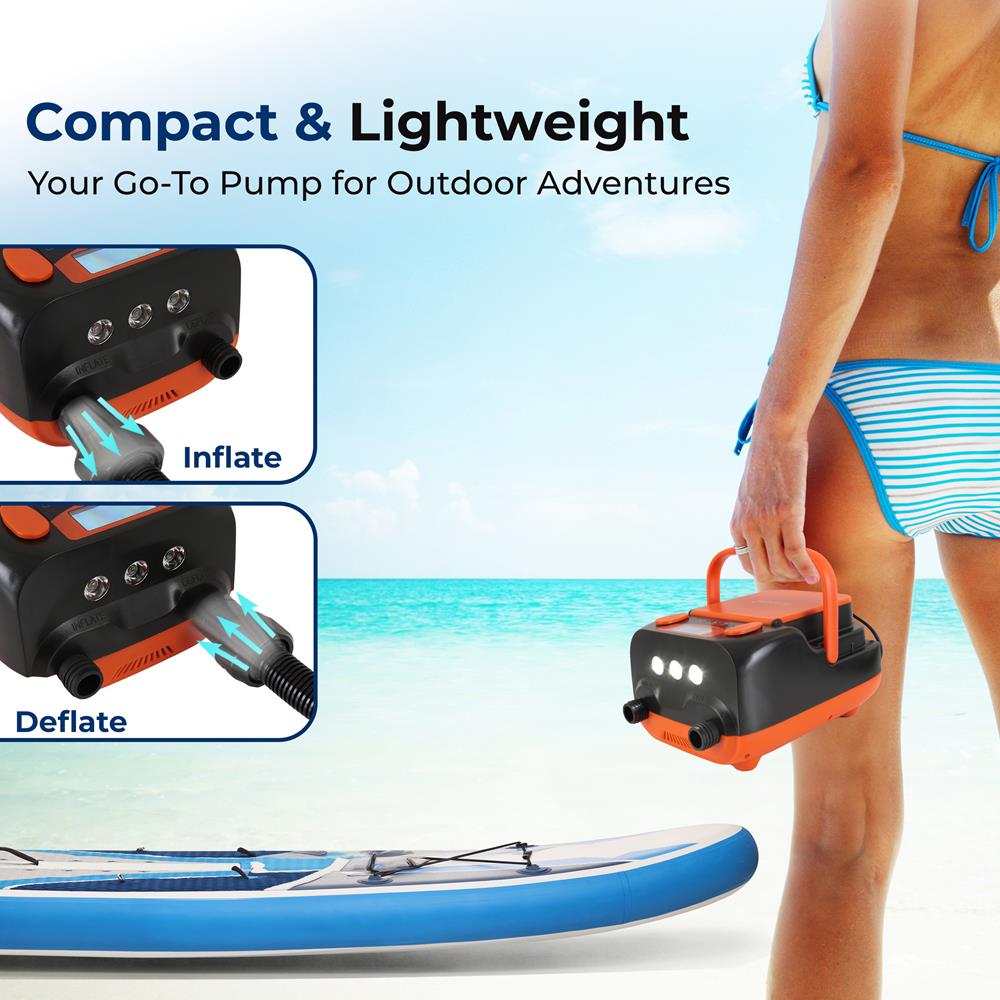
Electric pumps are the most convenient option. You connect them to your car’s 12V socket or a portable battery. They usually inflate a board in 8–12 minutes to full pressure with minimal effort. Some models stop automatically when the right PSI is reached.
Here’s a quick comparison of inflation times for each pump type:
| Pump Type | Inflation Time (Average) | Effort Required |
|---|---|---|
| Single-Action Hand Pump | 10–20 minutes | High |
| Double-Action Hand Pump | 8–15 minutes | Medium |
| Triple-Action Hand Pump | 6–12 minutes | Medium-Low |
| Electric Pump | 8–12 minutes | Low |
Key insight: Many new paddlers think electric pumps are always fastest, but a strong person using a triple-action hand pump can sometimes beat a basic electric pump.
Board Volume And Psi: Why They Matter
Inflation time depends heavily on your board’s volume (measured in liters) and the required PSI (pounds per square inch). Most all-around boards are 200–300 liters and need 12–15 PSI. Racing or touring boards can be over 350 liters and need up to 20 PSI.
Real Example
- 10’6” board, 220 liters, target PSI: 15
- 12’6” board, 340 liters, target PSI: 18
With the same pump, the larger board will take 40–60% longer to inflate. This is not just about size—higher pressure means more time and effort. Beginners often make the mistake of stopping at 8–10 PSI, thinking the board is “firm enough.
” But underinflated boards bend in the water and are harder to paddle.
Manual Vs. Electric Pumps: Which Is Faster?
Let’s take a closer look at manual and electric pumps. Both have pros and cons for speed and ease.
Manual Pumps
Manual pumps can be quick if you’re strong and know how to use them. The double-action and triple-action versions are much faster than single-action. The main downside is physical effort, especially for the final 2–4 PSI, which can be tiring.
Electric Pumps
Electric pumps are consistent and require almost no effort. Plug in, set your PSI, and wait. However, they are not always faster for small boards or if you forget to keep the car running (some pumps drain batteries quickly). A high-quality electric pump is usually as fast as a good triple-action hand pump.
Here’s a direct comparison:
| Pump | Typical Time (for 10’6” Board) | Effort | Noise |
|---|---|---|---|
| Double-Action Manual | 10–15 minutes | High | Silent |
| Triple-Action Manual | 7–12 minutes | Medium | Silent |
| Electric (12V) | 8–12 minutes | Low | Loud |
Non-obvious tip: If you want the fastest inflation, start with a manual pump for the first few minutes (when it’s easiest) and switch to electric for the last few PSI. Few paddlers realize you can combine methods.
Steps To Inflate A Paddle Board Faster
Want to get on the water quickly? Use these steps for efficient paddle board inflation:
- Unroll and Prepare: Lay the board flat and make sure the valve is open and clean.
- Attach the Pump: Secure the pump hose tightly. A loose connection slows things down.
- Use Double or Triple Action: Start with the highest volume setting if your pump allows.
- Pump Steadily: Use your body weight and keep your arms straight for efficiency.
- Switch Modes: As the board gets firmer, switch your pump to a lower volume/higher pressure mode.
- Check Pressure Often: Use the built-in gauge. Don’t guess—underinflation wastes your paddling effort.
- Let the Pump Do the Work: For electric, double-check the connection and set your target PSI.
- Top Off if Needed: If using a manual pump, the last few PSI need slow, steady pushes.
- Listen for Air Leaks: Any hissing means you’re losing air and time—fix leaks before pumping more.
Extra insight: Many people rush and tire themselves out. Take short breaks if you feel fatigued—your speed and form will improve.
How Temperature And Altitude Affect Inflation
Air temperature and altitude also change how fast and how much you should inflate your board. Warm air expands, so if you inflate in the morning and the day heats up, the PSI inside your board will rise. At high altitudes, air is thinner and you may need more pumps to reach the same pressure.
Example: If you inflate your board to 15 PSI at 15°C (59°F) and the temperature rises to 30°C (86°F), your board could reach 17 PSI without extra pumping. Overinflation can damage the seams, so check your PSI if the weather changes.
At high mountain lakes, expect to spend 10–20% more time inflating because the air is less dense. Beginners often overlook this and wonder why their usual routine feels harder.

Common Mistakes That Slow Down Inflation
Inflating a paddle board seems simple, but many people make mistakes that waste time and energy. Here are mistakes to avoid:
- Not fully unrolling the board: Air can’t fill evenly if the board stays curled.
- Loose hose connection: Even a small leak at the hose or valve can double your pumping time.
- Ignoring the gauge: Guessing PSI usually leads to underinflation or wasted effort.
- Wrong pump setting: Not using double or triple action on new pumps.
- Stopping too soon: Boards can feel firm at 8–10 PSI, but you need 12–15 PSI for proper performance.
Pro tip: Get in the habit of checking for leaks and hose tightness before every session. This simple check saves time and headaches.
Is It Worth Upgrading Your Pump?
If you paddle often, a high-quality pump can be a smart investment. Upgrading from a single-action to a double or triple-action pump can cut your inflation time by several minutes. For families or group outings, an electric pump can save energy and keep everyone happy.
Real-life example: Many paddlers switch to electric pumps after a season or two, especially if they have multiple boards. The small extra cost brings big time savings on busy beach days.

Paddle Board Inflation Speed: Real-world Timings
Let’s look at real inflation times from experienced paddlers for a standard 10’6” board (around 220 liters, 15 PSI):
- Single-action hand pump: 15–20 minutes
- Double-action hand pump: 10–15 minutes
- Triple-action hand pump: 7–12 minutes
- Electric pump: 8–12 minutes
For larger 12’6” touring boards (340 liters, 18 PSI):
- Single-action hand pump: 20–28 minutes
- Double-action hand pump: 14–18 minutes
- Electric pump: 10–15 minutes
Of course, strong paddlers can go faster, and beginners may need extra time. But these ranges are typical for most people.
Another overlooked factor: Humidity and even sand inside the valve can make pumping harder. Always check your equipment before you start.
Tips For Faster, Easier Paddle Board Inflation
- Use a mat: Inflate on a clean, soft surface to protect your board and avoid leaks.
- Warm up your pump: Work the pump a few times before connecting to the board; this loosens seals and makes pumping smoother.
- Practice technique: Use your whole body, not just your arms.
- Keep your pump clean: Sand or dirt can block air flow and slow inflation.
- Upgrade wisely: Consider a triple-action or electric pump if speed is important to you.
Surprising insight: Most manual pumps work faster with steady, full strokes—not quick, short ones. Focus on consistency, not speed.
When To Inflate: Timing Your Setup
Many paddlers wonder if it’s okay to inflate their board at home and transport it. For short drives, this can save time, but for longer trips, it’s better to inflate at the water. Temperature changes during transport can alter your board’s pressure.
If you arrive early, you can pump up your board while chatting or setting up your gear. Most people overestimate how long inflation takes—using the right pump and technique, you’ll be ready in 10 minutes.
For more technical details on paddle board construction and inflation, you can visit the Wikipedia Standup Paddleboarding page.
Frequently Asked Questions
How Do I Know When My Paddle Board Is Fully Inflated?
Check the PSI gauge on your pump. Most boards have a recommended range printed near the valve, usually 12–15 PSI for all-around boards. The board should feel firm, with little bend when you stand on it.
Can I Use An Air Compressor To Inflate My Paddle Board?
Some air compressors work, but many deliver air too quickly or at too high a pressure, risking damage. Always use an adapter and never exceed the recommended PSI. Electric paddle board pumps are safer.
Why Does My Pump Get Harder To Use As I Inflate?
As pressure rises inside the board, it naturally takes more effort to push in air. This is normal. Switch your double or triple-action pump to a lower volume mode, or use slow, steady strokes for the last PSI.
How Do I Avoid Getting Tired While Pumping?
Use your legs and body weight, keep your arms straight, and take short breaks if needed. Using a double or triple-action pump reduces fatigue. For even less effort, consider an electric pump.
Is It Possible To Over-inflate My Paddle Board?
Yes. Over-inflation can damage seams or cause the board to burst. Always use a pump with a reliable PSI gauge and check the manufacturer’s limits before inflating.
Getting your paddle board ready doesn’t have to be a slow or tiring process. With the right equipment, technique, and a little practice, you’ll be on the water in minutes—enjoying the adventure you came for.

