
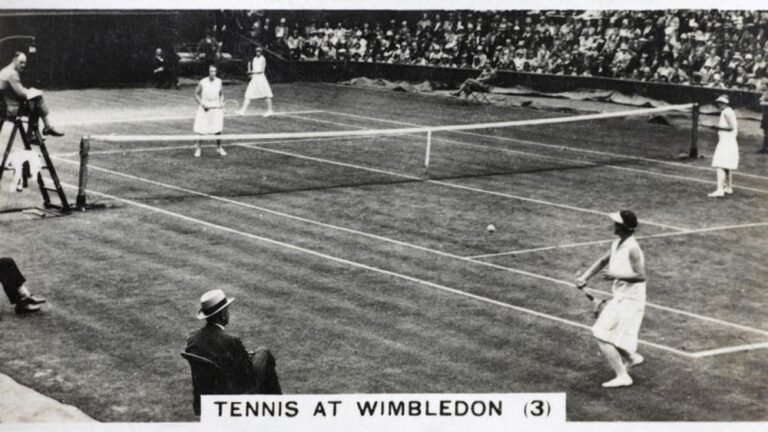
Tennis is one of the most popular sports in the world, played by millions and watched by even more. The game is known for its speed, skill, and excitement, but its roots reach back much further than many people realize.
The history of tennis is a rich tapestry of social change, technological innovation, and remarkable personalities. Understanding where tennis comes from helps us appreciate the game we see today—on grass, clay, or hard courts, with its famous tournaments and legendary players.
Early Origins: Before Modern Tennis
The story of tennis begins long before modern rules and rackets. Early forms of ball games were played in ancient civilizations, such as Greece and Egypt, but the real ancestor of tennis is believed to be a French game called jeu de paume, meaning “game of the palm.” In this game, players used their hands to hit a ball back and forth across a net or line.
By the 12th century, jeu de paume had become popular among French monks, who played it in monastery courtyards. Over time, players began using gloves, then bats, and eventually, a racket. The ball was made of leather stuffed with hair or wool, and the game was played indoors, which is why it became known as real tennis or royal tennis.
This early form was popular with royalty and the upper classes across Europe. In England, Henry VIII was a keen player, and several courts were built at royal palaces. The rules were complicated, and the courts were asymmetric and covered, but the basic idea—hitting a ball over a net—remained.
The Birth Of Lawn Tennis
The sport we recognize today as tennis began in the late 19th century. The Industrial Revolution brought new materials and ideas, making it possible to create lighter, bouncier balls and more flexible rackets. But the biggest change was taking the game outdoors.
In 1873, a British army officer named Major Walter Clopton Wingfield created a version of real tennis that could be played on grass. He called it Sphairistikè, a Greek word meaning “playing ball.” Wingfield’s game had a court shaped like an hourglass and a set of rules that were simpler than real tennis. The net was five feet high at the posts and four feet, eight inches high at the center.
Wingfield patented his game and sold sets that included balls, net, rackets, and instructions. This new “lawn tennis” quickly caught on, especially among the British upper class. Gardens and lawns became tennis courts, and the game spread to country clubs and even schools.
By 1877, the rules were changed to make the court rectangular, and the net height lowered. That year, the All England Croquet and Lawn Tennis Club in Wimbledon held the first tennis championship. This event marked the true birth of modern tennis.

Standardization And Global Spread
After its early popularity in England, tennis began to spread around the world. The rules were standardized, and the sport moved beyond the British elite.
The First Tournaments
The first Wimbledon Championships in 1877 had only 22 men competing, and it was played on grass. The winner, Spencer Gore, could not have known he was starting a tradition that would become one of the world’s most prestigious sporting events. Women were allowed to compete in Wimbledon from 1884.
Other countries followed quickly. The U.S. National Championships (now the US Open) began in 1881, the French Championships in 1891, and the Australian Championships in 1905. These four events became known as the Grand Slam tournaments.
Tennis Goes International
The International Lawn Tennis Federation (ILTF) was formed in 1913 to manage rules and organize competitions. Tennis became an Olympic sport in 1896 but was dropped after 1924, only returning as a full medal sport in 1988.
The sport’s popularity grew in Europe, the United States, Australia, and beyond. Courts appeared in parks, schools, and clubs. Lawn tennis was now a global game.
Table: The Oldest Grand Slam Tournaments
| Tournament | Year Established | Location | Surface |
|---|---|---|---|
| Wimbledon | 1877 | London, England | Grass |
| US Open | 1881 | New York, USA | Hard (since 1978) |
| French Open | 1891 | Paris, France | Clay |
| Australian Open | 1905 | Melbourne, Australia | Hard (since 1988) |
Evolution Of Equipment
The history of tennis is also a history of changing technology. Early rackets were made of wood, balls were stuffed with hair, and shoes had little grip. Over the decades, new inventions have transformed how the game is played.
Rackets
For almost 100 years, rackets were made from wood, which limited their size and power. In the 1960s and 70s, manufacturers began using metal (especially aluminum) and then graphite and other composites. These new materials made rackets lighter, stronger, and larger. The result: faster serves, more spin, and a more dynamic game.
Balls
Tennis balls were originally made of leather, stuffed with hair or wool. The switch to rubber came in the late 19th century, making balls more consistent in bounce and easier to produce. The familiar yellow color was introduced in the 1970s, after studies found it was easier for TV viewers to see.
Clothing And Shoes
In the 19th century, tennis players wore long trousers, dresses, and even hats. Over time, clothing became lighter and more practical. Today’s players wear high-performance fabrics that wick sweat and allow freedom of movement. Shoes are designed for grip, support, and the specific needs of different court surfaces.
Table: Evolution Of Tennis Rackets
| Era | Main Material | Notable Feature |
|---|---|---|
| 19th Century | Wood | Heavy, small head |
| 1960s-1970s | Metal (Aluminum) | Lighter, stiffer |
| 1980s-Present | Graphite/Composite | Large head, powerful |
The Game’s Changing Rules And Scoring
Tennis rules have evolved, but the basic principle—hit the ball over the net and inside the lines—remains. The scoring system is unique and sometimes confusing for beginners.
Scoring
The use of “15, 30, 40, game” dates back to medieval France. One theory is that it comes from a clock face (15, 30, 45, 60), with “45” shortened to “40” for speed. A player must win at least four points to win a game, and at least six games to win a set.
A match is usually played as best of three or five sets. If both players reach 6–6 in a set, a tiebreak is used to decide the winner (except in some major tournaments, which have their own rules).
Rule Innovations
Several changes have been made to make tennis fairer and more exciting:
- The tiebreak was introduced in the 1970s to speed up matches.
- The Hawk-Eye electronic review system began in 2006, allowing players to challenge close line calls.
- Service rules, net-cord sensors, and time limits between points were also added.
These changes reflect the sport’s willingness to adapt while respecting its traditions.
Major Milestones In Tennis History
Many events have shaped tennis into what it is today. Some are about the game itself; others are about the people who played it.
The Rise Of Professional Tennis
For many years, tennis was an amateur sport. Only “gentlemen” and “ladies” could play in the biggest tournaments. In 1968, the Open Era began, allowing professionals to compete with amateurs. This led to higher levels of competition, more money, and global television audiences.
The Davis Cup And Fed Cup
In 1900, the Davis Cup was created as a team competition between countries. The women’s equivalent, the Fed Cup (now called the Billie Jean King Cup), started in 1963. These events have helped tennis develop national rivalries and showcase teamwork.
The Influence Of Women In Tennis
Women have played tennis since the 19th century, but equal pay and recognition took much longer. Billie Jean King led the fight for equality. The “Battle of the Sexes” match in 1973, where King defeated Bobby Riggs, was a turning point.
The Women’s Tennis Association (WTA) was founded in 1973. In 2007, Wimbledon and the French Open awarded equal prize money to male and female champions.
Table: Key Moments In Women’s Tennis
| Year | Milestone | Impact |
|---|---|---|
| 1884 | First women’s Wimbledon | Women compete at major event |
| 1973 | WTA founded | Professional tour for women |
| 2007 | Equal prize money at Wimbledon, French Open | Gender equality in pay |

Notable Players And Legendary Matches
Tennis history is full of unforgettable personalities and dramatic contests. Some players changed the sport with their skills; others broke records and inspired millions.
Early Legends
- Suzanne Lenglen: French star who dominated women’s tennis in the 1920s, known for her grace and athleticism.
- Bill Tilden: American champion of the 1920s, who won 10 Grand Slams.
- Helen Wills Moody: American, winner of 19 Grand Slam singles titles in the 1920s and 30s.
The Open Era Stars
- Rod Laver: The only player to win all four Grand Slam tournaments in a single year—twice.
- Björn Borg: Swedish star who won 11 Grand Slams and helped make tennis cool in the 1970s.
- Chris Evert and Martina Navratilova: Their rivalry in the 1970s and 80s raised the level of women’s tennis.
The Modern Icons
- Pete Sampras and Andre Agassi: American rivals who won multiple Grand Slams in the 1990s.
- Serena Williams: Winner of 23 Grand Slam singles titles, a dominant force in the 21st century.
- Roger Federer, Rafael Nadal, and Novak Djokovic: Known as the “Big Three,” these men have broken almost every record in tennis, with more than 20 Grand Slam titles each.
Famous Matches
Some matches are remembered for their drama, skill, or importance:
- 1980 Wimbledon final: Borg vs. McEnroe—a five-set battle with a famous 18-16 tiebreak.
- 2008 Wimbledon final: Federer vs. Nadal—often called the greatest match ever.
- 2012 Australian Open final: Djokovic vs. Nadal—the longest Grand Slam final in history at 5 hours, 53 minutes.
Tennis And Social Change
Tennis has been a mirror for society, reflecting and sometimes leading social change.
Breaking Barriers
- Althea Gibson (USA) was the first Black player to win a Grand Slam title, winning the French Open in 1956 and Wimbledon in 1957 and 1958.
- Arthur Ashe broke color barriers in men’s tennis, winning the US Open in 1968 and Wimbledon in 1975.
Promoting Gender Equality
The fight for women’s rights in tennis has inspired other sports. The creation of the WTA, equal prize money, and the visibility of female champions like Serena Williams have helped change attitudes worldwide.
Inclusion And Accessibility
Wheelchair tennis and other adaptive forms have made the sport more inclusive. The Paralympic Games now feature tennis, and many clubs offer programs for players with disabilities.
The Modern Game
Today, tennis is a truly global sport. Players come from every continent, and the biggest tournaments attract huge crowds and TV audiences.
Professional Tours
- The ATP Tour (men) and WTA Tour (women) run events year-round.
- Tournaments are played on hard, clay, and grass courts.
- Prize money, sponsorship, and TV rights have grown dramatically.
Technology In Tennis
- Hawk-Eye and electronic line-calling have reduced human error.
- Fitness and nutrition science have extended careers and improved performance.
- Social media allows fans to follow players more closely than ever before.
Tennis In Popular Culture
Tennis stars are not just athletes; they are global celebrities. Their rivalries, styles, and personalities shape how the world sees the sport. Movies, books, and video games have brought tennis to new audiences.
Non-obvious Insights About Tennis History
- The role of the hourglass court: Early lawn tennis was played on an hourglass-shaped court. This unique design forced strategy and movement different from today’s rectangular courts. The change to a rectangle made the game faster and more balanced for both sides.
- The impact of television: The switch to yellow tennis balls in the 1970s was not just for players—it was for TV audiences. As tennis became a televised sport, visibility became crucial, leading to changes in ball color, court design, and even clothing.
- The importance of amateurism: For decades, only amateurs could play at major tournaments, which meant some of the world’s best professionals were banned from events like Wimbledon. The start of the Open Era in 1968 unified the sport and raised the level of play.
- Tennis and politics: During the Cold War, tennis was a way for Eastern Bloc and Western athletes to compete, and sometimes defect, in international tournaments. The sport often reflected political tensions of the time.
- The influence of surfaces: Grass, clay, and hard courts each produce a different style of play and favor different types of players. This variety is rare in most sports and keeps the Grand Slam tournaments unique and challenging.

Frequently Asked Questions
What Is The Oldest Tennis Tournament In The World?
The Wimbledon Championships, first held in 1877 in London, England, is the oldest tennis tournament. It is still regarded as the most prestigious tournament in the sport.
How Did Tennis Get Its Name?
The word tennis comes from the French word “tenez,” which means “take” or “receive.” Players would shout this word before serving the ball in the old French game jeu de paume.
Why Are Tennis Scores Counted As 15, 30, And 40?
One theory is that scores were originally counted on a clock face (15, 30, 45, 60), with “45” shortened to “40” for speed. Another idea is that “40” was simply easier to say in French.
When Did Women Start Playing Professional Tennis?
Women have played tennis since the late 19th century, with the first women’s Wimbledon in 1884. The Women’s Tennis Association (WTA) was founded in 1973, creating a true professional tour for women.
Where Can I Learn More About Tennis History?
A good place to start is the Wikipedia page on the history of tennis. It offers detailed information, timelines, and references for deeper study.
Tennis has a history full of change, challenge, and inspiration. From monastery courtyards to global stadiums, from wooden rackets to high-tech equipment, the sport has always found ways to evolve. Whether you play for fun or follow the world’s best, knowing the history of tennis adds a new level of appreciation for every serve, rally, and match point.
