

Baseball is a sport that millions enjoy worldwide, but its rules can seem complicated if you are new. Watching a game, you might wonder why players run at certain times, how scoring works, or what the pitcher and batter are really trying to do.
If you want to understand baseball better, it’s important to start with the basics. This guide will walk you through the essential rules, the flow of the game, and the roles of each player. By the end, you’ll have the confidence to watch, play, or talk about baseball with a solid foundation.
The Basic Structure Of A Baseball Game
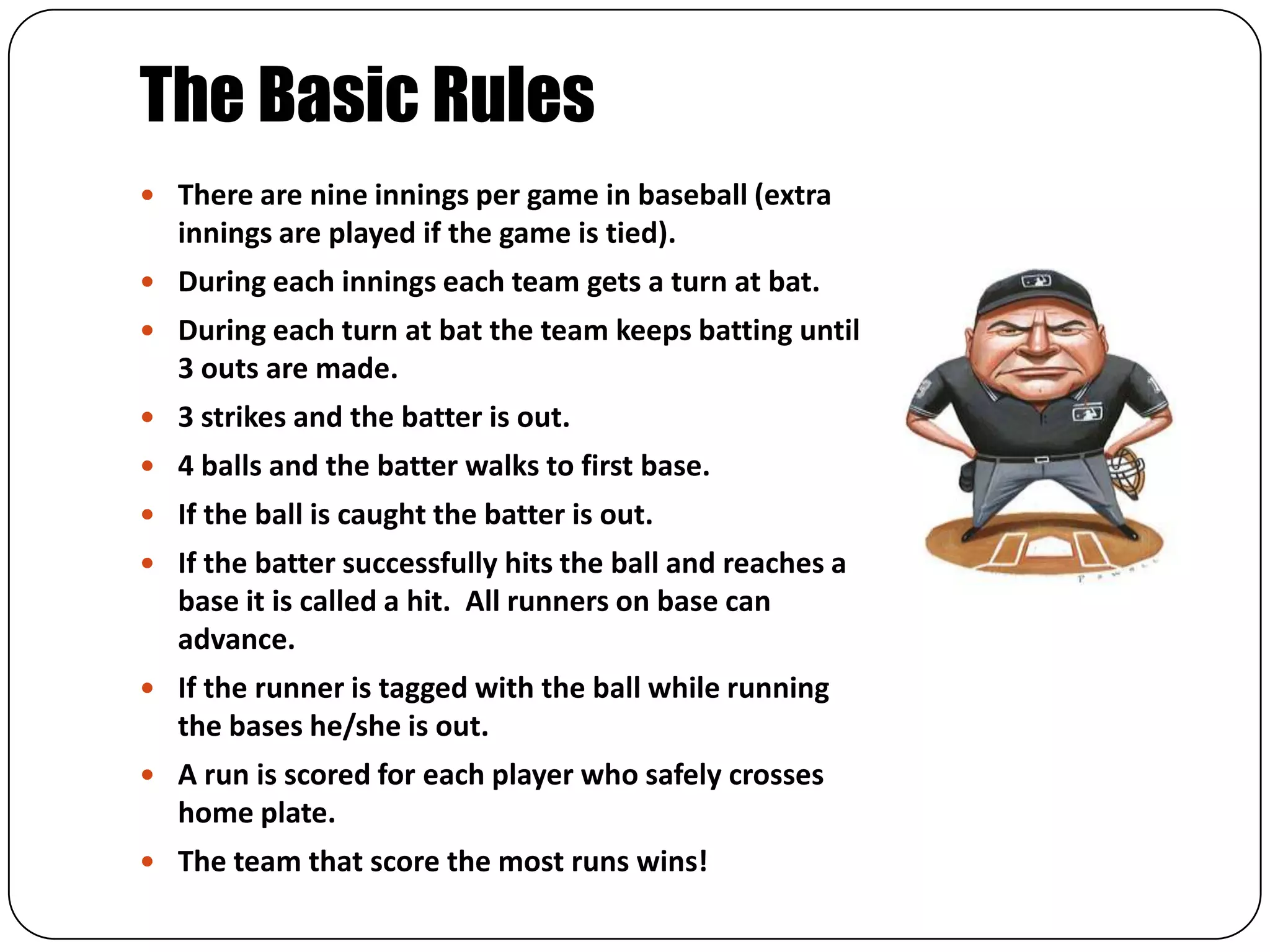
A standard baseball game is played between two teams. Each team has nine players on the field at one time. The game is divided into innings. Most professional games have nine innings. Each inning is split into two halves: the top and the bottom. During the top half, the away team bats and tries to score runs, while the home team plays defense. In the bottom half, the teams switch roles.
An inning ends when the defending team gets three outs. Outs can happen in several ways, which we’ll discuss soon. The team with the most runs at the end of the last inning wins the game.
The Objective: Scoring Runs
The main goal is to score more runs than the other team. A run is scored when a player successfully circles all four bases (first, second, third, and home plate) in order and touches home plate.
Here’s a simple example: A batter hits the ball and runs to first base. If his teammates also hit the ball, he can move to second, third, and finally home. Every time a player completes this journey, their team adds one run to the score.
The Baseball Field And Its Key Parts
To understand the rules, it’s helpful to know the layout of a baseball field.
| Part | Description |
|---|---|
| Home Plate | The starting point for batters and where runs are scored. |
| First Base | The first stop for a batter after hitting the ball. |
| Second Base | Located diagonally across from home plate, halfway through the circuit. |
| Third Base | The last base before returning to home plate. |
| Pitcher’s Mound | The raised area where the pitcher stands to throw the ball. |
| Outfield | The grassy area beyond the bases where outfielders play defense. |
Knowing these parts helps you follow the action, as each play involves movement around these bases.
Player Positions And Roles
Each defensive team has nine players, and each has a specific position:
- Pitcher – Throws the ball to the batter.
- Catcher – Receives pitches behind home plate.
- First Baseman – Covers first base.
- Second Baseman – Covers second base area.
- Third Baseman – Covers third base.
- Shortstop – Plays between second and third base.
- Left Fielder – Covers the left outfield.
- Center Fielder – Covers the center outfield.
- Right Fielder – Covers the right outfield.
The pitcher and catcher work together to try to get batters out. Infielders (first, second, third basemen, and shortstop) field balls hit on the ground. Outfielders catch balls hit high and far.
Batting And The Strike Zone
When it’s your team’s turn to bat, players take turns in a set order. The batter stands at home plate and tries to hit the ball thrown by the pitcher.
The strike zone is an imaginary box over home plate. The size changes based on the batter’s height, but usually runs from the batter’s knees to their chest.
If the pitcher throws the ball into this area and the batter misses, it’s a strike. If the batter hits the ball but it lands outside the field’s foul lines, it’s also a strike. If the pitcher throws outside the strike zone and the batter does not swing, it’s a ball.
Count: Balls And Strikes
A batter gets up to three strikes. If the batter gets three strikes, they are out. If the pitcher throws four balls (outside the strike zone), the batter is allowed to walk to first base. This is called a base on balls.
Outs: How The Defense Stops The Offense
There are several ways the defending team can get an out:
- Strikeout: Batter gets three strikes.
- Fly Out: Batter hits the ball in the air and a fielder catches it before it hits the ground.
- Ground Out: Batter hits the ball on the ground, and a fielder throws it to first base before the batter arrives.
- Tag Out: Runner is touched by the ball (in a fielder’s glove) while off base.
Each half-inning continues until the defense gets three outs.
Base Running And Stealing
Once a batter becomes a runner, they try to move around the bases without getting out. Runners can advance by:
- Hits: When a batter hits the ball, runners can move as far as they safely can.
- Walks: If a batter walks, any runner already on base moves up if forced.
- Stealing: Runners can try to move to the next base while the pitcher is throwing. This is called stealing a base. It’s risky, and the defense can try to tag the runner out.
A common mistake for beginners is leaving a base too early or not tagging up after a fly ball, which can result in an easy out.
Types Of Hits
When a batter hits the ball into play, there are several possible outcomes:
- Single – Batter reaches first base.
- Double – Batter reaches second base.
- Triple – Batter reaches third base.
- Home Run – Ball is hit out of the playing field, and the batter circles all bases to score.
A home run is the most exciting play, but even singles and doubles can help a team score.
Common Ways To Score
A team scores a run when a player touches home plate after rounding all the bases. Usually, this happens in these ways:
- The batter hits the ball and circles all bases (home run).
- A sequence of hits moves runners around the bases.
- Walks or errors by the defense let runners advance.
In rare cases, a team can score when the defense makes a mistake, called an error.
Comparing Offense And Defense
Here is a simple comparison of the main objectives for each side:
| Offense | Defense |
|---|---|
| Score runs | Get three outs |
| Move runners around bases | Prevent runners from advancing |
| Take advantage of mistakes | Force mistakes and make quick plays |
The Order Of Play: Batting Lineup And Rotation
Each team creates a batting order before the game starts. Players bat in this order throughout the game. Changing the order without permission is not allowed.
The pitching rotation refers to the group of pitchers used during the game or series. The starting pitcher begins the game, but relief pitchers may come in later.
Key Rules About Equipment
Baseball uses a few main pieces of equipment:
- Bat: Usually made of wood (in professional leagues) or metal (in amateur leagues).
- Ball: About the size of a fist, with red stitching.
- Glove: Worn by fielders to catch the ball.
- Helmet: Worn by batters and base runners for safety.
Bats must not be longer than 42 inches or heavier than the league’s rules allow. Gloves vary in size by position, with catchers and first basemen using larger gloves.

Duration And Tie-breaking
A professional game is usually nine innings. If the score is tied after nine innings, the game goes into extra innings. The first team to lead after a complete extra inning wins.
In some youth and amateur leagues, games might be seven innings or end early if one team is winning by a large margin (called the mercy rule).
Penalties And Infractions
Breaking the rules can lead to penalties:
- Balk: When the pitcher breaks certain rules while pitching with runners on base, runners are allowed to advance.
- Interference: If a player illegally blocks or distracts another, the play can be stopped and runners may advance.
- Obstruction: When a fielder without the ball blocks a runner, the runner is awarded the next base.
Many beginners overlook balks and interference because they are less common, but they can change the outcome of a game.
Special Plays And Situations
Some plays are unique to baseball and may seem confusing at first:
- Double Play: Two outs are made during the same play, often when a ball is hit on the ground.
- Triple Play: Three outs on one play, which is very rare.
- Sacrifice Fly: Batter hits a fly ball that lets a runner score, but the batter is out.
Another situation is the infield fly rule, which prevents the defense from intentionally dropping a fly ball to get easy outs. If an infield fly is called, the batter is out even if the ball is not caught.
Umpires And Decision Making
Every game has umpires who enforce the rules and make important decisions. The main umpire stands behind home plate and calls balls and strikes. Others stand near bases to judge plays.
Umpires’ decisions are usually final, but in some leagues, teams can challenge certain calls using video review.
Baseball Terminology That Beginners Should Know
Learning a few common baseball terms will help you follow the game:
- At bat: A player’s turn to hit.
- On deck: Next batter due up.
- Bullpen: Area where relief pitchers warm up.
- Dugout: Where players sit when not on the field.
- RBI: “Run batted in”—when a batter’s hit helps a teammate score.
Example Of A Typical Inning
To tie all the rules together, here’s how a typical inning might look:
- The visiting team comes up to bat.
- The first batter hits a single and reaches first base.
- The second batter strikes out (one out).
- The third batter hits a double, moving the runner to third base.
- The fourth batter hits a fly ball caught by the outfielder (two outs); the runner on third tags up and scores (one run).
- The fifth batter grounds out to first base (three outs).
Now the teams switch, and the home team bats.
Two Non-obvious Insights For Beginners
- Knowing When to Run: Many beginners think you should always run as far as possible. In fact, smart base running means understanding when to stay put, especially when a ball is caught in the air or when a play is close.
- Pitch Counts and Fatigue: Pitchers have a limit to how many throws (pitches) they can make. Managers often watch pitch counts closely because tired pitchers make mistakes. This is why teams use relief pitchers later in the game.
Frequently Asked Questions
What Is The Difference Between A “ball” And A “strike”?
A ball is a pitch thrown outside the strike zone that the batter does not swing at. A strike is a pitch inside the strike zone that the batter misses, or any pitch the batter swings at and misses, or a foul ball (with some exceptions).
How Many Players Are On A Baseball Team?
Each team has nine players on the field during defense. Teams can have more players on their roster, but only nine play defense at a time.
Can A Game End In A Tie?
In professional baseball, games do not end in a tie. If the score is even after nine innings, teams play extra innings until one team wins. Some youth leagues may allow ties due to time limits.
What Happens If The Ball Is Hit Outside The Field?
If a ball is hit outside the foul lines, it is called a foul ball. Foul balls count as strikes unless the batter already has two strikes (then, only bunts that go foul count as a third strike).
Where Can I Learn More About Baseball Rules?
For full and official rules, you can visit the Major League Baseball Official Rules page. This resource covers every detail and is trusted by professionals.
Understanding the basic rules of baseball gives you a strong foundation. Watching games, playing with friends, or joining a local team becomes much more enjoyable. While there are many small details and strategies, knowing the essentials lets you follow the action and appreciate the skill involved.
Baseball is a game of moments—each pitch, hit, and run can be a story on its own. Now that you know the basics, you’re ready to enjoy the game in a whole new way.
