How Deep Can You Go When Scuba Diving?
Scuba diving opens a world many people never see. You move weightless under the water, surrounded by amazing life and colors. But every diver, from new students to experts, asks one important question: How deep can you go when scuba diving? The answer is not simple. It depends on your training, the equipment you use, and the risks you are ready to face. Let’s explore what really controls dive depth, why limits exist, and how you can dive safely—no matter your skill level.
What Controls How Deep You Can Dive?
Many people think scuba diving is just about swimming deeper and deeper. In reality, several factors decide how deep you can go.
- Training and experience: Beginner divers must stay shallow. Advanced divers can go deeper.
- Equipment: Basic scuba gear works only up to a certain depth. Special equipment is needed for very deep dives.
- Breathing gases: Normal air becomes dangerous at depth. Special gas mixes are needed for technical dives.
- Body limits: Your body reacts differently under pressure. Deep dives have higher risks.
- Laws and standards: Dive organizations set clear limits for each certification level.
Understanding these controls is the first step to safe diving. Ignoring them can cause serious injury or death.
Depth Limits For Recreational Diving
If you are a recreational diver, you dive for fun, not for work or science. Most people start with this type of diving.
Open Water Certification
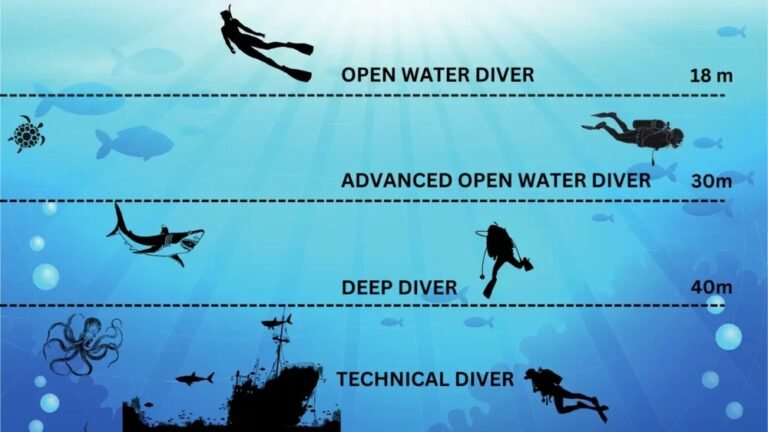
The most common first certificate is Open Water Diver.
- Maximum recommended depth: 18 meters (60 feet)
- Why this limit? Below 18 meters, you use air faster. Problems are harder to solve. Safety stops are more critical.
Advanced Open Water Divers
With more training, you can earn an Advanced Open Water certificate.
- Maximum recommended depth: 30 meters (100 feet)
- What changes? You learn about deep water risks, better buoyancy, and emergency skills. You also practice going a bit deeper in safe conditions.
Recreational Limit
No matter how skilled you get, regular recreational diving has a final limit.
- Maximum depth: 40 meters (130 feet)
- Set by major agencies like PADI, SSI, and NAUI
- Why this limit? Deeper than 40 meters, risks jump much higher, and special planning and gas mixes are needed.
Comparing Certification Depths
Here’s a quick look at how different certifications compare:
| Certification Level | Max Depth (meters) | Max Depth (feet) |
|---|---|---|
| Open Water Diver | 18 | 60 |
| Advanced Open Water Diver | 30 | 100 |
| Recreational Limit | 40 | 130 |
Why Are There Depth Limits?
Depth limits are not random. They exist for real, science-based reasons:
- Nitrogen narcosis: At deeper depths, nitrogen in air makes you feel drunk or confused. This is called “the rapture of the deep. “
- Air supply: The deeper you go, the faster you use air. You can run out much more quickly.
- Decompression sickness: If you come up too fast, nitrogen bubbles form in your body, causing pain, paralysis, or even death.
- Equipment failure: Standard scuba gear is designed for safe operation up to certain pressures.
- Rescue and safety: It is much harder to help a diver in trouble at great depth.
Technical Diving: Beyond Recreational Limits
Some divers want to go beyond 40 meters. This is called technical diving. It is not for beginners.
What Is Technical Diving?
- Uses special gases like nitrox, trimix, or helium
- Requires extra equipment such as multiple tanks and redundant systems
- Demands training in decompression procedures and emergency plans
How Deep Can Technical Divers Go?
- Some technical divers reach 100 meters (330 feet) or more.
- World records exist much deeper, but these are extreme and dangerous.
Example Of Technical Dive Gases
| Gas Mixture | Main Use | Typical Max Depth |
|---|---|---|
| Air | Recreational | 40m (130 ft) |
| Nitrox | Extended time, shallow to mid-depth | 40m (130 ft) |
| Trimix | Deep technical dives | 100m+ (330 ft+) |
| Heliox | Very deep, commercial/professional | 150m+ (500 ft+) |
Practical Example
In 2005, diver Nuno Gomes set a world record by reaching 318 meters (1,044 feet) in the Red Sea. This dive needed years of planning, a team, and advanced technology. Most technical divers never go anywhere near these depths.
What Happens To Your Body At Depth?
Going deeper changes how your body works. Some of these effects are easy to feel. Others are hidden but dangerous.
Pressure Effects
- At 10 meters, the pressure is twice what it is at the surface.
- At 40 meters, it’s five times normal pressure.
This pressure squeezes air spaces in your body. Equalizing is needed to protect your ears and sinuses.
Gas Absorption
- More pressure means more nitrogen dissolves in your blood.
- If you come up too fast, nitrogen bubbles can damage your nerves and joints.
Narcosis And Oxygen Toxicity
- Nitrogen narcosis can start around 30 meters.
- Oxygen toxicity becomes a risk below 56 meters (185 feet) if using normal air.
- Both can cause confusion, seizures, or loss of consciousness.
Cold And Darkness
- Water gets colder with depth. Hypothermia can happen fast.
- Light fades after about 40 meters. Below that, it’s very dark without a torch.
Equipment Limits And Upgrades
Your gear has its own limits.
Recreational Scuba Gear
- Standard tanks and regulators are tested for use up to 40 meters.
- Dive computers may not track deep technical profiles accurately.
Technical Diving Equipment
- Multiple tanks: Needed for different gas mixes and emergencies.
- Redundant systems: Extra regulators, computers, and lights.
- Dry suits: Protect from cold at great depths.
Full-face Masks And Rebreathers
- Used for very deep or long dives.
- Rebreathers recycle breathing gas, making them efficient but complex.
- Maintenance and training are critical.
Special Cases: Professional And Commercial Diving
Some jobs require going even deeper, using advanced methods.
Commercial Diving
- Oil rig workers, underwater welders, and salvage teams often dive deeper than recreational limits.
- Use saturation diving: Living in pressurized chambers for days or weeks.
- Can reach 300 meters (1,000 feet) or more, but always with surface support.
Military And Scientific Diving
- Use special gas mixes and submarines for extreme depths.
- Risk is managed by strict protocols and top equipment.
Comparing Dive Depths: Recreational Vs Technical Vs Commercial
This shows how depth limits compare across different types of diving.
| Dive Type | Typical Max Depth | Breathing Gas | Special Training Needed |
|---|---|---|---|
| Recreational | 40 m / 130 ft | Air/Nitrox | Basic to advanced |
| Technical | 100 m / 330 ft | Trimix/Heliox | Advanced technical |
| Commercial | 300 m / 1,000 ft | Heliox, surface supplied | Professional |

Common Beginner Misconceptions
Many new divers believe:
- “Deeper is always better.” The truth: Most sea life and colors are found above 20 meters, and deeper means higher risk.
- “If I have air, I can keep going.” Actually, your body’s gas limits—not your tank—are what matter most.
- “Dive computers make me safe.” Computers are tools, not magic. You must understand what they tell you and have backup plans.
- “I’ll just go a little deeper.” Small increases in depth can mean big increases in risk, especially without training.
Two Non-obvious Insights
- Every extra 10 meters below 20 meters increases your risk much more than most people think. Problems that are small at 18 meters can be deadly at 30 or 40 meters.
- Deep diving is less about adventure, more about discipline. The more advanced your dives, the more you must stick to rules, checklists, and backup plans. The best deep divers are careful, not careless.

How To Dive Deeper Safely
If you want to go deeper, take these steps:
- Get proper training. Never skip levels or try to “self-teach” deep diving.
- Use the right gear. Make sure all equipment is rated for your planned depth.
- Plan your dive and dive your plan. Set limits before you enter the water, and stick to them.
- Have a dive buddy. Never dive deep alone.
- Be honest about your limits. Turn back if you feel uneasy or conditions change.
- Learn emergency procedures. Practice what to do if something goes wrong.
Real-world Example: Blue Hole In Dahab, Egypt
The Blue Hole in Dahab is famous for deep diving. Many divers die here every year because they ignore depth limits. The “Arch” is at 56 meters. Many try to reach it with only basic training. This is a classic mistake—one that often leads to tragedy.
Where To Learn More
If you’re serious about diving deeper, look for advanced and technical diving courses from respected agencies like PADI, TDI, or GUE. They teach you not just to go deep, but to come back safe. For more on diving limits and safety, see the Wikipedia: Scuba Diving page.
Frequently Asked Questions
How Deep Can You Scuba Dive Without Certification?
Most dive shops will not let you go below 12 meters (40 feet) without a certification. This is the standard for “try dives” with an instructor.
Can You Scuba Dive To 100 Meters?
Only with technical diving training, special equipment, and the right gas mixtures. Recreational divers should never go this deep.
Why Do I Feel Dizzy Or “drunk” On Deep Dives?
This is likely nitrogen narcosis, which affects your brain at depths greater than 30 meters. It is dangerous and a key reason for depth limits.
What Happens If You Dive Too Deep With Normal Air?
You risk oxygen toxicity, nitrogen narcosis, and running out of air very quickly. You may also get decompression sickness if you ascend too fast.
How Do Commercial Divers Go Deeper Than 100 Meters?
They use special gas mixtures (like heliox), surface-supplied air, and sometimes saturation diving. They also live in pressurized environments between dives for safety.
Scuba diving offers adventure and beauty, but respect for depth limits keeps you alive to enjoy it. The ocean is waiting—but only if you dive smart.

