Paddle boarding is one of the fastest-growing water sports in the world, but if you own an inflatable paddle board, you know your adventure starts long before you hit the water. A critical part of your gear is the paddle board pump. Without it, your SUP (stand-up paddle board) is just a floppy piece of fabric! Yet, many paddlers never really think about how their pump works or which type is best. Understanding your pump can make inflating your board faster, easier, and even extend the life of your equipment. Let’s break down exactly how a paddle board pump works, explore the main types, and reveal some pro tips most beginners miss.
Exclusive Deals
Limited-time Exclusive Deals. Check current discount on Amazon.
Check Price on Amazon As an Amazon Associate I earn from qualifying purchases.What Is A Paddle Board Pump?
A paddle board pump is a device designed to inflate your SUP to the correct pressure. Inflatable paddle boards use strong, airtight materials that hold high-pressure air inside. This pressure—usually 12 to 18 PSI (pounds per square inch)—makes the board stiff and stable on water. The pump is the tool that helps you reach this pressure.
There are two main pump categories:
- Manual pumps (you use your hands or feet)
- Electric pumps (powered by batteries or your car)
Each type uses similar physics, but the user experience is quite different.
Exclusive Deals
Limited-time Exclusive Deals. Check current discount on Amazon.
Check Price on Amazon As an Amazon Associate I earn from qualifying purchases.The Basic Physics: How Do Pumps Move Air?
At its core, a paddle board pump works by moving air from outside and forcing it inside your board. The main principle is increasing pressure in a closed space. When you push down the pump handle (or the motor turns on), air is compressed inside a small chamber. This compressed air is then forced through a hose and into your board’s valve.
Inside the pump, there are:
- Cylinders: Where air is compressed.
- Pistons: These move up and down to push air.
- Valves: Control the direction of airflow, so air only goes into the board, not back out.
The more efficiently a pump can move air with each motion or cycle, the quicker your board inflates.
Exclusive Deals
Limited-time Exclusive Deals. Check current discount on Amazon.
Check Price on Amazon As an Amazon Associate I earn from qualifying purchases.Types Of Paddle Board Pumps
Let’s look at the main types you’ll see and how they work differently.
Manual Pumps
Manual pumps are the most common. They don’t need electricity—just your energy.
Single-action Pump
A single-action pump pushes air into your board only when you push down the handle. When you pull up, it fills the pump with new air but doesn’t send any to the board.
Double-action Pump
A double-action pump moves air into your board on both the push and pull strokes. This design means you fill your board faster, especially in the first few minutes.
Triple-action Pump
Some newer models are triple-action. They let you change between double and single action as you pump, using a simple switch. This makes the first stage fast (using double action) and lets you finish the last few PSI with less effort (single action).
Electric Pumps
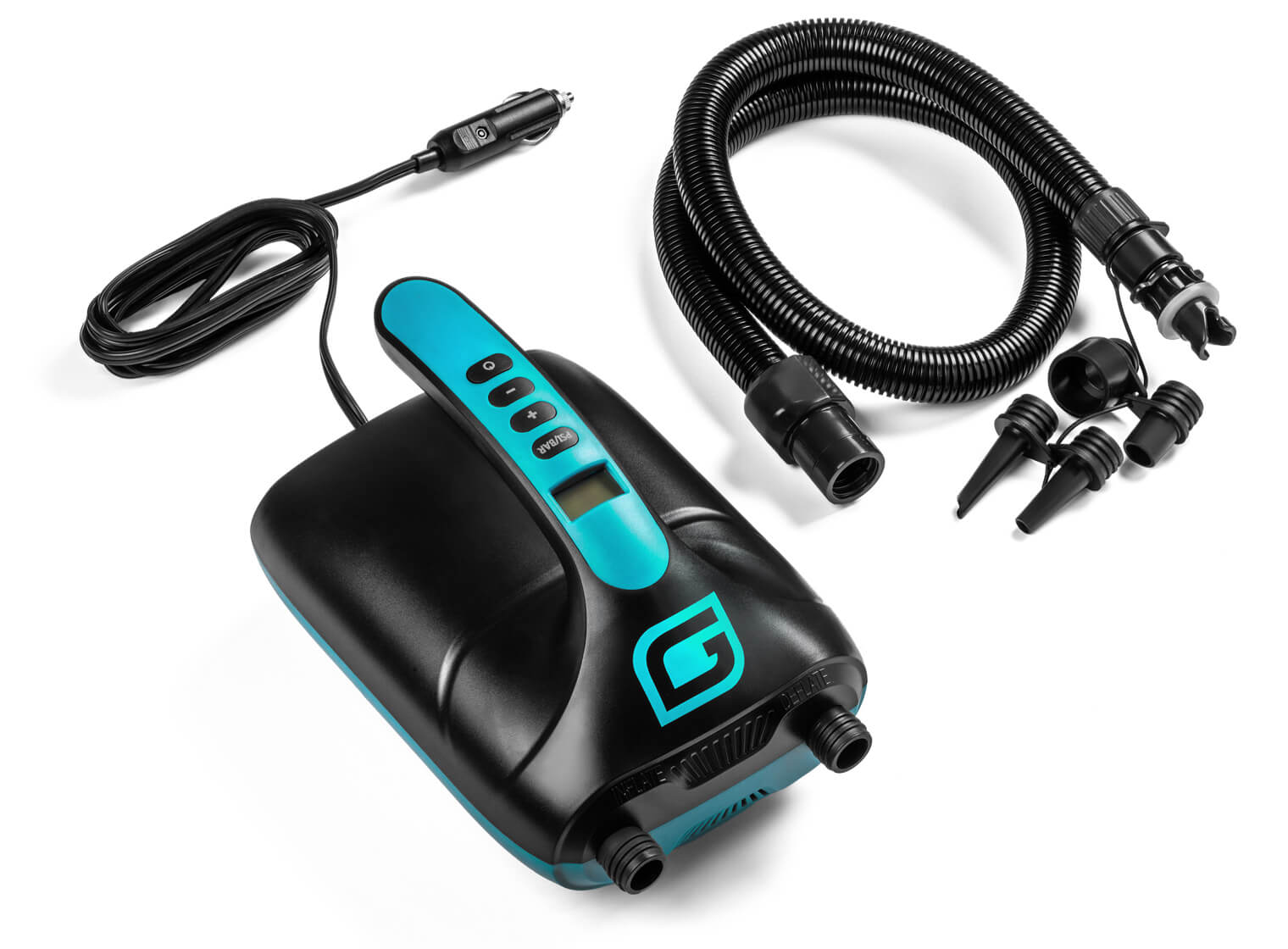
Electric paddle board pumps are becoming more popular. They connect to your car’s 12V outlet or have built-in batteries.
- High-Volume, Low-Pressure Stage: The pump fills the board quickly up to about 1 PSI.
- High-Pressure Stage: The pump switches to a lower airflow but higher pressure to reach 12–18 PSI.
Electric pumps often have automatic shut-off when they reach your set pressure.
How Does The Pump Attach To The Board?
Most inflatable SUPs use a Halkey-Roberts (HR) valve. Your pump hose should have a fitting that clicks or screws onto this valve. When you attach the hose, it creates an airtight path for air to flow from the pump into your board.
Insider tip: Always check that the valve’s center pin is in the “up” position before attaching the pump. If it’s down, air will escape when you remove the hose!
Step-by-step: How To Inflate A Paddle Board
- Unroll your SUP on a flat surface.
- Attach the pump hose to the HR valve, making sure it’s tight.
- Begin pumping. For manual pumps, use strong, steady strokes.
- Switch modes if needed. With a triple-action pump, start in double action and switch to single for the last bit.
- Monitor the gauge. Stop when you reach your board’s recommended PSI (usually marked near the valve).
- Detach the hose quickly and close the valve cap.
If using an electric pump, set your target PSI, press start, and wait. Most electric pumps take 8–12 minutes.
Comparing Manual Vs. Electric Paddle Board Pumps
Here’s a look at how the main types compare in real use:
| Feature | Manual Pump | Electric Pump |
|---|---|---|
| Power Source | User (your strength) | Battery/Car outlet |
| Inflation Time (10’6″ SUP) | 6–10 minutes | 8–12 minutes |
| Effort Level | High | Low |
| Portability | Very portable | Heavier, needs power |
| Cost | Lower ($30–$70) | Higher ($80–$150+) |
Understanding Psi: Why Pressure Matters
PSI (pounds per square inch) measures how much air pressure is inside your board. Most SUPs need 12–18 PSI. Too little pressure, and your board will feel floppy and unstable. Too much, and you risk damaging the seams.
A good pump has a pressure gauge. This gauge shows the current PSI so you don’t have to guess. Note that the gauge may not move much until the board is partly full—this is normal.
| Board Type | Recommended PSI | Performance Effect |
|---|---|---|
| All-around | 12–15 PSI | General paddling, stable ride |
| Touring/Race | 15–18 PSI | Stiffer, faster on water |
| Kids’ SUP | 10–12 PSI | Easier to handle, softer deck |
Common Features Of Paddle Board Pumps
When you shop for a pump or check your own, look for:
- Pressure gauge: Shows exact PSI.
- Durable hose: Thick, flexible, won’t crack easily.
- Multiple valve adapters: Useful if you have other inflatables.
- Ergonomic handles/foot rests: More comfortable for manual use.
- Anti-sand filters: Helps electric pumps last longer.
Some electric pumps also deflate your board, making packing up faster.

Pro Tips Most Beginners Miss
- Let the pump cool down. With electric pumps, run for 1–2 boards, then let it rest. Overheating is the #1 killer of electric pumps.
- Store out of the sun. UV rays can crack the plastic parts on both manual and electric pumps.
- Use slow, steady strokes. Pumping too fast on a manual can tire you out and even break the pump seals.
- Check the O-rings and seals. A leaky pump wastes energy and time. Inspect and replace these parts once a year.
- Don’t overinflate. Always stop at your board’s max PSI, usually written near the valve.
Paddle Board Pump Maintenance
To keep your pump working well:
- Rinse with fresh water after every use, especially if you paddle in saltwater.
- Dry it fully before storing.
- Lubricate O-rings with a little silicone grease every few months.
- Store pumps in a cool, dry place.
- For electric pumps, keep the battery charged and never leave it plugged in unattended.

Why The Right Pump Matters
A good pump saves time and energy. If you paddle often or have more than one board, an electric pump can make your day much easier. For travel, manual pumps are lighter and never need charging. But the most important thing is to always reach the correct PSI—this keeps your board safe and your paddling experience better.
Paddle Board Pump Innovations
Recent years have seen some clever upgrades:
- Integrated pressure shut-off: Electric pumps now stop automatically at your set PSI.
- Rechargeable batteries: No car? Some pumps now have built-in lithium batteries.
- Smartphone apps: Track your PSI and even control some pumps with Bluetooth.
- High-efficiency triple-action designs: These new manual pumps can fill a board in 30% less time.
For more technical details on the mechanics of pumps, you can check this Wikipedia article on pumps.
Frequently Asked Questions
How Do I Know When My Paddle Board Is Fully Inflated?
Check the pressure gauge on your pump. Stop inflating when you reach the manufacturer’s recommended PSI (usually 12–18). The board should feel very firm, not soft.
Can I Use A Regular Air Pump For My Paddle Board?
No. Most regular air pumps (like bike or pool pumps) do not reach high enough pressure. Paddle board pumps are designed for high-pressure, low-volume inflation, which is what inflatable SUPs require.
Why Does The Pressure Gauge Not Move At First?
The gauge only starts to show a reading when there is enough internal pressure. Early in inflation, the board is just filling with air. As it stiffens, the gauge will show the true PSI.
How Long Does It Take To Inflate A Paddle Board?
With a manual pump, it takes 6–10 minutes. With a good electric pump, expect 8–12 minutes for a standard 10–12 foot SUP.
What Should I Do If My Pump Loses Pressure Or Leaks?
Check all connections and O-rings. Make sure the hose is tight and the valve is clean. If you find cracks or broken seals, you may need to replace those parts or the pump itself.
Paddle boarding is all about the adventure, but getting your board ready shouldn’t be a struggle. When you understand how your paddle board pump works and choose the right one, you’ll spend less time on the shore and more time on the water.
Happy paddling!