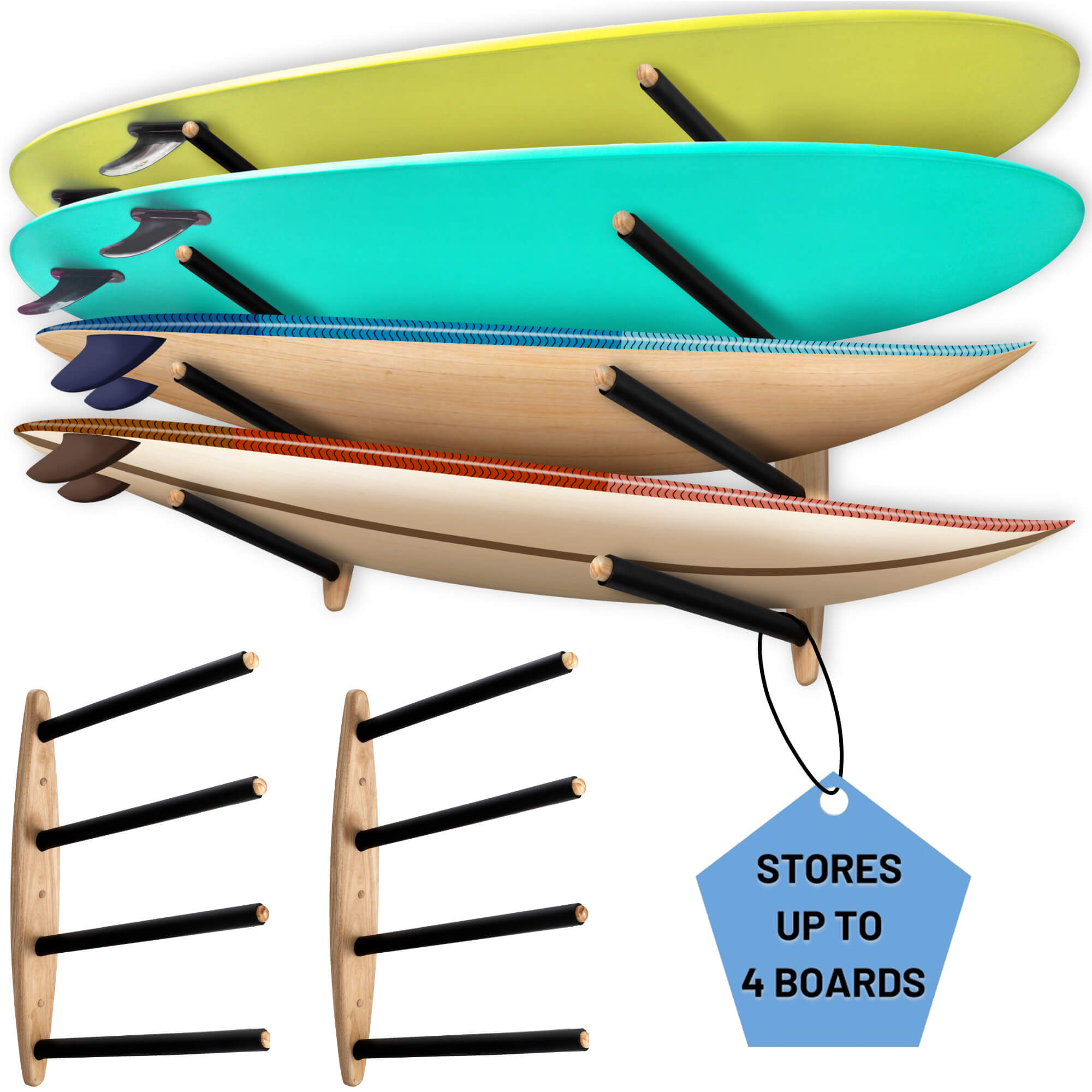
Storing your surfboards safely is more important than many surfers realize. A good surfboard rack does more than just keep your board off the ground—it protects your investment, saves space, and even makes your surfboards part of your home’s style.
But with so many types, sizes, and designs, how do you pick the best surfboard rack for storage? Let’s break down what really matters, explore the most popular rack types, and help you choose the right rack for your needs.

Today's Exclusive Deals
Limited-time Exclusive Deals. Check current discount on Amazon.
Check Price on Amazon As an Amazon Associate I earn from qualifying purchases.Why Proper Surfboard Storage Matters
Surfboards are not cheap. Even an entry-level board can cost several hundred dollars, while top performance boards go far higher. But the real value of a surfboard is in its shape, finish, and performance. Storing a board the wrong way—leaning in a corner, outdoors, or on a rough surface—can cause dings, warping, and sun damage.
A well-designed surfboard rack keeps your boards safe from:
- Pressure dings from stacking or leaning
- Warping caused by heat or humidity
- Scratches from concrete, metal, or rough walls
- Accidental knocks in busy garages or rooms
Even if you have just one or two boards, a rack can make your space more organized and your boards last longer.
Main Types Of Surfboard Racks
There’s no one-size-fits-all solution for surfboard racks. The best rack for you depends on your space, number of boards, and whether you want to display your boards or just store them.
Here are the most common types:
- Wall-mounted racks
- Freestanding racks
- Ceiling racks
- Vertical standing racks
- Horizontal wall racks
- Portable or travel racks
Let’s look at the strengths and weaknesses of each.
Wall-mounted Racks
Wall-mounted racks are among the most popular choices. They hold the board off the ground, either horizontally or at an angle, using padded arms or hooks.
Pros:
- Save floor space
- Display boards as art
- Easy access
Cons:
- Need to find wall studs for mounting
- Limited by wall space
- Not ideal for very heavy longboards
Most wall racks can hold 1–4 boards. Some allow you to stack them, others are designed for just one.
Freestanding Racks
Freestanding racks are like small shelves or stands. They don’t need to be attached to the wall, so you can move them around.
Pros:
- No wall installation
- Holds several boards
- Good for garages, rental homes
Cons:
- Takes up floor space
- Less secure during earthquakes or bumps
These racks are usually made from wood or metal and can hold between 2 and 8 boards, depending on the model.
Ceiling Racks
If you’re short on space, ceiling racks are a smart solution. These racks attach to the ceiling and keep boards out of the way.
Pros:
- Use wasted overhead space
- Great for small rooms or garages
Cons:
- Harder to access boards
- Installation requires drilling into ceiling joists
Ceiling racks are best for lightweight boards and are often used in garages or basements.
Vertical Standing Racks
Vertical racks hold boards upright, resting on their tails. They’re common in surf shops and work well for small spaces.
Pros:
- Compact footprint
- Easy to add or remove boards
Cons:
- Boards may tip if bumped
- Not good for soft-top boards (they can dent at the tail)
A vertical rack is a great option if you want to store several boards together but need easy access.
Horizontal Wall Racks
These racks let you store boards flat against the wall. They’re similar to wall-mounted racks but designed for side-by-side storage.
Pros:
- Keeps boards out of the way
- Good for showing off board art
Cons:
- Needs a long, clear wall
- Not always suitable for thick or wide boards
Portable Or Travel Racks
These are simple racks made from foam or folding metal. They’re meant for temporary use, like at the beach or while traveling.
Pros:
- Lightweight and portable
- No installation
Cons:
- Not for long-term storage
- Limited protection
A portable rack is best as a backup, not your main storage solution.
Features That Make A Surfboard Rack Great
Choosing the best surfboard rack isn’t only about type. Here are the features that truly matter:
- Padding: Look for soft foam or rubber where the rack touches your board. This prevents dings and scratches.
- Material: Stainless steel, quality wood, or powder-coated aluminum resist rust and weather.
- Board capacity: Count your boards and leave room for growth.
- Easy access: Make sure you can get to each board without moving all the others.
- Installation: Check if you need special tools, or if the rack comes with all hardware.
A surprising feature many beginners miss is UV resistance. Racks placed near windows or outdoors should use UV-stable materials. Sunlight can fade both your rack and your surfboard.
Comparing Top Surfboard Racks
To help you visualize the differences, here’s a quick comparison of three popular rack types:
| Type | Max Boards | Best For | Key Weakness |
|---|---|---|---|
| Wall-mounted | 1–4 | Small spaces, display | Needs strong wall |
| Freestanding | 2–8 | Garages, collections | Uses floor space |
| Ceiling | 1–3 | Very tight spaces | Hard to reach |

Real-world Examples
Let’s look at three racks that surfers and shops use:
- COR Surf Wall Rack – Made from bamboo, padded arms, holds 2–3 boards. Mounts easily and looks great in living spaces.
- StoreYourBoard Freestanding Rack – Heavy-duty steel, holds up to 5 boards, powder-coated for rust resistance. Perfect for garages.
- Suspenz Ceiling Rack – Adjustable arms, soft padding, supports SUPs and longboards. Needs strong ceiling joists.
Each of these racks solves different problems. A home surfer with one favorite board might pick the COR Wall Rack. A collector with several boards might go with the StoreYourBoard Freestanding. Someone with limited floor and wall space may need the Suspenz Ceiling Rack.
Mistakes To Avoid When Storing Surfboards
It’s easy to make small mistakes that can damage boards over time.
- Stacking boards on top of each other without padding can cause pressure dings.
- Storing wet boards leads to mildew and soft spots—always dry them first.
- Leaving boards in direct sunlight fades colors and weakens materials.
- Using bare metal racks without foam or rubber pads can scratch or dent the glass.
A common mistake is mounting a rack too high or too close to the ceiling, making it hard to remove the board without scraping the nose or fins.
How To Install A Surfboard Rack (general Tips)
Most racks come with instructions, but here are some universal tips:
- Find studs or solid supports—never mount heavy racks into drywall only.
- Measure your boards first to ensure the rack arms are spaced correctly.
- Use a level so your boards sit evenly and don’t slide.
- Check clearance for fins, leashes, and rail thickness.
- Test with your lightest board first before adding heavier ones.
If you’re renting, consider a freestanding rack to avoid holes in the wall.
Top 5 Surfboard Racks For Storage In 2024
Based on user reviews, durability, and value, here are five racks that stand out this year:
1. Cor Surf Bamboo Wall Rack
This eco-friendly wall rack fits most shortboards and funboards. The bamboo arms are padded for protection, and the design is stylish enough for living rooms.
2. Storeyourboard Multi Board Freestanding Rack
With a steel frame and soft cradles, this rack stores up to five boards vertically. It’s heavy enough not to tip, even with longboards.
3. Suspenz Ceiling Rack
Perfect for garages or basements, this rack keeps boards off the floor. The adjustable arms fit most board sizes, and the foam padding prevents dings.
4. Pro Board Racks Horizontal Wall Mount
Made from high-strength ABS plastic, these racks hold boards flat against the wall. Simple, effective, and easy to install.
5. Grassracks Vertical Display Rack
Designed for both storage and showing off your board’s art, this bamboo rack keeps boards upright and secure. Great for one or two boards in small spaces.
Here’s a quick side-by-side comparison:
| Model | Type | Material | Max Boards | Special Feature |
|---|---|---|---|---|
| COR Surf Bamboo Wall Rack | Wall-mounted | Bamboo | 3 | Eco-friendly, stylish |
| StoreYourBoard Freestanding | Freestanding | Steel | 5 | Heavy-duty, tip-resistant |
| Suspenz Ceiling Rack | Ceiling | Steel/foam | 2 | Adjustable arms |
| Pro Board Racks Wall Mount | Wall-mounted | ABS plastic | 2 | Simple, low-profile |
| Grassracks Vertical Display | Vertical | Bamboo | 2 | Display/art focus |

Two Insights Most Beginners Miss
- Future-proofing storage: Many new surfers buy a rack for their first board but quickly add more boards as their skills grow. It’s smart to pick a rack that can expand, or at least has space for one extra board.
- Humidity and airflow: Storing a board in a closed, damp space (like a basement) can lead to soft spots or mold. Choose racks that keep boards separated and allow air to move around them.
What If You Have Limited Space?
If you live in a small apartment, consider a horizontal wall rack in a hallway or above a doorway. For garages, a ceiling rack uses space that’s often wasted. Small freestanding racks can tuck into corners.
Some surfers use hooks and straps to hang boards vertically on closet doors—just make sure to use padding to avoid pressure marks.
How To Choose The Right Rack For You
Ask yourself these questions:
- How many boards do I own now? Will I buy more?
- Where do I have space—wall, floor, or ceiling?
- Do I want to display my board, or just store it safely?
- Am I renting, or can I drill into walls/ceilings?
- Will I need to move the rack often?
Always check product reviews, and look for racks that include a warranty. For more details on surfboard racks and storage, check the guide at Wikipedia.
Frequently Asked Questions
How Should I Store A Surfboard To Avoid Dings?
The safest way is on a padded surfboard rack that supports the board evenly. Never stack boards on hard surfaces or lean them in corners.
Can I Store My Surfboard Outside?
It’s better to store boards indoors. Sun, rain, and humidity can damage the board’s finish and materials. If you must store outside, use a rack with a cover and keep it out of direct sunlight.
How Many Boards Can A Typical Rack Hold?
Most home racks hold between 1 and 5 boards. Large freestanding or shop-style racks can hold more, but make sure each board is separated by padding.
Is It Okay To Store A Surfboard Vertically?
Yes, as long as the tail is padded and the board is stable. Avoid placing soft-top boards upright for long periods, as the tail can dent.
Do I Need A Special Rack For Longboards Or Sups?
Longer, heavier boards need stronger racks with wider spacing. Many wall and ceiling racks have adjustable arms for longboards and SUPs.
Storing your surfboards the right way keeps them looking great and performing well for years. With the right rack, you’ll protect your investment and keep your home organized—so you’re always ready for your next surf session.