Field hockey and ice hockey are two exciting sports played across the world. At first, they might look similar—they both use sticks, aim for goals, and require teamwork. But in reality, these sports are very different in their rules, equipment, playing surfaces, and even the style of play.
Understanding these differences can help you appreciate each sport more, whether you’re a player, a fan, or just someone curious about the world of hockey.

Today's Exclusive Deals
Limited-time Exclusive Deals. Check current discount on Amazon.
Check Price on Amazon As an Amazon Associate I earn from qualifying purchases.Playing Surface And Environment
The most obvious difference is the playing surface. Field hockey is played on grass or artificial turf. Most international matches now use smooth, synthetic fields that allow for fast movement of the ball. In contrast, ice hockey is played on an ice rink, which is kept cold to maintain a hard, slippery surface.
Because of the surface, the two games feel very different. Field hockey matches are often played outdoors, while ice hockey is played indoors to control the temperature. Weather can affect field hockey, but ice hockey is more stable since it’s always inside a rink.
Equipment Used
Both sports require specialized gear, but the equipment is quite different.
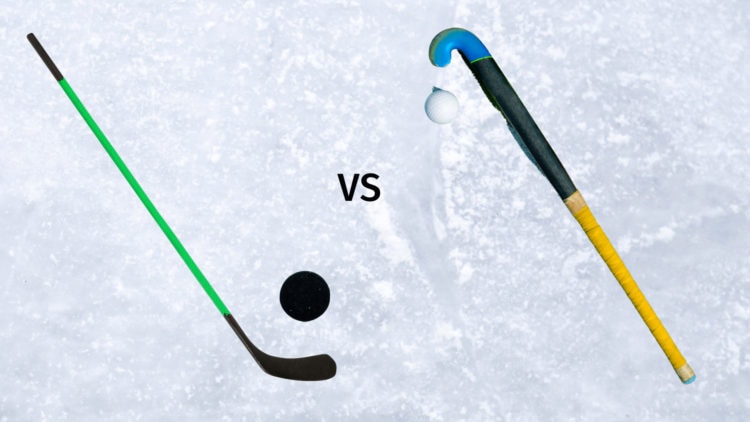
- Sticks: Field hockey sticks are flat on one side and curved at the end. They are usually made of wood, carbon, or fiberglass and are about 36-38 inches long. Ice hockey sticks are longer, with a flat blade at the end and are made from wood, fiberglass, or carbon fiber.
- Ball vs. Puck: Field hockey uses a small, hard plastic ball. Ice hockey uses a flat, rubber puck that slides on the ice.
- Protective Gear: Ice hockey players wear heavy padding, including helmets with cages, gloves, shin guards, padded shorts, and shoulder pads. Field hockey players wear mouthguards, shin guards, and sometimes face masks, but less padding overall.
Here is a quick comparison:
| Aspect | Field Hockey | Ice Hockey |
|---|---|---|
| Stick | Curved, one flat side | Straight, flat blade |
| Ball/Puck | Hard plastic ball | Rubber puck |
| Protective Gear | Mouthguard, shin guards | Helmet, full pads |
A common mistake is to think that field hockey is “safer” because there is less padding. In fact, injuries can happen in both sports, but ice hockey players need more protection due to the speed and physical contact.

Rules And Game Structure
The rules of field hockey and ice hockey set them apart even more.
- Number of Players: Field hockey teams have 11 players on the field, including the goalkeeper. Ice hockey has 6 players per team on the ice at a time (5 skaters and 1 goalie).
- Game Duration: A field hockey match consists of four quarters, each 15 minutes, totaling 60 minutes. Ice hockey games are usually three periods of 20 minutes each, also totaling 60 minutes, but with potential overtime and shootouts for tie-breakers.
- Substitutions: Field hockey allows rolling substitutions, but only at certain times. Ice hockey uses “line changes,” where players swap in and out quickly during play.
- Scoring: In field hockey, goals can only be scored from inside the “shooting circle.” In ice hockey, goals can be scored from almost anywhere on the ice.
| Rule | Field Hockey | Ice Hockey |
|---|---|---|
| Players per Team | 11 | 6 |
| Match Length | 4 x 15 min quarters | 3 x 20 min periods |
| Substitution Style | Rolling, during stoppages | Anytime, “line changes” |
| Goal Scoring Area | Inside shooting circle | Anywhere on ice |
One non-obvious detail: in field hockey, players can only use one side of their stick, while in ice hockey, both sides of the stick blade can be used to control the puck. This changes how players move and handle the ball or puck.
Style Of Play And Physical Contact
How the games are played makes a big difference in their feel and strategy.
- Physical Contact: Ice hockey allows body checking, which is a key part of the game. Players often crash into each other, especially near the boards. Field hockey, on the other hand, is a non-contact sport. Stick checking and obstruction are penalized.
- Speed: Ice hockey is generally faster because players glide on skates and the puck moves quickly over the ice. Field hockey is still quick, but running on turf is slower than skating.
- Skill Focus: Field hockey relies heavily on stick skills, passing, and tactics. Ice hockey requires skating skill, puck control, and quick reflexes.
Many beginners miss that ice hockey’s fast pace means players are on the ice for shorter “shifts,” often less than a minute. Field hockey players may stay on the field much longer, so endurance is more important.
Global Popularity And Culture
Where these sports are played and how they are viewed also sets them apart.
- Field Hockey is most popular in countries like India, the Netherlands, Australia, Germany, and the UK. It has a strong presence in schools and universities, especially among women.
- Ice Hockey is most popular in Canada, the USA, Russia, Sweden, and Finland. It is a major professional sport, especially in North America and parts of Europe.
The Olympic Games include both sports, but field hockey has been played since 1908, while ice hockey started in 1920. The professional leagues are also different—the NHL (National Hockey League) for ice hockey is famous worldwide, while field hockey has smaller leagues and less media coverage.
Common Myths And Misunderstandings
Many people confuse the two sports or believe in myths:
- Field hockey is just “hockey without ice”: In reality, the sports have different skills, tactics, and cultures.
- Ice hockey is only for cold countries: Thanks to indoor rinks, it’s played globally.
- Women only play field hockey: Both men and women play field and ice hockey at all levels.
- Equipment is interchangeable: Field hockey sticks and ice hockey sticks are not the same and can’t be used in the other sport.
Key Differences At A Glance
For a quick summary, see the main differences side by side:
| Feature | Field Hockey | Ice Hockey |
|---|---|---|
| Surface | Grass/Turf | Ice Rink |
| Ball/Puck | Ball | Puck |
| Contact | Limited | Frequent |
| Main Regions | Asia, Europe, Oceania | North America, Europe |
Frequently Asked Questions
Is Field Hockey Older Than Ice Hockey?
Yes, field hockey has ancient roots, with forms of the game played over 4,000 years ago in Egypt and Persia. Ice hockey developed much later, with the modern game starting in Canada in the 19th century.
Can A Field Hockey Player Easily Switch To Ice Hockey?
Switching is not easy. The skills, surfaces, and rules are very different. Ice hockey requires learning to skate, and field hockey has unique stick handling. Some basic tactics are similar, but most players need special training to switch.
Which Sport Is More Dangerous?
Both sports have risks. Ice hockey is more physical and has more collisions, leading to injuries like concussions. Field hockey has fewer collisions but still risks, such as being hit by the ball or stick. Proper safety gear reduces injuries in both sports.
Why Do Field Hockey Sticks Have A Curved End?
The curved end helps players control, lift, and spin the ball. The flat side is used for all play, making stick skills important. The curve also helps with powerful hits and accurate passing.
Where Can I Learn More About The Rules?
A good resource is the official websites for each sport. For ice hockey, check the Wikipedia page on ice hockey for a detailed overview.
Field hockey and ice hockey share a name but are unique sports with their own challenges, excitement, and history. Whether you prefer the speed of the ice or the strategy of the turf, both offer great experiences for players and fans.
Understanding their differences lets you enjoy each one even more.