Basketball is loved across the world, but the game’s rules change depending on where and at what level you play. One of the biggest divides is between college basketball (NCAA in the USA) and the NBA (National Basketball Association). If you’ve ever watched a college game and then an NBA match, you may have noticed differences in timing, court size, fouls, and even how the game feels. But what exactly sets them apart, and why do these differences exist?
If you’re a fan, a player hoping to transition from college to pro, or just curious about how the game evolves, understanding these rule differences is essential. Let’s break down the key distinctions, why they matter, and how they affect the way basketball is played and experienced.
Court And Equipment Differences
The court is where all the action happens. But not all courts are the same, and the equipment changes depending on the league.
Court Size
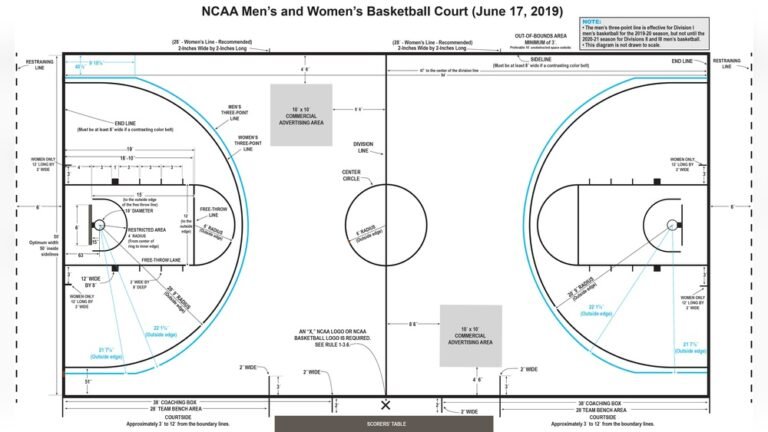
NBA courts are slightly bigger than college courts. The standard NBA court is 94 feet long and 50 feet wide. In contrast, NCAA courts measure 94 feet in length but are only 50 feet wide—so the length is the same, but the feel of the game is affected by other factors, like the three-point line and the paint area.
Three-point Line
The NBA three-point line is 23 feet 9 inches from the basket at the top of the key, and 22 feet at the corners. In college basketball, the three-point line is 22 feet 1¾ inches from the basket, for men’s basketball, and 20 feet 9 inches for women’s basketball. The closer arc in college makes long-range shooting a bit easier, which affects offensive strategies.
Paint (key) Size
The NBA paint (the rectangle under the basket, also called the key) is 16 feet wide, while the NCAA paint is only 12 feet wide. This impacts how much space players have to operate near the basket.
Ball Size
Men’s basketball uses the same size 7 ball (29.5 inches in circumference) in both NCAA and NBA. However, the women’s NCAA uses a slightly smaller ball (size 6, 28.5 inches). The NBA uses the size 7 for men’s games only.
Shot Clock
The NBA shot clock is 24 seconds, while in college basketball it’s 30 seconds for men and women. This means NBA teams must shoot faster, leading to a quicker pace and more possessions per game.
Game Duration And Structure
How long a game lasts and how it’s broken up makes a big difference in player fatigue, coaching strategy, and excitement.
Quarters Vs. Halves
The NBA divides games into four 12-minute quarters, for a total of 48 minutes of regulation play. College basketball (NCAA men’s) uses two 20-minute halves (40 minutes total), while NCAA women’s games use four 10-minute quarters. This affects not only game flow but how fouls and timeouts are managed.
Overtime
In both leagues, overtime periods are 5 minutes each. However, the buildup to overtime can feel different because of the different game structures.
Halftime
Both NBA and NCAA have a halftime break, but the length may vary. In the NBA, halftime is 15 minutes; in college, it’s usually about 15 minutes as well.

Fouls And Penalties
Foul rules influence game physicality, defensive strategies, and player discipline. There are some big differences here.
Personal Fouls
NBA players are disqualified (foul out) after 6 personal fouls. In college basketball, a player fouls out after 5 fouls.
Team Fouls And Bonus
In the NBA, after a team commits its fifth team foul in a quarter, the opposing team gets two free throws (the “penalty”). In college basketball, once a team commits its seventh team foul in a half, the other team enters the “one-and-one” bonus—making the first free throw earns a second. After the 10th team foul, it’s two free throws (the “double bonus”).
Technical And Flagrant Fouls
Both leagues penalize unsportsmanlike conduct and dangerous plays, but the NBA has stricter penalties for flagrant fouls (types 1 and 2), with automatic ejections for flagrant 2. The NCAA also penalizes flagrant fouls, but the definitions and consequences can vary.
Defensive Three-second Rule
The NBA has a defensive three-second violation, meaning a defender cannot stand in the paint for more than three seconds unless actively guarding an opponent. NCAA basketball has no such rule, allowing more zone defense strategies.
Timeouts And Substitutions
Managing timeouts and player rotations is a huge part of coaching. The rules are different at each level.
Timeouts
NBA teams get seven timeouts per game, with restrictions on how many can be used in the fourth quarter and overtime. Each timeout lasts 75 seconds.
In college basketball, each team gets four 75-second timeouts and two 30-second timeouts per game, plus additional TV timeouts. The timing and use of timeouts can greatly affect momentum.
Substitutions
Both leagues allow unlimited substitutions during stoppages, but the NBA’s faster pace and TV-driven format lead to more frequent rotations.
Overtime Rules
When the score is tied at the end of regulation, both leagues use a 5-minute overtime period. However, the NBA allows for unlimited overtimes, while college basketball rarely goes beyond one or two extra periods due to the lower scoring and slower pace.
Goaltending And Basket Interference
Goaltending occurs when a player touches the ball on its downward flight towards the basket or after it hits the backboard.
Both leagues have rules against goaltending and basket interference, but in the NBA, once a ball hits the rim, it’s fair game for anyone to touch—even above the rim. In college basketball, players cannot touch the ball while it’s on or above the rim.
Possession Arrow Vs. Jump Balls
A subtle but important difference is how tied possessions are handled.
The NBA uses a jump ball to start the game and for most tie-ups. In NCAA basketball, the initial possession is decided by a jump ball, but all other tied possessions use an alternating possession arrow system. This can affect strategy in close games.
The Nba Draft And Eligibility
While not a rule of the game, the path from college to the NBA is shaped by eligibility rules. NBA players must be at least 19 years old and one year removed from high school. College players can be younger, and their amateur status is managed differently. The transition requires adapting to new rules and game speed.
Practical Example: How These Rules Change The Game
Imagine a player who dominates in college by clogging the paint and playing zone defense. In the NBA, the defensive three-second rule forces him to move out of the paint, changing his effectiveness. Or consider a college team that uses the extra shot clock seconds to set up complex plays; that strategy may not work in the NBA’s faster environment.
Key Differences At A Glance
Here’s a quick side-by-side look at some of the most important rule differences:
| Rule | NBA | NCAA (Men’s) |
|---|---|---|
| Game Length | 4 x 12-min quarters (48 min) | 2 x 20-min halves (40 min) |
| Shot Clock | 24 seconds | 30 seconds |
| Three-Point Line | 23 ft 9 in (top) | 22 ft 1¾ in |
| Paint Width | 16 feet | 12 feet |
| Personal Fouls to Foul Out | 6 | 5 |
| Team Fouls (Bonus) | 5 per quarter (2 free throws) | 7 per half (1-and-1), 10 (double bonus) |
| Timeouts | 7 per game | 6 per game + TV timeouts |
| Possession Arrow | No (jump balls) | Yes |
| Defensive 3-Second Rule | Yes | No |
Differences In Women’s College Basketball
Women’s college basketball has its own differences. For example, the game is played in four 10-minute quarters, and the three-point line is closer (20 feet 9 inches). The shot clock is also 30 seconds, same as men’s.
Impact On Coaching And Playing Style
These rule differences don’t just change the numbers—they change how the game is played. NBA coaches must manage more possessions, focus on quick offense, and handle stricter foul rules. College coaches can use more zone defenses and set plays, thanks to the longer shot clock and different defensive rules.
Players moving from college to the NBA often struggle with the faster pace, physical demands, and new rules. For example, a player known for defense in college might find himself out of position in the NBA paint due to the defensive three-second rule.

Non-obvious Insights
- Timeout Management Is a Hidden Art: In the NBA, coaches often “save” timeouts for late-game strategy, while in college, the many TV timeouts mean less control for coaches. This changes how coaches plan end-of-game situations.
- The Possession Arrow Can Decide Games: In college, the possession arrow can determine who gets the ball in key moments, which means that even small decisions (like tying up the ball) have big strategic value. In the NBA, every tied ball is a battle, with taller players having an advantage on jump balls.
Why Do These Differences Exist?
Many of these rule differences developed to fit the needs of each league. The NBA wants a faster, higher-scoring game for entertainment, so it uses a shorter shot clock and more penalties for fouls. College basketball values teaching, development, and tradition, so its rules encourage more strategy and teamwork.
For more in-depth rulebooks, you can check the official resources at the NBA’s official rules page.

Frequently Asked Questions
What Is The Main Reason For Different Shot Clocks In College And Nba Basketball?
The NBA shot clock is 24 seconds to encourage faster play and more scoring, making the game more exciting for fans. The college shot clock is longer (30 seconds) to allow teams more time to set up plays and teach strategy.
Can College Basketball Players Go Straight To The Nba?
Most NBA players must be at least 19 years old and one year out of high school. Many play at least one year of college basketball before entering the draft, but international and G-League players can be exceptions.
Why Does The Nba Use Quarters And College Use Halves?
NBA basketball adopted quarters to create more TV ad breaks and manage game flow. Men’s college basketball uses halves for tradition, though women’s college basketball switched to quarters in 2015 to match other leagues.
Are The Three-point Lines The Same In Nba And Ncaa?
No. The NBA three-point line is farther from the basket (23 feet 9 inches at the top), making three-point shots harder. The NCAA line is closer, which changes shooting percentages and spacing.
How Do Bonus Free Throws Work In College And Nba?
In the NBA, after five team fouls in a quarter, every defensive foul leads to two free throws. In college basketball, after seven fouls in a half, the other team gets a one-and-one (must make the first to get a second). After ten fouls, it becomes two free throws every time.
Understanding the difference between college and NBA basketball rules helps fans appreciate the unique style and excitement each level brings to the court. For players and coaches, knowing these details is key to success at any level.
