
Rugby is a fast, physical sport that’s exciting to watch and play. If you’ve seen a match, you’ve probably heard fans cheer for a “try. ” This word carries a special meaning in rugby, and it’s not just about attempting to score.
Understanding what a try is—and why it matters—will help you appreciate the game’s strategy and spirit.
What Is A Try?
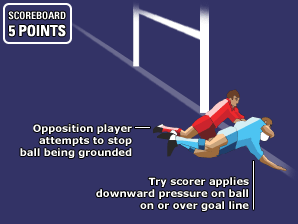
A try is the main way to score points in rugby. To earn a try, a player must carry the ball over the opponents’ goal line and touch it down on the ground within the in-goal area. This action is called “grounding the ball.” A try is worth 5 points in both rugby union and rugby league, though the exact rules and point values can vary slightly depending on the code.
The word “try” comes from the early days of rugby. Originally, grounding the ball behind the line gave a team the chance (or “try”) to kick for more points. Today, the try itself is the biggest prize.
How To Score A Try
Scoring a try sounds simple, but it’s not easy. Here’s how it works in practice:
- Carry the Ball: A player must have clear control of the ball.
- Cross the Goal Line: The player needs to move into the in-goal area, which is the space beyond the opponent’s goal line.
- Ground the Ball: The ball must be pressed down onto the ground with downward pressure. The player can use their hand, arm, or upper body. Dropping the ball or losing control before touching it down means no try.
If the referee is unsure, they may ask the video referee (known as the Television Match Official, or TMO) to review the play.
Key Rules For A Try
Several rules make sure a try is fair:
- The ball must not be dropped or knocked forward before grounding.
- The player must not step into touch (out of bounds) before scoring.
- Defenders can tackle or try to prevent the grounding, but not illegally (such as high tackles).
- In rugby union, a try can also be scored from a rolling maul—a group pushing over the line.
If there’s a foul during the act of scoring, the referee may award a penalty try, which is an automatic try given when a try would likely have been scored but for illegal play.
Points Value: Rugby Union Vs. Rugby League
The try’s value is different between the two main types of rugby:
| Type of Rugby | Points for a Try | Conversion Attempt |
|---|---|---|
| Rugby Union | 5 | Yes, 2 points |
| Rugby League | 4 | Yes, 2 points |
In both, after a try is scored, the team can attempt a conversion kick for extra points.

The Conversion: Extra Points After A Try
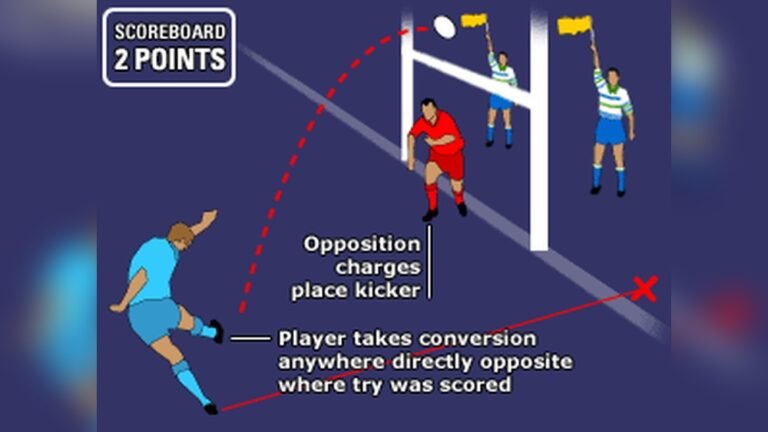
After a try, the scoring team gets a chance for a conversion. This is a kick at goal, taken in line with where the try was scored. If successful, the team gets 2 more points. The kicker can choose how far back to take the kick, often picking a spot that suits their style.
If a try is scored near the posts, the conversion is easier. If it’s near the sideline, the angle is much harder.
Penalty Try: When Fouls Stop A Score
Sometimes, a defender breaks the rules to stop a certain try. In these cases, the referee can award a penalty try. This gives the full points for a try, plus the conversion automatically, with no kick needed.
Penalty tries are rare but important. They punish unfair play and protect the attacking team’s right to score.
Famous Try Examples
Tries are often the most memorable moments in rugby. Here are two famous examples:
- In the 2003 Rugby World Cup final, Jason Robinson scored a try for England, helping his team win the trophy.
- In 2015, Julian Savea scored a remarkable try for New Zealand against France, running through several defenders in a single move.
These moments show how a try can change a game and create history.
Common Mistakes And Missed Tries
Even experienced players sometimes miss tries because of small errors. Here are mistakes to avoid:
- Knock-on: Losing control and pushing the ball forward before grounding means no try.
- Out of Bounds: Stepping on or over the sideline before grounding cancels the score.
- Double Movement (League): In rugby league, a tackled player cannot make a second movement to score.
Coaches always stress the importance of control and awareness near the try line.
How Tries Shape The Game
Because a try is worth the most points, teams build their strategies around scoring or stopping tries. Attacking teams use creative moves and teamwork to break defenses. Defending teams focus on tackling and positioning.
A single try can shift momentum and lift a team’s confidence. In close matches, one try often decides the winner.
Try Statistics In Major Rugby Events
Looking at top tournaments, tries are a key stat. For example, the 2019 Rugby World Cup saw 285 tries scored in 48 matches, with South Africa leading the way. In club competitions like the English Premiership, some teams average more than 3 tries per game.
The number of tries can show which teams play attacking rugby.
Try Celebrations And Culture
Scoring a try is an emotional moment. Players often celebrate with teammates, and fans love to join in. Some players have signature celebrations, but respect for the opponent is part of rugby’s culture.
Celebrating too much or taunting can lead to penalties or warnings from referees.
Try Vs. Other Scores In Rugby
Tries are not the only way to score, but they are the most valuable.
| Score Type | Rugby Union Points | Rugby League Points |
|---|---|---|
| Try | 5 | 4 |
| Conversion | 2 | 2 |
| Penalty Goal | 3 | 2 |
| Drop Goal | 3 | 1 |
This table shows why teams focus on tries—they offer the biggest reward for attacking play.

Non-obvious Insights About Tries
Most beginners don’t realize:
- Try Location Matters: Where a try is scored affects the difficulty of the conversion kick. Scoring near the posts makes extra points much easier.
- Teamwork Is Essential: Most tries are not the result of one player’s skill, but a series of passes, runs, and support from the whole team.
- Video Reviews (TMO): In big matches, technology helps referees make tough calls, which can add drama and suspense.
Frequently Asked Questions
What Happens If The Ball Is Dropped Before Grounding?
If the ball is dropped before being grounded, it’s called a knock-on. No try is awarded, and the defending team gets a scrum.
Can You Score A Try By Kicking The Ball?
A player can kick the ball ahead, but to score a try, they must regain control and ground the ball themselves or a teammate must do so.
What Is An In-goal Area?
The in-goal area is the space behind the goal line and between the touch lines. This is where the ball must be grounded for a try.
How Is A Penalty Try Different From A Normal Try?
A penalty try is awarded by the referee when a try would probably have been scored except for foul play. The conversion is automatic—no kick is taken.
Are All Tries Worth The Same Points?
No. In rugby union a try is worth 5 points, but in rugby league it’s worth 4 points. The value can also vary in youth or social competitions.
Scoring a try is the heart of rugby. It brings excitement, drama, and often decides the outcome of the game. Whether you’re new to rugby or a longtime fan, understanding tries gives you a deeper appreciation for this thrilling sport. For more official rules and history, check the Wikipedia Try (rugby) page.
