
A basketball court is where exciting moments and big dreams happen. But have you ever wondered about its exact size and layout? Whether you play for fun, coach, or just love watching games, knowing the dimensions of a basketball court can help you understand the sport better. Court sizes are not the same everywhere—different leagues and levels of play use different measurements. From professional arenas to school gyms, each court has its own shape and numbers. Let’s explore the details, so next time you watch or play, you’ll see the court in a new way.
Standard Basketball Court Dimensions
Let’s start with the most recognized measurements in the world: the NBA court and the FIBA court. These two organizations set the standards for professional basketball, but they are not exactly the same.
Nba Court Dimensions
The NBA, which is the top league in the United States, uses a specific court size.
- Length: 94 feet (28.65 meters)
- Width: 50 feet (15.24 meters)
This is the same size used in most U. S. colleges and many high schools. The NBA also has exact sizes for lines and markings, which help with fair play and consistency.
Fiba Court Dimensions
FIBA is the international basketball organization, and most countries outside the U. S. follow its rules.
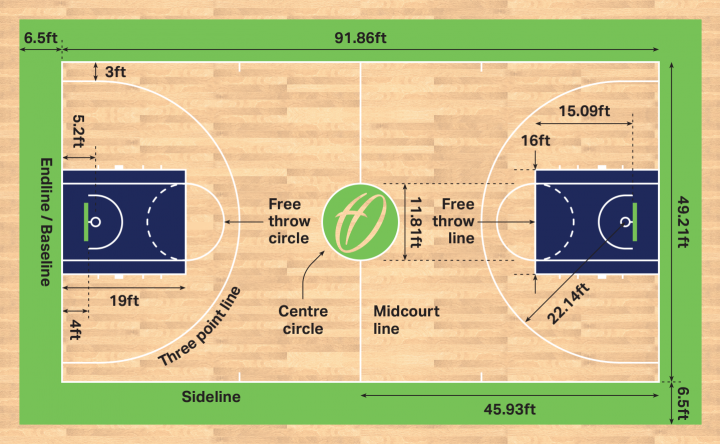
- Length: 28 meters (91.86 feet)
- Width: 15 meters (49.21 feet)
You’ll notice FIBA courts are a little shorter and narrower than NBA courts. This can affect the pace of the game and even the strategies teams use.
Ncaa And High School Courts
- NCAA (college basketball): Same as NBA—94 feet by 50 feet.
- High School (U.S.): 84 feet (25.6 meters) long and 50 feet (15.24 meters) wide.
These differences matter when players move between levels. For example, high school players often notice the extra 10 feet in college or pro gyms.
Key Areas And Their Measurements
Knowing the total court size is only the beginning. Every basketball court has special areas with their own measurements. These include the three-point line, free throw lane, key (paint), and more.
Center Circle
This is where the jump ball happens at the start of the game.
- NBA and NCAA: 12 feet (3.66 meters) in diameter
- FIBA: 3.6 meters (11.81 feet) in diameter
Three-point Line
Scoring a basket from behind this arc gives your team three points instead of two.
- NBA: 23.75 feet (7.24 meters) from the basket at the top of the arc, 22 feet (6.7 meters) in the corners
- FIBA: 6.75 meters (22.15 feet) from the basket
- High School: 19.75 feet (6.02 meters) from the basket
The three-point line distance is one of the biggest differences between levels. NBA players face a longer shot, which makes their three-pointers even more impressive.
Free Throw Line
This line is where players stand to shoot free throws after a foul.
- All levels: 15 feet (4.57 meters) from the backboard
This distance is the same in NBA, FIBA, NCAA, and high school basketball.
Key (paint) And Free Throw Lane
This area is also called the key or the paint. It is the rectangular area under the basket.
- NBA: 16 feet (4.88 meters) wide
- FIBA: 4.9 meters (16.08 feet) wide
- NCAA and High School: 12 feet (3.66 meters) wide
The key’s width affects how much space big players have to operate. In the NBA, the key is wider than in FIBA or college basketball.
Restricted Area Arc
This is the semicircle under the basket. Defenders can’t draw charging fouls if they’re standing inside this arc.
- NBA: 4 feet (1.22 meters) radius from the center of the basket
- FIBA: 1.25 meters (4.1 feet) radius
Baseline And Sideline
- Baseline: The short boundary lines under each basket (width of the court)
- Sideline: The long boundary lines along the court’s length
These lines are part of the court’s total dimensions, but each has a standard thickness—usually about 2 inches (5 cm).
Basketball Hoop And Backboard Dimensions
A basketball court is not complete without the hoop and backboard. Their size and position are strictly regulated.
Basketball Hoop
- Height: 10 feet (3.05 meters) from the playing surface
- Rim Diameter: 18 inches (45.72 cm)
This never changes, from pro basketball to children’s leagues (although very young kids sometimes use lower rims).
Backboard
- Width: 6 feet (1.83 meters)
- Height: 3.5 feet (1.07 meters)
- Inner Rectangle (Shooter’s Square): 24 inches (61 cm) wide by 18 inches (45.7 cm) tall
The backboard’s size helps players aim their shots and bank the ball off the glass. The shooter’s square is especially useful for practicing layups and bank shots.
Comparison Of Court Sizes Across Levels
To make the differences easier to see, here is a comparison of the main court dimensions for NBA, FIBA, NCAA, and high school courts.
| Organization | Length | Width | Three-Point Line | Key Width |
|---|---|---|---|---|
| NBA | 94 ft (28.65 m) | 50 ft (15.24 m) | 23.75 ft (7.24 m) | 16 ft (4.88 m) |
| FIBA | 91.86 ft (28 m) | 49.21 ft (15 m) | 22.15 ft (6.75 m) | 16.08 ft (4.9 m) |
| NCAA | 94 ft (28.65 m) | 50 ft (15.24 m) | 22.15 ft (6.75 m) | 12 ft (3.66 m) |
| High School | 84 ft (25.6 m) | 50 ft (15.24 m) | 19.75 ft (6.02 m) | 12 ft (3.66 m) |
This table highlights how court sizes shift as players move up in competition.

The Importance Of Court Dimensions
You might think a few feet do not matter, but they actually change the game in many ways:
- Pace of Play: A bigger court (NBA) means players run more and need better fitness.
- Three-Point Shooting: A longer arc (NBA) makes it harder to score from deep.
- Spacing: Wider keys and courts create more room for players to drive or pass.
- Defense: Shorter courts (high school) often lead to more crowded paint and less room to operate.
These details explain why players sometimes struggle when moving from one level to another. Even a small change in distance can affect shooting percentages and strategies.
Non-obvious Court Features
Many beginners miss the purpose of some court markings. Here are two you might not notice at first:
- Hash Marks: Small lines along the lane tell players where to stand during free throws. Positioning is critical for rebounding after a missed shot.
- Coach’s Box: A marked area along the sideline shows where coaches can stand during play. Staying inside this box is required, especially in professional and college games.
Understanding these helps you see the court as more than just lines and paint—it’s a carefully designed space to make games fair and exciting.
Outdoor Vs Indoor Court Dimensions
Most outdoor courts in parks or homes try to copy NBA or high school sizes, but often they are smaller due to space limits. However, the hoop height almost always remains at 10 feet. If you plan to build your own court, remember:
- Use available space wisely. A full-size NBA court is hard to fit in a backyard.
- Mark key areas (like the free throw line and three-point arc) as closely as possible to official measurements.
- For half-courts, divide the length in half, but keep the width and hoop height the same.
Court Materials And Surface Markings
Court surfaces affect how the game feels and how players move.
- Indoor Courts: Made from polished hardwood (usually maple). This surface offers good bounce and grip, helping with fast moves and jumps.
- Outdoor Courts: Usually concrete, asphalt, or synthetic materials. These are tougher on shoes and bodies, and lines can wear off faster.
The court markings are typically painted or taped in white or contrasting colors so they are easy to see. If you play outdoors, check the lines often—faded markings can lead to confusion during games.

How Court Dimensions Affect Tactics
The best teams and players use court size to their advantage. For example:
- NBA teams use the wide key and longer three-point line to spread out shooters, making it harder for defenders to help each other.
- College teams may run different offenses because their keys are narrower and three-point shots are closer.
- International teams often use more passing and movement, since their court is slightly smaller and the key is almost as wide as the NBA’s.
Smart coaches plan their defenses and offenses based on these small but important differences.
Court Dimension Myths And Common Mistakes
Many people think all basketball courts are the same size. In reality, as you’ve seen, even small differences can impact play. Here are some mistakes to avoid:
- Assuming all three-point lines are the same. Practice at your level’s distance.
- Building a backyard court without checking official dimensions. Even small mistakes can make shooting and spacing feel off.
- Ignoring surface type. A slippery or uneven floor changes how you play and can cause injuries.
If you’re planning to build or mark a court, always double-check the measurements for your league or main use.
Detailed Markings And Measurements
Sometimes, the small details matter most, especially for referees and serious players. Here are a few more:
| Marking | NBA Measurement | FIBA Measurement | NCAA/High School |
|---|---|---|---|
| Free Throw Circle Diameter | 12 ft (3.66 m) | 3.6 m (11.81 ft) | 12 ft (3.66 m) |
| Distance from Baseline to Free Throw Line | 15 ft (4.57 m) | 4.57 m (15 ft) | 15 ft (4.57 m) |
| Backboard Distance from Baseline | 4 ft (1.22 m) | 1.2 m (3.94 ft) | 4 ft (1.22 m) |
These details can be useful if you’re a coach, player, or even designing a court for school or community use.
Where To Find Official Court Diagrams
If you want to see professional diagrams and up-to-date measurements, check the rules on the websites of each organization. For a reliable resource, look at the official Wikipedia page about basketball courts.
Frequently Asked Questions
What Are The Official Nba Basketball Court Dimensions?
The NBA court is 94 feet long and 50 feet wide. The three-point line is 23.75 feet from the basket at the top, and the key is 16 feet wide. The hoop is always 10 feet high.
How Does A Fiba Basketball Court Differ From An Nba Court?
A FIBA court is slightly shorter (28 meters or 91.86 feet) and narrower (15 meters or 49.21 feet) than an NBA court. The three-point line is closer (6.75 meters), and the key is similar in width to the NBA.
Are High School Basketball Courts Smaller Than College Or Professional Courts?
Yes, high school courts are usually 84 feet long and 50 feet wide. The three-point line is also closer (19.75 feet), and the key is only 12 feet wide.
Why Do Three-point Line Distances Matter?
The three-point line distance affects shooting difficulty and team strategy. NBA players shoot from farther away, making three-point shots harder and more valuable.
Can I Build A Basketball Court At Home Using Official Dimensions?
You can, but a full-size NBA court needs a lot of space (94×50 feet). Many people build half-courts or use high school dimensions. Always keep the hoop at 10 feet and mark the key areas as accurately as possible.
Understanding the dimensions of a basketball court can help you appreciate the details behind every game. Whether you play, coach, or watch, knowing these measurements gives you a new level of respect for the sport and its players. Use this knowledge to spot subtle differences between games, improve your own play, or even design a better court for your community.
