Basketball is one of the world’s most exciting and fast-paced sports. It combines skill, teamwork, athleticism, and strategy in a way that’s easy for beginners to pick up, but hard to master. Whether you’re watching a professional game or playing with friends at the park, understanding the basic rules of basketball makes the experience much more enjoyable. These rules shape how the game is played, keep it fair, and help everyone communicate on the court.
Many people know the aim is to shoot the ball through the hoop, but there’s much more to basketball than just scoring points. From the number of players on the court to what counts as a foul, every detail has a rule behind it.
Even small things like how long a player can hold the ball or where they can stand are guided by clear rules. These basics are important for players of all levels, and even fans who want to enjoy the game fully.
If you are new to basketball or want a stronger grasp of the game, this guide will explain all the main rules in simple language. You will learn about the court, how the game starts, scoring, common violations, fouls, substitutions, timeouts, and more.
Along the way, you’ll discover useful details that beginners often miss, so you’ll feel more confident playing or watching basketball.
The Basketball Court And Equipment
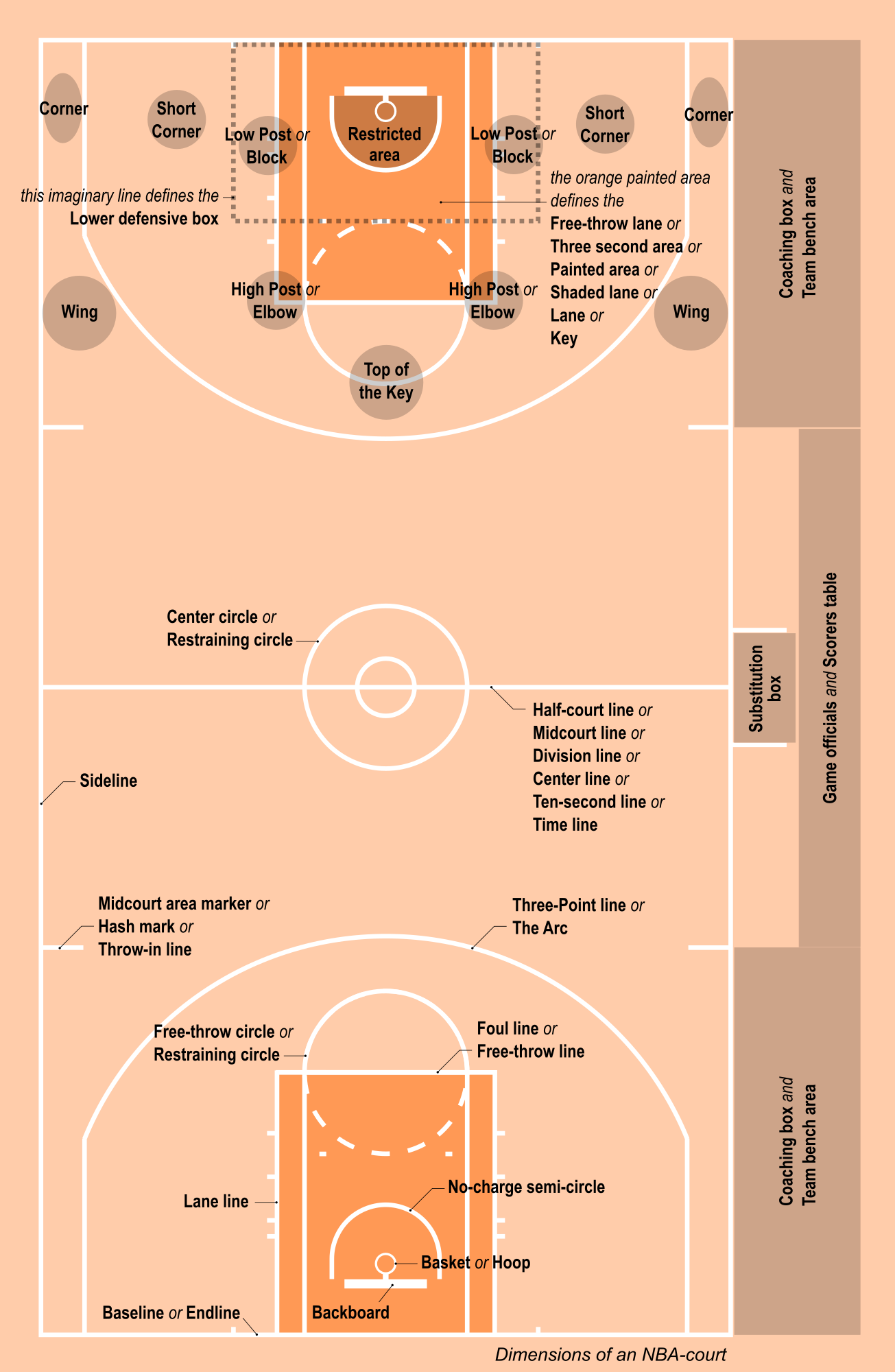
Basketball is played on a rectangular court with a hoop at each end. The court’s size can vary, but professional and college courts are 28 meters (about 94 feet) long and 15 meters (about 50 feet) wide. The main parts of the court are:
- Free-throw line: 4.6 meters (15 feet) from the backboard.
- Three-point line: 6.75 meters (22.15 feet) from the basket in international play; 7.24 meters (23.75 feet) in the NBA.
- Paint (key area): The rectangular area near the basket where players cannot stay too long.
- Half-court line: Divides the court into two halves.
The basket is 3.05 meters (10 feet) high. The ball is usually made of leather or composite material and is about 75 centimeters (29.5 inches) in circumference for men, and 72 centimeters (28.5 inches) for women’s games.
Comparison Of Court Dimensions
| Level | Length (m) | Width (m) | Three-Point Line (m) |
|---|---|---|---|
| NBA | 28.65 | 15.24 | 7.24 |
| FIBA | 28.00 | 15.00 | 6.75 |
| High School | 25.60 | 15.00 | 6.02 |
Number Of Players And Team Structure
Each team has five players on the court at one time. These include:
- Point guard: Directs the team’s offense.
- Shooting guard: Scores points, often from long range.
- Small forward: Versatile, both scores and defends.
- Power forward: Strong and good at rebounding.
- Center: Tallest, plays near the basket.
Most teams have 12–15 players in total, so substitutions are common. This keeps the game fast and lets tired players rest.
Starting The Game: The Jump Ball
The game begins with a jump ball at center court. The referee throws the ball upward between two players, usually the centers. Each tries to tap it to a teammate. After this, possession alternates for other jump-ball situations.
Scoring Points
The main goal in basketball is to score by putting the ball through the opponent’s hoop. Points are awarded based on where the shot is taken:
- 2 points: Any shot made from inside the three-point line.
- 3 points: A shot made from beyond the three-point line.
- 1 point: Free throws, taken after certain fouls.
Example Of Scoring
If a player is fouled while shooting a three-pointer and makes the basket, they get 3 points plus one free throw (potential for 4 points).
Game Duration And Clock Rules
A standard basketball game is divided into four quarters. The length depends on the level:
- NBA: 12 minutes per quarter (48 minutes total)
- FIBA/International: 10 minutes per quarter (40 minutes total)
- High School: 8 minutes per quarter
There’s a short break between quarters and a longer halftime break. If the score is tied after the last quarter, the game goes into overtime, usually 5 minutes.
Shot Clock
Teams must attempt a shot within a certain time after gaining possession:
- NBA: 24 seconds
- FIBA: 24 seconds
- College: 30 seconds
If the team fails, it’s a shot clock violation and the ball is given to the other team.
Basic Rules Of Ball Movement
The ball can be moved in two ways:
- Dribbling: Bouncing the ball while walking or running.
- Passing: Throwing the ball to a teammate.
Players cannot run with the ball without dribbling. This prevents traveling and keeps the game fair.

Violations: Actions That Are Not Allowed
Violations are minor rule breaks that do not involve physical contact. The other team gets the ball if a violation happens.
Common Violations
- Traveling: Taking too many steps without dribbling.
- Double dribble: Stopping the dribble, then starting again, or dribbling with both hands.
- Carrying/palming: Turning the hand under the ball while dribbling.
- Backcourt violation: After crossing the half-court line, the team cannot return the ball to their own half.
- Three-second violation: An offensive player stays in the paint for more than three seconds.
- Five-second violation: Failing to inbound the ball within five seconds.
- Shot clock violation: Not attempting a shot before the shot clock runs out.
- Goaltending: Blocking a shot after it’s on the way down or touching the rim.
Violation Consequences
When a violation occurs, the other team gets possession. For example, if a player travels, the ball goes to the other team at the spot of the violation.
Fouls: Illegal Physical Contact
A foul is an illegal action involving physical contact. Basketball allows some contact, but pushing, hitting, or holding is not allowed.
Types Of Fouls
- Personal foul: Illegal contact with an opponent, such as hitting, holding, or blocking.
- Shooting foul: Fouling a player while they are shooting. The shooter gets free throws.
- Offensive foul: The player with the ball charges into a defender.
- Technical foul: Breaking rules like unsportsmanlike conduct or arguing with referees. Results in free throws.
- Flagrant foul: Violent or dangerous contact. Often punished with extra free throws and possible ejection.
Foul Limits
Players can only commit a certain number of fouls before they must leave the game:
- NBA: 6 personal fouls
- FIBA: 5 personal fouls
When a team commits too many fouls in a quarter (usually 5), the other team gets free throws for every foul after that.
Free Throws
After certain fouls, players take free throws from the free-throw line. Each basket is worth one point. The shooter cannot step over the line until the ball hits the rim.
Substitutions And Timeouts
Coaches can substitute players during stoppages, but not during live play unless the referee allows. Each team gets a limited number of timeouts to rest, strategize, or stop the clock.
Timeout And Substitution Comparison
| Level | Team Timeouts | Player Fouls to Foul Out |
|---|---|---|
| NBA | 7 (per game) | 6 |
| FIBA | 5 (per game) | 5 |
| High School | 5 (per game) | 5 |
Out Of Bounds And Possession
If the ball goes outside the court lines, it is out of bounds. The last team or player to touch the ball loses possession. The other team throws the ball in from the sideline or baseline.
The Role Of Referees
There are usually three referees in professional games. They enforce the rules, call fouls, and manage the game clock. They also control substitutions and handle disputes. Referee decisions are final, and arguing can result in technical fouls.
Overtime Rules
If the score is tied at the end of regulation, the game goes to overtime. Overtime periods are shorter (usually 5 minutes). Teams get extra timeouts, and the rules remain the same.
Key Insights For Beginners
Many beginners focus only on scoring, but two important details are often missed:
- Movement without the ball is critical. Players not holding the ball must follow rules, like not staying in the paint for too long or not blocking defenders illegally. Learning to move smartly can change a game.
- Foul trouble can change a team’s strategy. If a key player has many fouls, coaches may sit them out to avoid ejection. Teams with many fouls give up extra free throws, so playing defense without fouling is a big skill.
Another common beginner mistake is ignoring the shot clock. Teams must always be aware of how much time they have to shoot, or they risk losing possession.
Basic Strategies Tied To The Rules
Understanding the rules leads to smarter play. For example, teams use timeouts to break the momentum of the other team or to set up important plays. Substitutions allow coaches to use their best defenders or scorers at the right moment.
Defensive teams may intentionally foul weak free-throw shooters late in games, hoping they miss their shots. This is called the “Hack-a-Shaq” strategy, named after former NBA player Shaquille O’Neal.
Differences In Basketball Rules
Rules can change between leagues. For example, the NBA, FIBA, and college basketball all have small differences in things like court size, shot clock, and number of fouls allowed. Always check the exact rules for the league you play in.
Rule Differences Example
| Rule | NBA | FIBA |
|---|---|---|
| Game Length | 4 x 12 min | 4 x 10 min |
| Shot Clock | 24 sec | 24 sec |
| Three-Point Line | 7.24 m | 6.75 m |
| Fouls to Foul Out | 6 | 5 |
Sportsmanship And Fair Play
Besides the official rules, basketball values sportsmanship. Respecting opponents, referees, and teammates is expected. Unsportsmanlike behavior can result in technical fouls or ejection from the game.
Learning And Improving
The best way to learn the rules is to watch games and practice. Pay attention to referee signals and how players react to fouls and violations. Many leagues, from youth to adult, use slightly different rules, but the basics are always similar.
For a deeper understanding of international basketball rules, the official FIBA website is a reliable resource: Wikipedia: Rules of Basketball.
Basketball combines clear rules with fast action and teamwork. By understanding the basics, you will enjoy the game more—whether you play, coach, or watch.
Frequently Asked Questions
What Is A Double Dribble In Basketball?
A double dribble happens when a player stops dribbling, holds the ball, then starts dribbling again, or dribbles with both hands at the same time. This is not allowed. The other team gets the ball if this happens.
How Many Fouls Before A Player Is Disqualified?
In most leagues, a player is disqualified after five or six personal fouls. For example, the NBA allows six fouls, while FIBA and high school games allow five.
What Is The Three-second Rule?
The three-second rule says that an offensive player cannot stay in the paint (key area) for more than three seconds. If they do, the referee calls a violation, and the ball goes to the other team.
When Is A Shot Worth Three Points?
A shot is worth three points if the player’s feet are behind the three-point line when they release the ball. If any part of the foot is on the line, the shot is only worth two points.
Can You Block A Shot After It Hits The Backboard?
No, this is called goaltending. Once the ball touches the backboard on its way down, or is above the rim, defenders cannot touch it. The basket counts if they do.
Basketball’s basic rules may seem complex at first, but learning them makes the game much more fun. With practice and attention, anyone can enjoy playing or watching basketball at any level.
