
Baseball is often called America’s pastime, and the Major League Baseball (MLB) game is at its heart. Many people, especially those new to the sport, wonder: How many innings are played in a standard MLB baseball game? The answer seems simple at first, but there’s more to it than just a number. Let’s take a closer look at innings, how they work, and why the number can sometimes change. By the end of this article, you’ll understand not just the rule, but the details behind it and what makes baseball so unique.
Understanding Innings In Baseball
An inning is a key part of every baseball game. In simple words, an inning is a segment of the game where both teams have a chance to bat and field. The visiting team bats first in the top half, and the home team bats in the bottom half. Each team tries to score as many runs as possible before making three outs.
In professional baseball, the inning is the basic unit that shapes how long the game lasts. But just saying “nine innings” is not enough to explain all the possibilities in a standard MLB game.
Standard Number Of Innings In An Mlb Game
A standard MLB game is scheduled for nine innings. This has been the rule for over a century. Each team gets to bat nine times, unless the home team is winning after the top of the ninth inning, in which case the game ends immediately without the home team needing to bat again.
Here’s how it works:
- The visiting team bats first in each inning (top of the inning).
- The home team bats second (bottom of the inning).
- Each half-inning ends when the fielding team gets three outs.
- This continues until nine innings are completed.
If the score is tied after nine innings, the game goes into extra innings. If the home team is ahead after the top of the ninth, they win without needing to bat again.
Quick Example
Suppose the New York Yankees are playing the Boston Red Sox. After nine innings, the score is 5-3 for the Yankees. If the Red Sox are the home team and still behind after their last chance to bat, the Yankees win. If the score is tied, the game continues.
Why Nine Innings?
Baseball didn’t always have nine innings. In the 1800s, games were played to a set number of runs (often 21) or sometimes seven innings. But by 1857, nine innings became the standard. This change gave both teams equal chances and added more strategy to the game.
The nine-inning rule makes sure that:
- Each team has many chances to score.
- Games are long enough for comebacks.
- The contest feels fair and complete.
How Long Does A Nine-inning Game Last?
The number of innings is fixed, but the time is not. A nine-inning MLB game can last anywhere from two and a half hours to over four hours, depending on several factors:
- Number of runs scored
- Number of pitching changes
- Time between pitches
- Reviews or delays
According to MLB data, the average nine-inning game in 2023 lasted about 2 hours and 40 minutes. This is shorter than previous years, thanks to new rules like the pitch clock.
Comparison: Average Game Times By Year
Here is a comparison of average game times for nine-inning MLB games from recent years:
| Year | Average Time | Reason for Change |
|---|---|---|
| 2021 | 3h 10m | Slower pace, no pitch clock |
| 2022 | 3h 03m | Small rule adjustments |
| 2023 | 2h 40m | Pitch clock introduced |
You can see that the number of innings stays the same, but the total time can change.
What Happens If The Game Is Tied After Nine Innings?
If the score is tied at the end of nine innings, the game does not end. Instead, teams play extra innings until one team has more runs at the end of a completed inning. This means a game could go to 10, 11, or even 15 or more innings. The longest MLB game ever lasted 26 innings (Brooklyn Robins vs. Boston Braves, 1920).
Here’s how extra innings work:
- The game continues, inning by inning.
- Each team gets a turn to bat and field.
- The first team to lead at the end of a completed inning wins.
Since 2020, a special rule places a runner on second base at the start of each extra half-inning to help end games faster.
Shortened And Suspended Games
Not all MLB games finish the full nine innings. Sometimes, games are shortened or suspended because of weather, darkness (in stadiums without lights, very rare now), or other reasons.
Rain-shortened Games
If it rains and the game cannot continue:
- If at least five innings are complete (or 4.5 innings if the home team is ahead), the game is official.
- The team with more runs wins.
- If the game is tied, it may be suspended and finished later.
Suspended Games
If a game is stopped before it is official, it is suspended and completed at a later date from where it left off.
Comparison: Full Game Vs. Shortened Game
| Situation | Number of Innings | Result |
|---|---|---|
| Standard, full game | 9 (or more with extra innings) | Official result |
| Rain-shortened, official | 5 or more | Official result |
| Suspended, not official | Less than 5 | Continued later |
Doubleheaders And Seven-inning Games
In rare cases, MLB has used seven-inning games. During the 2020 and 2021 seasons, doubleheaders (two games in one day between the same teams) were played as seven-inning games to reduce player fatigue during the pandemic. This rule is no longer in use for regular-season games, but it is an important part of recent history.
Fans should know that for playoffs and most regular games, nine innings is the rule. Seven-inning games are only for specific, temporary situations.
Innings In Other Baseball Leagues
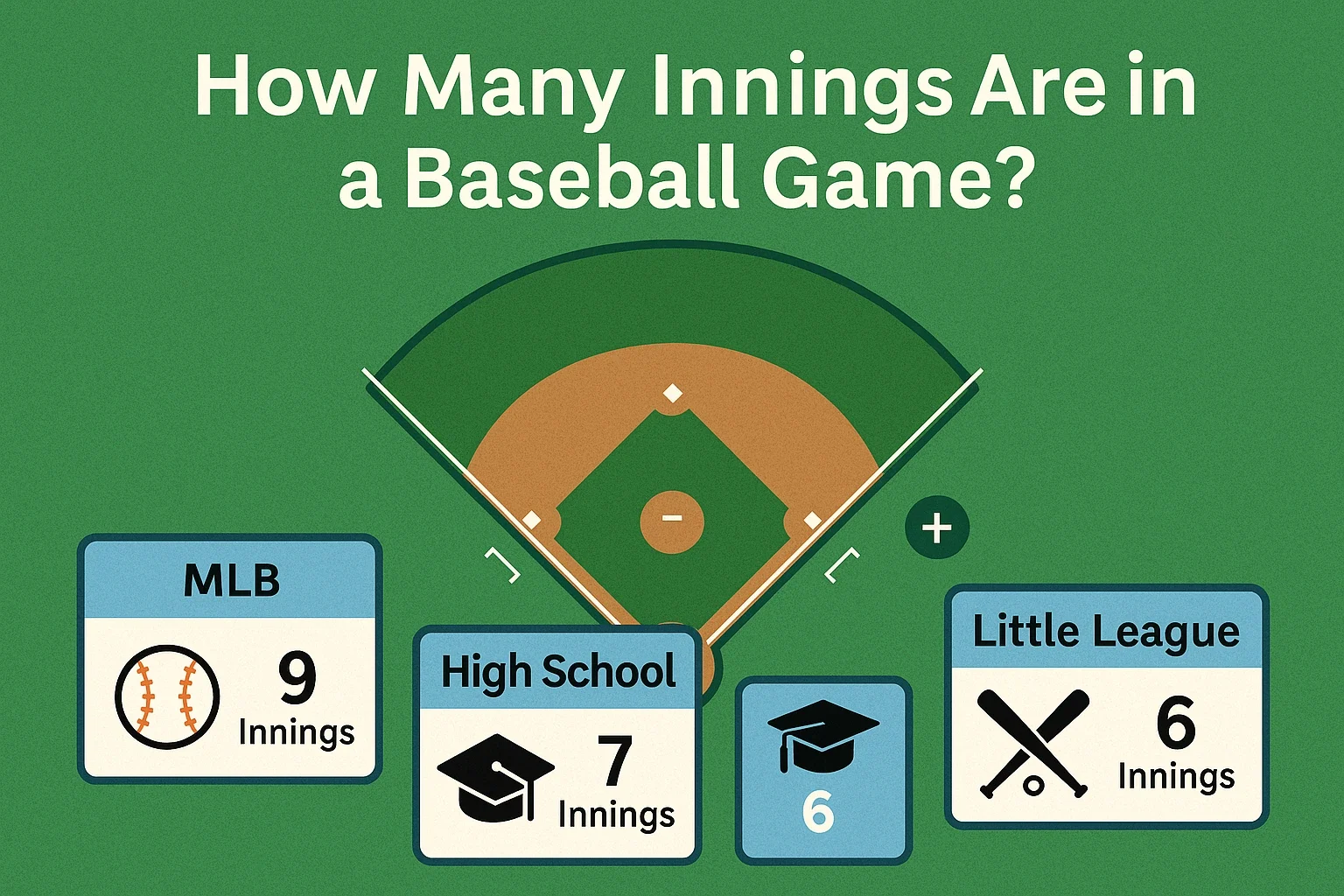
While MLB uses nine innings, some other leagues or levels of baseball use different numbers:
- Minor League Baseball: Doubleheaders are often seven innings.
- College Baseball: Usually nine innings, but sometimes seven for doubleheaders.
- High School Baseball: Usually seven innings.
- Little League: Six innings.
This difference can confuse new fans. Always check which league is playing to know the number of innings.
Unique Aspects Of Baseball Innings
Baseball is different from sports like soccer or basketball. In those sports, the game has a set time, and the clock decides when the game ends. But in baseball, the number of outs (not time) decides when an inning or game is over. This means:
- A team can make a big comeback in the last inning.
- There is no clock running out; each team gets all their chances.
- Games can be much longer or shorter than expected.
This is one reason why baseball fans love the game. The excitement can last until the very last out.
Key Rules Related To Innings
Understanding a few important rules will help you enjoy MLB games more.
- Mercy Rule: There is NO mercy rule in MLB. Games continue no matter the score.
- Walk-Off Wins: If the home team takes the lead in the bottom of the ninth or later, the game ends immediately.
- Batting Order: Each player gets a chance to bat in the same order through the innings.
- Pitching Changes: Managers can change pitchers between or during innings, but each pitcher must face at least three batters (with some exceptions).
Common Questions New Fans Have
Does Every Player Bat In Every Inning?
No. Only three outs are allowed per team per half-inning, so not every player gets to bat each inning. The lineup continues from where it left off in the previous inning.
Can A Game End Before Nine Innings?
Yes, but only in special situations like weather or if the home team is winning after the top of the ninth.
Why Do Some Games Last Much Longer?
Extra innings, many runs, pitching changes, or long at-bats can make games much longer than normal.
What Is The Shortest Possible Mlb Game?
A game can be official after five innings if stopped by weather, but the scheduled length is always nine innings.
Are There Ever 10-inning, 12-inning, Or 20-inning Games?
Yes. If the score is tied after nine, the game continues with extra innings until someone wins. Some of the longest games in history have gone over 20 innings.
Notable Long And Short Mlb Games
Some games become famous because of how long or short they are.
- The longest game by innings: 26 innings (Brooklyn Robins vs. Boston Braves, 1920).
- The longest by time: Over 8 hours (Chicago White Sox vs. Milwaukee Brewers, 1984, 25 innings).
- The shortest nine-inning game: Just 51 minutes (New York Giants vs. Philadelphia Phillies, 1919).
These extremes show that while nine innings are standard, the experience of watching a game can vary greatly.

How Innings Shape Baseball Strategy
Managers and players must plan for nine innings. They decide when to use their best pitchers, how to set the batting order, and when to take risks. If a game goes into extra innings, teams must be creative because they may run out of pitchers or bench players.
A common beginner mistake is thinking all innings are the same. In reality, the last three innings (seventh, eighth, ninth) are often called the “late innings” and can be the most dramatic. Teams use their best relief pitchers, and every play is critical.
Why Understanding Innings Matters
If you’re new to baseball, knowing about innings helps you:
- Follow the game’s progress
- Understand when the most important moments happen
- Appreciate the unique drama of a sport without a game clock
Even longtime fans sometimes overlook how innings affect strategy, game length, and excitement.
Frequently Asked Questions
How Many Innings Are In A Standard Mlb Baseball Game?
A standard MLB game is scheduled for nine innings. Each team gets to bat and play defense in each inning unless the home team leads after the top of the ninth.
What Happens If The Game Is Tied After Nine Innings?
The game goes into extra innings. Teams play one full inning at a time until one team is ahead after both have batted.
Can An Mlb Game End Before Nine Innings?
Yes, but only in special cases like weather. If five innings are complete (or 4. 5 if the home team leads), the game can be official and end early.
Are There Any Situations When Games Are Not Nine Innings?
Doubleheaders during 2020 and 2021 were played as seven-inning games. In the minors and other leagues, seven-inning games are more common.
Where Can I Find The Official Mlb Rules About Innings?
You can read the official rules on the MLB website or check this Wikipedia page on baseball rules for a helpful overview.
Baseball’s nine-inning structure is central to the sport’s character. It gives every team a fair shot and keeps fans guessing until the final out. Whether you’re a new fan or a seasoned expert, understanding innings helps you see why MLB games are as exciting and unpredictable as they are.
