
Rugby is a fast, physical sport that excites millions worldwide. But for new fans, the way points are scored can seem confusing. If you’ve ever wondered why some tries are worth five points or how a drop goal works, this guide will make it clear.
By the end, you’ll understand every way teams add to their score in rugby, common strategies, and even some details that many beginners miss.
Main Ways To Score In Rugby
Understanding scoring is the heart of enjoying rugby. There are several ways teams can earn points, each with its own rules and value.
Try
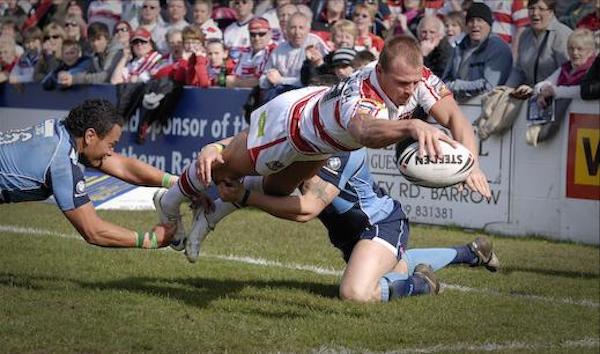
A try is the main way teams score. To score a try, a player must ground the ball in the opponent’s in-goal area (beyond the try line).
- Points: 5
- How it happens: A player carries, kicks, or passes the ball, then presses it to the ground in the try zone.
- Key insight: The try scorer must have control of the ball. Simply touching the ball to the ground with no control does not count.
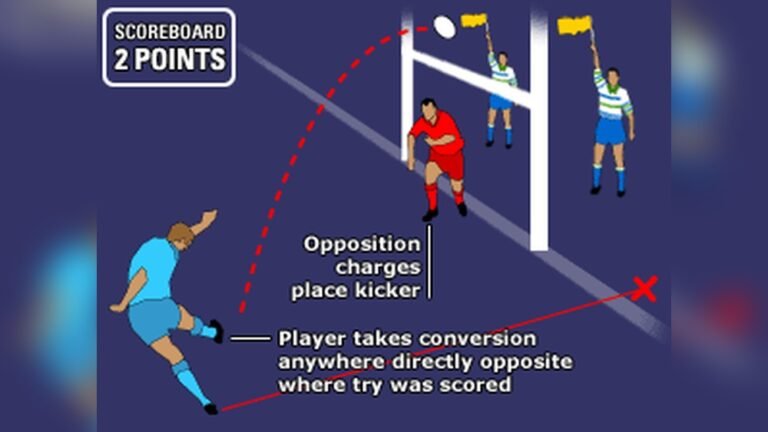
Conversion
After scoring a try, the team earns a conversion attempt. This is a kick at goal.
- Points: 2
- How it happens: The kicker tries to boot the ball through the goalposts from a line in line with where the try was scored.
- Key insight: The further from the center the try is scored, the harder the conversion. Teams often try to score near the posts for an easier kick.
Penalty Kick
When the opposing team breaks certain rules, the non-offending team may choose a penalty kick at goal.
- Points: 3
- How it happens: The kicker tries to kick the ball through the posts from the spot of the penalty.
- Example: If a defender illegally holds the ball, the attacking team may go for a penalty kick.
Drop Goal
A drop goal can be scored during open play.
- Points: 3
- How it happens: The player drops the ball and kicks it as it bounces, aiming between the posts.
- Key insight: Drop goals are often used late in tight matches, as they are worth three points and can win a game.
Summary Of Rugby Scoring Methods
Here’s a quick comparison of the main ways to score in rugby:
| Scoring Method | Points | How It’s Scored |
|---|---|---|
| Try | 5 | Grounding the ball in the try zone |
| Conversion | 2 | Kicking the ball through the posts after a try |
| Penalty Kick | 3 | Kicking at goal after an opponent’s foul |
| Drop Goal | 3 | Drop-kicking the ball in open play |

Extra Details That Make A Difference
Many new fans miss some important details about scoring.
- Scoring location affects conversion: Tries scored close to the sideline make conversions much tougher.
- Not every penalty is kicked for goal: Teams may choose to kick for touch, take a scrum, or run the ball instead of trying for three points.
How Teams Choose Scoring Methods
Teams make strategic decisions depending on the situation.
When To Go For A Try
- If the team is behind and needs more points quickly
- If the defense is weak near the try line
When To Kick For Points
- If the game is close and three points can give a lead
- If the kicker is confident from long range
When To Attempt A Drop Goal
- In the final minutes, especially in a tied game
- When defenses are tight, and tries are hard to score
Penalties And Free Kicks: What’s The Difference?
There are two types of kicks after fouls.
| Kick Type | Can Score Directly? | When Awarded |
|---|---|---|
| Penalty Kick | Yes | Serious infringements (e.g., offside, high tackle) |
| Free Kick | No | Technical infringements (e.g., delay in scrum) |
Free kicks cannot be used to score points directly. Teams must run the ball or kick for position.
Scoring In Rugby Union Vs Rugby League
There are two main versions of rugby: Rugby Union and Rugby League. Their scoring systems are similar but not identical.
| Score Type | Rugby Union | Rugby League |
|---|---|---|
| Try | 5 points | 4 points |
| Conversion | 2 points | 2 points |
| Penalty Kick | 3 points | 2 points |
| Drop Goal | 3 points | 1 point |
This means the same action can be worth different points depending on the rugby code.
Common Mistakes In Understanding Rugby Scoring
Even experienced viewers sometimes make errors. Here are two common beginner mistakes:
- Thinking any ball over the try line is a try: The ball must be grounded with clear control.
- Assuming penalties always mean three points: Teams can choose other options, like a lineout or scrum, for a chance at more points.
Example: Scoring Sequence In A Rugby Match
Let’s look at a quick example:
- Team A scores a try: 5 points.
- They make the conversion: +2 points (7 total).
- Team B scores a penalty kick: +3 points (now 7-3).
- Later, Team A drops a goal: +3 points (10-3).
In this example, both teams used different ways to score.

Fun Facts About Rugby Scoring
- The highest-scoring match in Rugby World Cup history was New Zealand vs Japan in 1995, with a total of 145 points scored.
- The fastest try ever recorded in rugby union was scored in just 8.2 seconds.
If you want to see more details about rugby history and rules, check the official World Rugby page.
Frequently Asked Questions
What Is A Try In Rugby?
A try is when a player grounds the ball in the opponent’s in-goal area. It is the main way to score and gives 5 points in Rugby Union.
How Much Is A Conversion Worth?
A conversion is worth 2 points. It happens after a try, and the kicker must send the ball through the posts.
Can You Score From A Penalty Kick?
Yes. If a team is given a penalty, they can try to kick the ball through the posts for 3 points (in Rugby Union).
What Is A Drop Goal?
A drop goal is when a player drops the ball and kicks it as it bounces. If the ball goes through the posts, it’s worth 3 points.
Does Scoring Work The Same In All Rugby Games?
No. Rugby Union and Rugby League have different scoring values for tries, penalty kicks, and drop goals.
Rugby’s scoring system may look complex at first, but with a little practice, it becomes easy to follow. Watching a match while keeping these rules in mind will help you enjoy the game even more. Whether you’re new or just looking to understand the fine details, knowing how scoring works adds excitement and strategy to every rugby match.
