Golf often appears simple from the outside: hit a ball, get it in the hole, and count the shots. But if you’ve ever watched a tournament or tried to follow a scorecard, you know there’s much more to scoring in golf than meets the eye. Whether you’re new to the sport or want to better understand the numbers on TV, learning how scoring works can help you enjoy the game more—on and off the course.
Golf uses its own scoring vocabulary and rules, which can feel confusing at first. Terms like par, birdie, and handicap have specific meanings. There are also several formats for both casual and competitive play, each with unique ways to count scores. In this guide, we’ll break down everything you need to know about golf scoring: the basics, different formats, important terms, and helpful tips for reading a scorecard. By the end, you’ll be able to follow a match with confidence and even explain the system to friends.
The Basics Of Golf Scoring
At its core, golf is a game of strokes. A stroke is any time you swing at the ball with the intent to hit it. The main goal is simple: use the fewest strokes to complete each hole.
Each golf course has 18 holes (sometimes 9 for smaller courses). Each hole has a par—the expected number of strokes an expert golfer should take to finish. For example, a par 4 means it should take four strokes to get the ball in the hole.
Here’s how a typical scorecard entry might look for a hole:
- If you finish a par 4 hole in 4 strokes, you “made par.”
- Finish in 3 strokes? That’s a birdie (one under par).
- Finish in 5 strokes? That’s a bogey (one over par).
The total score for the round is simply the sum of your strokes for all holes. The lower the number, the better.
Key Golf Scoring Terms
Understanding golf’s special words makes following a round much easier. Here are the most important terms:
- Stroke: Every time you hit the ball, it counts as one stroke.
- Par: The number of strokes a skilled golfer should need to complete a hole.
- Birdie: Scoring one stroke under par on a hole.
- Eagle: Two strokes under par.
- Albatross (Double Eagle): Three strokes under par (very rare).
- Bogey: One stroke over par.
- Double Bogey: Two strokes over par.
- Triple Bogey: Three strokes over par.
- Hole-in-One: Getting the ball in the hole in one stroke from the tee.
These terms help describe how well someone played compared to par.
How To Read A Golf Scorecard
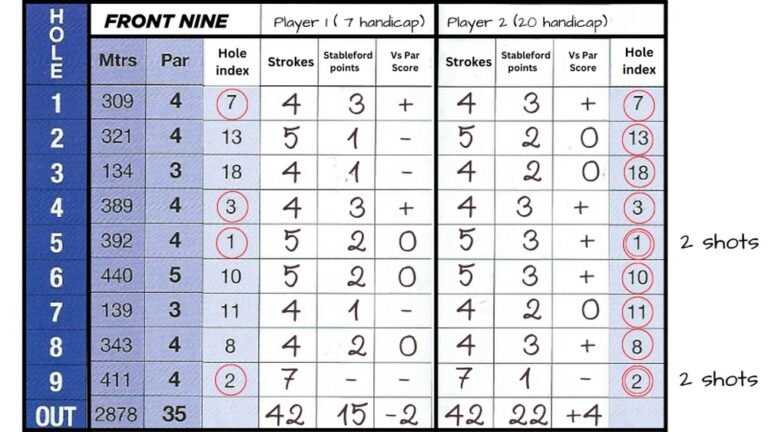
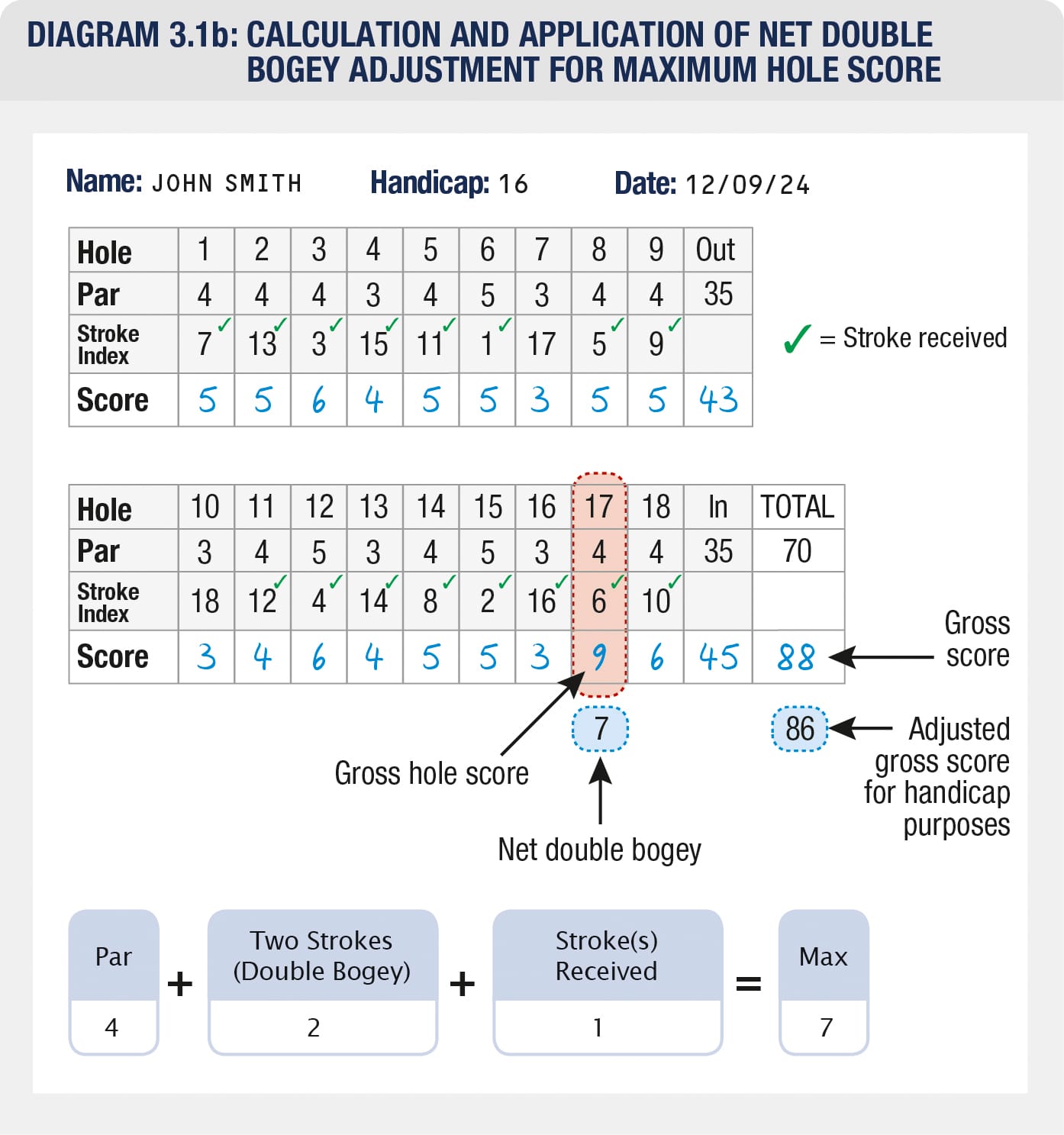
A golf scorecard shows the layout of a course and lets you track scores. It usually includes:
- Hole numbers (1–18)
- Par for each hole
- Yardage (distance) for each hole
- Spaces to write player names and scores
Here’s a simple example:
| Hole | Par | Player A | Player B |
|---|---|---|---|
| 1 | 4 | 5 | 4 |
| 2 | 3 | 3 | 2 |
| 3 | 5 | 6 | 5 |
To get the total score, add the strokes for all 18 holes. If the total is lower than the course par, it’s a good round!
Scoring In Stroke Play
Stroke play is the most common way to score golf, especially in professional tournaments. Every stroke counts, and the winner is the player with the lowest total score after all holes are played.
For example, if a course has a total par of 72 and you finish with 90 strokes, your score is +18 (18 over par).
Pros And Cons
- Pros: Easy to understand, rewards consistent play.
- Cons: A bad hole can ruin your chances, since every stroke counts.
Scoring In Match Play
Match play is another popular format, especially in head-to-head games like the Ryder Cup. Here, each hole is a separate contest. Whoever finishes the hole in fewer strokes wins that hole and goes “1 up.” If both players tie the hole, it’s “halved.”
The match ends when one side is ahead by more holes than remain to be played.
| Hole | Player A Strokes | Player B Strokes | Who Wins |
|---|---|---|---|
| 1 | 5 | 4 | Player B |
| 2 | 3 | 3 | Tied |
| 3 | 4 | 5 | Player A |
Match play is often more dramatic and forgiving—one bad hole doesn’t ruin your score for the whole round.
Stableford Scoring System
The Stableford system works differently. Instead of counting total strokes, you earn points based on your score for each hole compared to par:
- More points for better scores (e.g., birdie, eagle)
- Fewer or zero points for poor scores (e.g., bogey, worse)
This system encourages aggressive play. A disaster hole doesn’t destroy your round—you just get zero points for that hole and move on.
A typical Stableford point system:
| Score on Hole | Points Awarded |
|---|---|
| 2 or more over par | 0 |
| 1 over par (bogey) | 1 |
| Par | 2 |
| 1 under par (birdie) | 3 |
| 2 under par (eagle) | 4 |
| 3 under par (albatross) | 5 |
| Hole-in-one | 5 or more |
Stableford is popular in friendly games and amateur events.
Understanding Handicaps
The handicap system helps players of different skill levels compete fairly. Your handicap is a number that shows how many strokes above par you usually score. A lower handicap means a better golfer.
For example, a 10-handicap player is expected to score about 10 strokes over par on a typical course. If they shoot 82 on a par-72 course, they “played to their handicap. ”
When players of different handicaps compete, the weaker player gets extra strokes to level the playing field. For example, if Player A is a 5 handicap and Player B is a 15, Player B gets 10 extra strokes spread across the hardest holes.
How Handicaps Affect Scoring
- In stroke play, subtract your handicap from your total strokes.
- In match play, give handicap strokes on the hardest holes.
This system means you can fairly compete with golfers of all levels.
Scoring In Team Formats
Golf isn’t always played solo. Here are some common team scoring formats:
- Four-Ball (Better Ball): Each team member plays their own ball. The lowest score per hole counts as the team score.
- Foursomes (Alternate Shot): Teammates alternate hitting the same ball, taking turns until the hole is finished.
- Scramble: All team members hit from the tee. The team picks the best shot and everyone plays their next shot from that spot. Repeat until the ball is holed.
- Best Ball: Similar to four-ball, but can involve more players (like three or four per team). The best score counts for the team.
These formats allow for strategy, teamwork, and fun—especially in charity events or casual group play.

Penalties And How They Affect Scores
Golf has many rules, and breaking them usually means adding penalty strokes. Here are common examples:
- Out of bounds: Add one penalty stroke and replay from the original spot.
- Water hazards: Drop a ball near where it entered the water, add one penalty stroke.
- Lost ball: Add one penalty stroke and replay from the previous spot.
- Unplayable lie: Drop a ball within two club lengths, add one penalty stroke.
Penalties can quickly add up, so knowing the rules is important for keeping scores low.
Gross Vs. Net Scores
You’ll often hear the terms gross score and net score:
- Gross score: Your total number of strokes, with no adjustments.
- Net score: Your gross score minus your handicap.
For example, if you shoot 90 and have a 15 handicap, your net score is 75. Net scores are used in handicap competitions to determine the winner.

Understanding Par For The Course
A standard 18-hole course usually has a total par between 70 and 72. Courses mix par-3, par-4, and par-5 holes to challenge golfers.
- Par-3: Shortest holes, usually less than 250 yards.
- Par-4: Medium length, 250–450 yards.
- Par-5: Longest holes, over 450 yards.
Some courses may have a par-6 or par-7, but these are rare.
Scorekeeping Tips For Beginners
Recording and understanding scores can be tricky at first. Here’s how to keep it simple:
- Always write your score right after finishing a hole.
- Remember to add penalty strokes if you break a rule.
- Double-check your math at the end of the round.
- Use simple marks for special shots—like a circle for birdies or a square for bogeys.
Two common mistakes: forgetting penalty strokes and not writing scores after each hole (memory can play tricks on you!).
Professional Golf Scoring
In pro tournaments like the PGA Tour or the Masters, scoring is done using stroke play over four days (72 holes total). Professionals aim for scores well below par. For example, a winner might finish at -15 (15 strokes under par) for the tournament.
Leaderboard positions are shown as numbers above or below par—so “-3” means three strokes under par for the event.
Non-obvious Insights About Golf Scoring
- Par doesn’t change for weather or course conditions. If it’s windy, raining, or the greens are fast, the par stays the same. This means average scores can be higher, but the target never moves.
- No maximum score per hole in stroke play, unless a local rule sets one. If you hit 10 balls in the water, every stroke counts. This is why beginners sometimes prefer Stableford, where you can pick up the ball if you can’t finish the hole.
- Scorekeeping is a key part of golf’s honor system. In most play, you keep your own score and your opponent’s. Honesty is expected, and cheating is taken seriously.
How Technology Has Changed Golf Scoring
Modern technology makes scoring easier and more accurate:
- Golf GPS apps: Track your shots and scores in real-time.
- Online leaderboards: Update scores instantly in amateur and pro events.
- Digital scorecards: Reduce errors and help beginners follow rules.
Still, knowing how to keep score by hand is a valuable skill for any golfer.
Frequently Asked Questions
How Is Scoring Different In Mini Golf Or Putting Competitions?
Mini golf usually uses simple stroke play—lowest total strokes wins. There’s rarely a “par” for each hole, and special rules may apply for obstacles. Putting competitions often use the same system, but with fewer holes and no handicaps.
What Happens If Two Players Tie In Golf?
In stroke play tournaments, a tie usually leads to a sudden-death playoff or extra holes to determine a winner. In casual games, you can simply share the victory or use the best back nine scores as a tiebreaker.
Can You Have A Negative Score In Golf?
Yes, but “negative” means under par. If a player finishes a course with fewer strokes than the course par, their score is shown as -1, -2, and so on. This is a good thing—a “minus” means you played better than expected.
Are There Other Scoring Systems Besides Stroke, Match, And Stableford?
Yes. There are many creative formats for fun or charity events—like skins games, scramble, shamble, and alternate shot. Each has unique rules, but the main goal is still to get the ball in the hole in as few strokes as possible.
Where Can I Learn More About Official Golf Rules And Scoring?
The best source for official rules is the R&A’s Rules of Golf. They cover every detail about scoring, penalties, and more.
Golf scoring might look complicated, but with a little practice, the system makes sense. Whether you’re watching a tournament or starting your first round, knowing how scores work will help you appreciate the strategy and excitement of the game. Grab a scorecard, keep your strokes honest, and enjoy tracking your progress on the course!
