
Skydiving captures the imagination like few other activities. The thought of jumping out of an airplane, feeling the rush of wind, and floating gently to the ground is both thrilling and intimidating. But what exactly is skydiving, and how does it actually work?
For many, the details remain a mystery. This article explains skydiving from the ground up—how it started, what happens during a jump, what equipment is used, and how safety is managed. Whether you are curious about trying it yourself or simply want to understand this extreme sport, you will find clear answers here.

Today's Exclusive Deals
Limited-time Exclusive Deals. Check current discount on Amazon.
Check Price on Amazon As an Amazon Associate I earn from qualifying purchases.What Is Skydiving?
At its core, skydiving is the act of jumping from an aircraft and returning to Earth with the help of a parachute. It is both a sport and a recreational activity. Some people skydive for fun, others as part of military training, and some even compete in organized events.
Skydiving usually involves two main phases:
- Freefall: The jumper falls rapidly toward the earth before opening their parachute.
- Parachute descent: After the parachute opens, the fall slows dramatically and the person steers toward a landing spot.
The feeling of freefall is often described as flying or floating rather than simply falling. Unlike amusement park rides, there is no stomach-dropping sensation because the wind supports your body almost immediately.
Today's Exclusive Deals
Limited-time Exclusive Deals. Check current discount on Amazon.
Check Price on Amazon As an Amazon Associate I earn from qualifying purchases.How Did Skydiving Begin?
The idea of using parachutes goes back centuries, but modern skydiving began in the early 20th century. Parachutes were first used for emergencies by balloonists and pilots. In World War I and II, military pilots jumped from damaged planes to save their lives. After the wars, some soldiers continued parachuting for fun, which led to the sport we know today.
An interesting fact: the first recorded parachute jump was by André-Jacques Garnerin in 1797, who leapt from a hot air balloon in Paris. However, it was not until the invention of reliable, steerable parachutes and the airplane that skydiving as a popular sport became possible.
The Science Behind Skydiving
Skydiving is more than just jumping—it involves physics, aerodynamics, and careful planning. Understanding the forces at work helps explain why skydiving is both possible and safe when done correctly.
Freefall Physics
When you jump from a plane, gravity pulls you toward the earth. At first, you accelerate quickly, but soon the air resistance (drag) increases. After about 10-12 seconds, most skydivers reach a speed called terminal velocity—around 120 mph (193 km/h) in a belly-to-earth position. At this point, the forces of gravity and air resistance balance out, and you stop accelerating.
Today's Exclusive Deals
Limited-time Exclusive Deals. Check current discount on Amazon.
Check Price on Amazon As an Amazon Associate I earn from qualifying purchases.Parachute Deployment
The parachute dramatically increases air resistance, slowing your descent to about 10-15 mph (16-24 km/h), which is safe for landing. Modern parachutes are designed to open gradually to avoid a sudden jolt.
The Role Of Wind And Weather
Skydiving depends heavily on weather. Wind speeds, cloud cover, and visibility can affect both the freefall and the landing. Jumps are often canceled if conditions are not safe.
Types Of Skydiving
There is more than one way to experience skydiving. Some of the most popular types include:
- Tandem Skydiving: A beginner is attached to an experienced instructor, who controls the jump from start to finish.
- Solo Skydiving (Static Line or AFF): After training, a person jumps alone, either with a parachute that opens automatically (static line) or by deploying it themselves (Accelerated Free Fall—AFF).
- Formation Skydiving: Groups of skydivers form shapes in the air before separating and opening their parachutes.
- Wingsuit Flying: Jumpers wear a special suit with fabric between the arms and legs, allowing them to glide horizontally.
- Canopy Piloting: After the parachute opens, jumpers perform advanced maneuvers close to the ground.
These variations add excitement and challenge for those who want more than a basic jump.
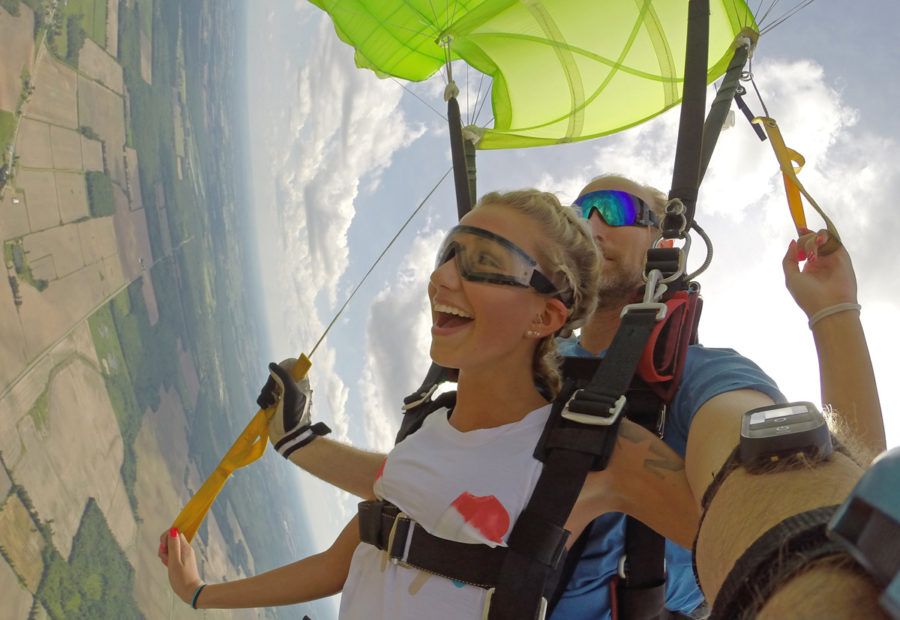
The Skydiving Process: Step By Step
What actually happens when you go skydiving? Here is a typical timeline for a first jump, especially for beginners.
1. Training And Preparation
- Briefing: You receive safety instructions, learn body positions, and understand the equipment.
- Gear Fitting: Instructors help you put on a jumpsuit, harness, helmet, and goggles.
2. Boarding The Aircraft
You and your instructor board a small plane, often with other jumpers. The plane climbs to an altitude of 10,000 to 15,000 feet (3,000 to 4,500 meters). This usually takes 10-20 minutes.
3. The Jump
At the right altitude, the door opens. If you are doing a tandem jump, you are attached to your instructor. You move to the door together and jump.
4. Freefall
For about 30-60 seconds, you experience freefall. The wind is loud, and the ground rushes toward you, but the instructor controls everything.
5. Parachute Deployment
At about 5,000 feet (1,500 meters), the parachute opens. The sensation changes from roaring wind to quiet and peace.
6. Parachute Descent
You glide down for 4-7 minutes, enjoying the view. The instructor can steer and even let you help.
7. Landing
The instructor guides the parachute to a safe landing. You lift your legs to avoid injury, and the jump ends with a gentle touch down.
Skydiving Equipment Explained
Every piece of skydiving gear is designed for safety and performance. Here is what is used on a typical jump:
| Equipment | Main Function |
|---|---|
| Main Parachute | Slows and controls descent |
| Reserve Parachute | Backup if the main fails |
| Automatic Activation Device (AAD) | Opens reserve automatically if needed |
| Altimeter | Measures altitude during the jump |
| Helmet & Goggles | Protects head and eyes |
| Jumpsuit | Reduces wind chill and helps stability |
| Harness/Container | Holds parachutes and connects jumper |
One non-obvious insight: every skydiver wears a reserve parachute that is packed and checked by a specially licensed technician. Also, the AAD is a small computer that monitors descent speed and altitude, acting as a last line of defense.
Is Skydiving Safe?
Safety is a top concern for anyone considering skydiving. While all extreme sports have risks, skydiving is surprisingly safe when proper rules are followed.
According to the United States Parachute Association (USPA), the chance of a fatal accident is about 1 in 220,000 jumps. In 2021, there were just 10 deaths out of 3.57 million jumps in the US.
Key reasons for this strong safety record:
- Modern equipment is highly reliable.
- Training and licensing standards are strict.
- Jumps are canceled for bad weather or poor conditions.
However, mistakes can happen. The most common causes of accidents are not equipment failures, but human errors—like poor decision-making or not following procedures.
How Skydiving Compares To Other Activities
To put the risk in context, here is a simple comparison:
| Activity | Fatality Rate (per 100,000) |
|---|---|
| Skydiving | 0.39 |
| Scuba Diving | 1.98 |
| Motorcycling | 21.5 |
| General Aviation | 1.2 |
| Driving (US average) | 1.1 |
This shows that skydiving, when done with a reputable company, is statistically less dangerous than many common activities.
Who Can Go Skydiving?
Most people in good health can try skydiving. There are a few basic requirements:
- Age: Minimum age is usually 18 years.
- Weight: There are weight limits, often around 220-240 lbs (100-110 kg), due to equipment limitations.
- Medical: You should have no major heart or lung problems. Some conditions require a doctor’s note.
Those with disabilities can often still skydive—many centers offer adapted experiences.

Common Fears And Misconceptions
Skydiving can seem scary. Here are some common fears and the facts behind them:
- Fear of Chute Failure: Reserve parachutes and AADs are standard. Total failure is extremely rare.
- Fear of Heights: Many people with a fear of heights say it feels different because you have no reference point.
- Fear of the Plane Ride: The jump itself is far less stressful than the anticipation.
One insight: the moment of leaving the plane is often the hardest part. Once in freefall, most people feel surprisingly calm.
The Cost Of Skydiving
Skydiving is not a cheap hobby, but the experience is unforgettable. Prices vary by country and location.
| Type of Jump | Average Cost (USD) |
|---|---|
| Tandem Jump | $200 – $300 |
| Solo First Jump (AFF or Static Line) | $300 – $400 |
| Experienced Jumper (per jump) | $25 – $40 |
| Video/Photo Package | $75 – $150 extra |
Tips for saving money: Book as a group, look for first-time jumper deals, or consider off-peak days.
How To Start Skydiving
If you want to try skydiving, here are the steps to get started:
- Find a licensed drop zone: Check for USPA or your country’s parachuting association membership.
- Book a tandem jump: This is the easiest and safest way to experience your first skydive.
- Arrive early: There will be paperwork, a safety briefing, and time to get comfortable.
- Dress comfortably: Wear sneakers and clothes that fit under a jumpsuit.
- Listen closely: Follow all instructions from your instructor.
After your first jump, you can decide if you want to continue with training to jump solo.
The Joy Of Skydiving: Why Do People Love It?
Skydiving is often described as life-changing. The mix of adrenaline, beauty, and challenge is unique. People report:
- A huge sense of achievement
- A new perspective on fear and courage
- The feeling of freedom and flying
Another non-obvious insight: many skydivers say the sport builds confidence that spills over into other areas of life. Facing the jump teaches you to trust training and overcome mental barriers.
For some, skydiving becomes a lifelong passion. For others, one jump is enough. Either way, it is an experience few forget.
Frequently Asked Questions
What Is The Minimum Age To Skydive?
In most countries, the minimum age is 18 years. Some places allow younger jumpers with parental consent, but this is rare.
Can I Skydive If I Have A Medical Condition?
Most medical conditions do not prevent skydiving, but you should check with a doctor. If you have heart, lung, or back problems, get medical advice first.
How Fast Do You Fall During A Skydive?
During freefall, you reach about 120 mph (193 km/h). After the parachute opens, you slow to about 10-15 mph (16-24 km/h).
What Happens If My Parachute Does Not Open?
Every skydiver has a reserve parachute and an automatic activation device (AAD). If you do not open the main chute, the AAD will deploy the reserve automatically.
Where Can I Learn More About Skydiving Safety And Statistics?
A good resource is the United States Parachute Association, which tracks safety data and offers advice for jumpers.
Skydiving is more than just falling from the sky. It is a carefully designed sport with decades of history, advanced technology, and a passionate community. If you ever dreamed of flying, skydiving brings you as close as possible. Whether you choose to jump or simply watch from the ground, now you know what makes this sport so special.