
Rugby is a sport loved for its speed, teamwork, and physical challenge. But not everyone knows how it all began. The history of rugby is a story of tradition, rivalry, and worldwide growth. From its beginnings in English schools to its place as a global phenomenon, rugby’s journey is packed with important moments and fascinating changes.
Understanding how rugby evolved helps fans appreciate every scrum, try, and tackle on the field today.

Today's Exclusive Deals
Limited-time Exclusive Deals. Check current discount on Amazon.
Check Price on Amazon As an Amazon Associate I earn from qualifying purchases.The Origins Of Rugby
Rugby’s roots go deep into the early 19th century in England. The most accepted story traces back to Rugby School in Warwickshire, 1823. Here, a student named William Webb Ellis is said to have picked up the ball during a football (soccer) game and ran with it. This act broke all existing rules but started a tradition that grew into a new sport. While some historians debate the accuracy of this story, the Rugby School played a clear role in shaping the early form of the game.
At this time, many English schools had their own versions of football. The rules were often different, with some schools allowing handling the ball. The Rugby School’s rules, written in 1845, were among the first official guidelines for the sport.
Standardizing The Game
Rugby soon spread from schools to universities and clubs. However, confusion grew because every group played by different rules. In 1863, the Football Association was formed to create standard rules for all types of football in England. The main disagreement was about handling the ball and hacking (kicking opponents in the shins). Clubs that wanted to allow running with the ball and more physical play split away from the Football Association. This led to the creation of the Rugby Football Union (RFU) in 1871.
The first RFU rules were published that same year. They shaped rugby as we know it: 20 players per team, running with the ball, and tackling. The RFU’s leadership helped rugby spread throughout England and beyond.
Rugby Goes Global
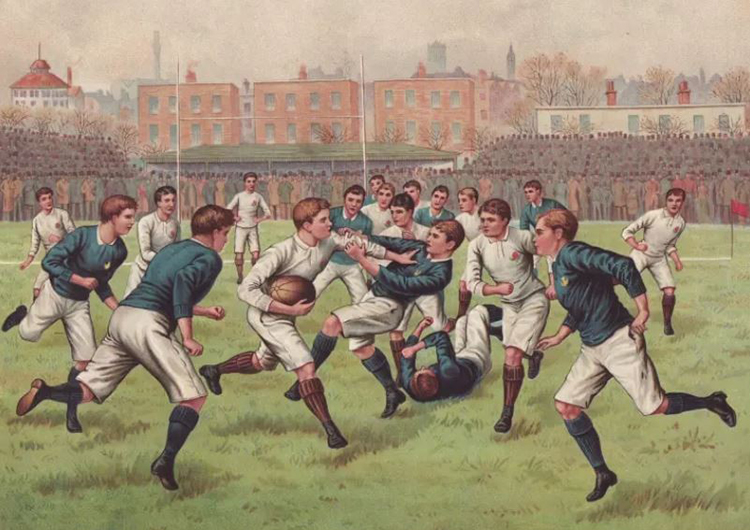
Rugby quickly crossed borders. By the late 19th century, the sport reached Australia, New Zealand, South Africa, and France. British soldiers, sailors, and settlers introduced the game wherever they traveled. In 1871, the first international match took place between England and Scotland.
The game adapted to different cultures and conditions. In New Zealand, the Maori people embraced rugby, making it part of their national identity. The South African rugby team, known as the Springboks, became a symbol of unity and, later, reconciliation after apartheid.
Here’s a look at when some key rugby nations played their first international matches:
| Country | First International Match | Opponent |
|---|---|---|
| England | 1871 | Scotland |
| New Zealand | 1884 | New South Wales |
| South Africa | 1891 | British Isles |
| France | 1906 | New Zealand |
The Split: Rugby Union And Rugby League
By the late 1800s, rugby’s popularity brought new challenges. In northern England, many players came from working-class backgrounds and needed compensation for missing work. The RFU, based in southern England, insisted rugby remain an amateur sport with no payment.
In 1895, 22 clubs broke away to form the Northern Rugby Football Union, which later became the Rugby League. Rugby league adopted new rules: 13 players per side, play-the-ball restarts, and different scoring. Over time, rugby league became especially popular in northern England and Australia.
Here’s how the two main types of rugby compare:
| Feature | Rugby Union | Rugby League |
|---|---|---|
| Players per team | 15 | 13 |
| Scrums | Yes | Limited |
| Scoring system | Try = 5 points | Try = 4 points |
| Professionalism | Since 1995 | Since 1895 |
Rugby In The 20th Century
The 1900s saw rugby become a true international sport. The Five Nations Championship (now the Six Nations) started in 1910, featuring England, Scotland, Ireland, Wales, and France. The Rugby Championship began in the southern hemisphere with Australia, New Zealand, and South Africa.
Rugby was also played at the Olympic Games in 1900, 1908, 1920, and 1924. The United States won the last two tournaments, surprising many rugby nations.
One non-obvious fact: rugby’s amateur status lasted much longer than most sports. Players were not paid in rugby union until 1995. Many legendary athletes balanced rugby with regular jobs, showing real passion for the game.
The Rugby World Cup
A major turning point came in 1987 with the first Rugby World Cup. Hosted by New Zealand and Australia, it brought together national teams from across the globe. New Zealand’s All Blacks won the first tournament, and the event has grown every four years since.
The Rugby World Cup now features 20 teams and draws millions of viewers. The 2019 tournament in Japan attracted over 857 million people watching worldwide. The trophy is called the Webb Ellis Cup, honoring rugby’s legendary founder.
Here’s a summary of Rugby World Cup champions:
| Year | Winner | Host Country |
|---|---|---|
| 1987 | New Zealand | New Zealand & Australia |
| 1991 | Australia | England |
| 1995 | South Africa | South Africa |
| 2003 | England | Australia |
| 2007 | South Africa | France |
| 2011 | New Zealand | New Zealand |
| 2015 | New Zealand | England |
| 2019 | South Africa | Japan |
| 2023 | South Africa | France |

The Rise Of Women’s Rugby
While men’s rugby grew fast, women’s rugby developed quietly for decades. The first women’s matches appeared in the late 1800s, but the sport gained real momentum in the 1980s and 1990s. The first Women’s Rugby World Cup was held in 1991, with the United States as the winner.
Today, women’s rugby is one of the fastest-growing sports worldwide. Over 2. 7 million women and girls now play rugby, according to World Rugby.
Rugby In The Modern Era
Rugby continues to evolve. Since becoming professional in 1995, players have become stronger and faster. Technology now helps referees make decisions, and safety is a top priority. Rugby sevens, a faster seven-a-side version, made its Olympic debut in 2016.
One insight: Many countries with small populations, like Fiji and Samoa, excel in rugby sevens. This shows that passion and skill can matter as much as numbers.
Rugby is now played in over 120 countries, with millions of fans from all backgrounds. The game’s values—teamwork, respect, discipline, and sportsmanship—are as important as ever.
For those interested in learning more, the Wikipedia History of Rugby Union offers a deep dive into the sport’s development.

Frequently Asked Questions
What Is The Origin Story Of Rugby?
The most famous story says William Webb Ellis picked up the ball and ran with it at Rugby School in 1823, creating a new game. While the details are debated, Rugby School’s rules shaped the early sport.
What Are The Main Differences Between Rugby Union And Rugby League?
Rugby union has 15 players per team, while rugby league has 13. The rules, scoring, and style of play are also different, with league being faster and union having more contests for possession.
When Did Rugby Become A Professional Sport?
Rugby union became fully professional in 1995. Rugby league has allowed professionalism since 1895, following the split over player payments.
How Did Rugby Spread Worldwide?
British soldiers, settlers, and workers brought rugby to countries like Australia, New Zealand, South Africa, and France. Each nation adapted the game, creating their own styles and traditions.
What Is The Significance Of The Rugby World Cup?
The Rugby World Cup is the top event in rugby union. It brings together national teams every four years and helps grow the sport’s popularity around the world.
Rugby’s history is a journey of change and tradition. From a schoolyard in England to stadiums filled with passionate fans, the sport has touched millions. Whether you’re new to rugby or a lifelong supporter, understanding its roots adds new meaning to every game.